Bitcoin miner Riot Platforms released its first-quarter operating update report on Thursday, disclosing that it sold 3,778 bitcoins during the first three months of 2026 at an average selling price of $76,626 per bitcoin, generating roughly $289.5 million in revenue. As of the end of the first quarter, Riot still held 15,680 bitcoins on its balance sheet, while its mining rigs newly mined 1,473 bitcoins during the same period.
Riot’s First-Quarter Financial Operations: A Strategic Choice to Cash Out Above Spot Prices
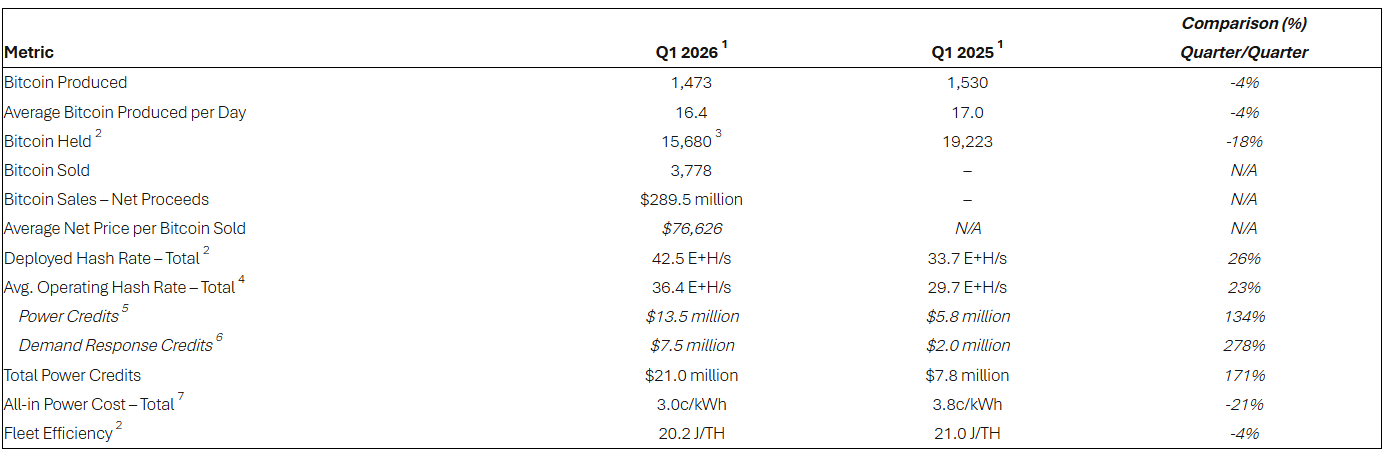 (Source: Riot Platforms)
A key detail behind Riot’s selloff was the timing window of its average selling price. The first-quarter average selling price of $76,626 was significantly higher than the spot market price of roughly $66,867 today, meaning Riot completed a profitable cash-out cycle when bitcoin was relatively high—while keeping a book holding of 15,680 bitcoins, which is worth about $1.049 billion based on current market prices.
From a financial perspective, this reflects strategic cash-flow management under pressure from high energy costs—covering continuously rising operating expenses by selling inventory bitcoins priced above the current market, rather than being forced to sell passively at lower levels. This shows the company’s financial flexibility during a market downturn.
Rising Energy Costs: How Middle East Oil Prices Squeeze Mining Profits
Compance co-founder Kadan Stadelmann, in an interview with Cointelegraph, directly pointed to the fundamental reason miners are selling now: “Oil prices are one of the main costs of Bitcoin mining. As energy costs rise, miners are forced to sell bitcoins to cover operating costs. And continued oil price shocks have further intensified this trend.”
Since the escalation of the Middle East conflict in February, global oil prices have jumped, creating a systemic squeeze on mining profits. Higher oil prices not only increase the direct electricity costs of operating mining rigs, but also affect the industry’s overall operational efficiency through broader energy-driven inflation. This macro factor, combined with the reality that bitcoin has fallen more than 47% from its October 2025 peak of $126,000, creates a double financial squeeze confronting miners today.
The Double-Edged Effect of Falling Hashrate: Weeding Out the Weak, Benefiting the Strong
The other side of the mining selloff wave is reflected in industry consolidation signals shown in underlying hashrate data:
Mining difficulty: On March 20, Bitcoin mining difficulty fell from about 145 trillion to 133 trillion, a drop of roughly 8%
Network hashrate: From 1.16 ZH/s (zettahash) at the beginning of this month, down to about 990 EH/s (exahash) by Friday, a decline of roughly 15%
Industry signal: A large amount of hashrate has gone offline, and miners with lower efficiency are being pushed out of the market under cost pressure
Stadelmann noted that this is beneficial for miners that are still operating: “As hashrate declines and mining difficulty drops, mining becomes easier and more profitable for those miners that remain online.” He also said large miners may expand scale through hardware investments or acquisitions, pushing further consolidation in the industry.
Frequently Asked Questions
What does it mean that Riot sold in Q1 at an average price above spot?
The Q1 average selling price of $76,626 was higher than the current market price, but this mainly reflects Riot’s results from selling in batches at different points from January through March, benefiting from bitcoin’s relatively higher prices at the time. This is not a judgment made at a single moment—it is a standard operating approach for miners under financial pressure to cash out in batches by using the high book-cost bitcoins they hold.
How does falling Bitcoin mining hashrate affect large miners like Riot?
A falling hashrate means fewer competitors across the network, so each mining rig can earn a higher proportion of block rewards with the same hashrate. For Riot, which is still operating efficiently, this directly boosts the bitcoin production efficiency per unit of electricity. If the subsequent bitcoin price rebounds—combined with the higher production efficiency enabled by the lower difficulty—large miners’ profit margins would expand significantly.
What structural impact does large-scale bitcoin selling by miners have on the market?
Miners are the native supply source for the Bitcoin market. Their selloffs are “cost-driven sell pressure,” not emotion-driven selloffs. When miners are forced to sell due to energy cost pressures, this structural sell pressure often combines with emotional selloffs during market downtrends, deepening short-term price pressure. Tracking miners’ holdings and selling behavior is one of the key leading indicators for assessing Bitcoin’s supply-demand balance.
Disclaimer: The information on this page may come from third parties and does not represent the views or opinions of Gate. The content displayed on this page is for reference only and does not constitute any financial, investment, or legal advice. Gate does not guarantee the accuracy or completeness of the information and shall not be liable for any losses arising from the use of this information. Virtual asset investments carry high risks and are subject to significant price volatility. You may lose all of your invested principal. Please fully understand the relevant risks and make prudent decisions based on your own financial situation and risk tolerance. For details, please refer to
Disclaimer.


