


Bitcoin short sellers face a massacre! 50 million in futures positions liquidated, altcoin funds rotate
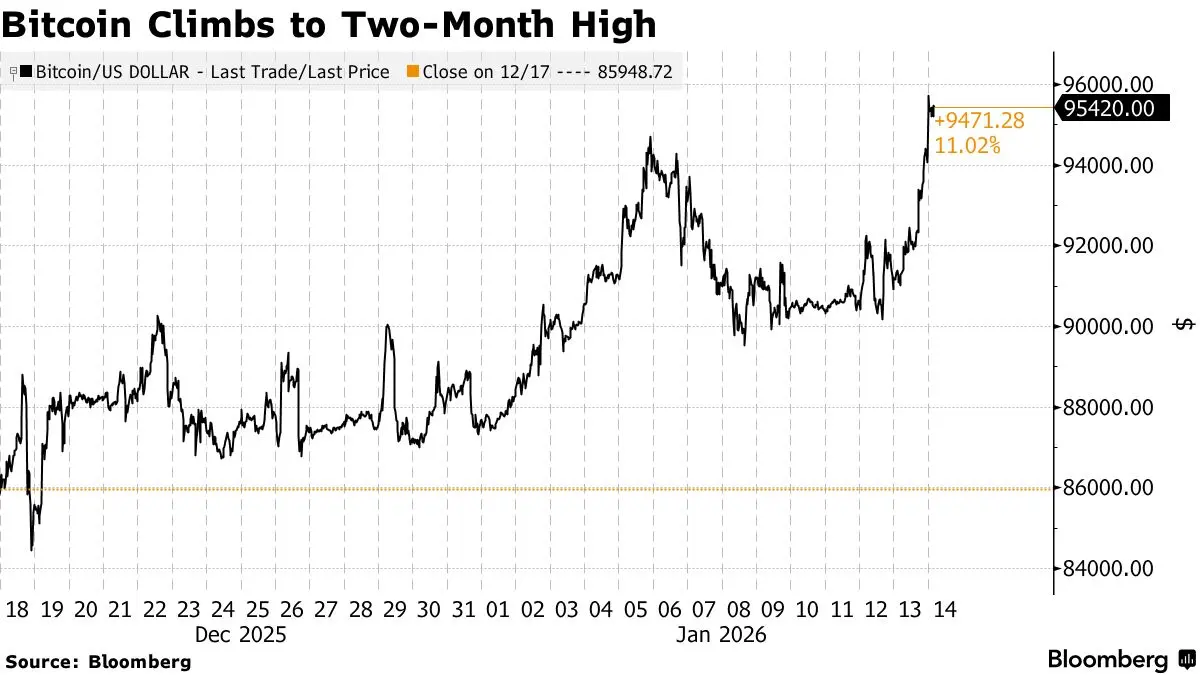
Bitcoin broke through $95,000 on Wednesday, reaching a two-month high, and after three attempts, finally surpassed $94,500. Over the past 24 hours, short positions were liquidated for $270 million, with total market liquidations reaching $600 million, indicating a clear short squeeze in derivatives. Open interest decreased from $31.5 billion to $30.6 billion, with leveraged liquidations and spot buying creating positive feedback. Altcoins rotated into the spotlight, with DASH surging to its highest level since 2021, and Optimism rising 18.5%.
The $500 Million Liquidation Behind the Short Squeeze Mechanism
(Source: Bloomberg)
During Wednesday’s Asian trading session, Bitcoin continued its cautious upward trend since January, briefly hitting a two-month high above $95,000. According to CoinDesk, Bitcoin briefly reached a two-month high of $96,240 on Tuesday, and this breakthrough further attracted capital into altcoins. As the price broke through the key level of $94,500, a significant “short squeeze” appeared in the derivatives market, with large leveraged positions being passively liquidated in a short period, boosting volatility and price gains.
The report states that after Bitcoin first broke above $94,500 since November, over $500 million in futures positions were liquidated in the past four hours. Bitcoin had previously attempted three times to break this level but failed, on January 5, December 10, and December 3. This breakout is seen as a sign of a phase of technical improvement, as successful breakthroughs after multiple failures often indicate that selling pressure has been fully released.
According to CoinGlass data, over the past 24 hours, Bitcoin short liquidations amounted to about $270 million, and total crypto asset short liquidations reached about $600 million. Data shows that Bitcoin futures open interest is approximately $30.6 billion, down from a high of $31.5 billion during the day. A decline in open interest usually indicates that some leveraged positions have been closed or actively reduced, and combined with the concentrated liquidations after the breakout, the market interprets this as more aggressive buying on the spot side, while derivatives shorts are forced to cover, creating a positive feedback loop that drives prices higher.
Four Stages of the Short Squeeze Chain Reaction
Stage 1: Price approaches $94,500, shorts increase bets on another failed breakout
Stage 2: Spot buying suddenly intensifies, the price effectively breaks through, triggering technical buy-ins
Stage 3: Leveraged shorts trigger forced liquidations, passive covering further pushes up the price
Stage 4: Panic spreads, more shorts close positions to cut losses, forming a waterfall rally
Kronos Research Chief Investment Officer Vincent Liu states that there is a “clear short squeeze” in the Bitcoin derivatives market. Data shows that forced liquidations often trigger passive covering during price rallies, forming a short-term “accelerated rise” feedback mechanism. This mechanism is especially prominent in highly leveraged crypto markets, where breaking through key resistance levels causes stop-loss and forced liquidations of shorts to concentrate, resulting in a waterfall-like surge in a short period.
The Return of the Fed Scandal and Safe-Haven Narrative
Against the backdrop of rising geopolitical uncertainties, softer US inflation data, and the Federal Reserve’s involvement in a subpoena controversy with the Department of Justice, the “safe-haven and hard asset” narrative has gained marginal appeal for crypto assets. Arctic Digital research director Justin d’Anethan said that in the medium term, funds may increase their Bitcoin holdings under the “chasing gold” narrative, and recent strong performance of other risk assets also supports this view.
He pointed out that the latest US inflation data was weaker than market expectations of a stronger rebound, providing a marginal positive for crypto assets. Meanwhile, the Federal Reserve has recently been subpoenaed by a grand jury related to its headquarters renovation project, and the controversy over the Fed’s “independence” has intensified, further strengthening the market’s discussion on the value of “safe-haven and hard assets.” When the Fed’s independence is questioned, investor confidence in fiat currencies may waver, pushing funds into Bitcoin and other non-sovereign assets.
Joshua Lim, Co-Head of Global Markets at FalconX, said that the overall macro environment currently favors Bitcoin: including tensions in Venezuela, unrest in Iran, the Fed’s independence controversy, and MSCI’s decision to delay removing companies like Strategy Inc. with high crypto asset exposure from major indices, all form a series of “ongoing positive macro developments.”
Altcoin Rotation and the $94,500 Key Level
In the altcoin sector, privacy coin DASH experienced a volume surge before Bitcoin’s breakout, rising to its highest level since 2021, which some traders see as a leading signal of increased risk appetite, also boosting activity in other trading pairs. Subsequently, the rally expanded, with Optimism up about 18.5% in 24 hours, TIA and PENGU both up about 14%, indicating that after a correction phase in altcoins, market sentiment is warming.
Meanwhile, Bitcoin’s market share fell from 59.3% on December 24 to 58.6%, reflecting a period of altcoin outperformance. Index-wise, CoinDesk 80, which tracks 80 non-Bitcoin tokens, has gained about 8% since the start of the year, while CoinDesk 20 has risen approximately 6.35%, showing increased investor willingness to allocate funds to a broader range of small- and mid-cap tokens.
In the short-term technical outlook, traders are watching whether Bitcoin can retest and hold the $94,500 level, turning it into a new support “floor.” If successful, the next key level to watch is around $99,000, an area that previously served as support from June to November and may now turn into resistance. Conversely, if Bitcoin cannot stabilize above $94,500, the price may fall back into a range of $85,000–$94,500 with sideways movement.