


CoinGate Data Shows Broadening Use Beyond Bitcoin in Crypto Payments
Merchants increasingly use Bitcoin and USDC as operational capital, signaling crypto’s move beyond checkout into core finance.
Crypto payment activity in 2025 showed a shift in how merchants handle digital assets. Data from CoinGate shows that crypto is used less as a payment option and more as operational capital. Changes in asset choice, settlement behavior, and network usage defined how merchants moved value throughout the year.
CoinGate Reports 1.42 Million Crypto Payments in 2025 as Bitcoin Regains Lead
According to CoinGate’s latest report, the platform processed 1.42 million crypto payments in 2025. This equals one transaction every 22 seconds, bringing the total lifetime payments on the platform to more than seven million. While regulatory changes affected transaction volumes during the year, overall usage pointed to deeper operational use.
Bitcoin returned as the most-used cryptocurrency for payments on CoinGate. The OG asset reached a 22.1% share of all transactions, surpassing USDT. Having processed 292,217 orders during the year, market participants trust in BTC as a neutral payment asset.
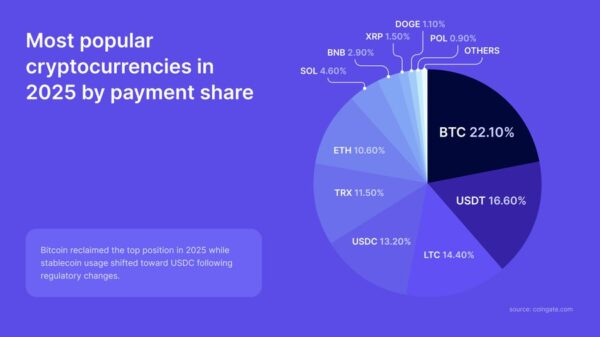
Image Source: X/CoinGate
The Bitcoin network also regained its place as the most-used payment rail, supported by continued adoption of the Lightning Network. About 11.3% of BTC payments were settled through Lightning, while the remaining 88.7% were processed on-chain.
Other major cryptocurrencies also gained ground, with Litecoin ranking as the third-most-used payment asset. The LTC token briefly moved into second place during the summer months.
Meanwhile, TRX increased its share of payments from 9.1% to 11.5%. On the other hand, Ethereum regained relevance as a payment network, alongside steady growth across Layer 2 solutions. A newly added Layer 2 chain, Base, gained adoption shortly after integration.
USDC Gains Role as Treasury Asset as Crypto Settlements Expand
Stablecoin usage shifted significantly throughout 2025 as regulation reshaped payment preferences across the platform. USDT finished the year as the second most-used cryptocurrency by volume. However, its share declined steadily after the second quarter.
Regulatory pressure tied to MiCA rules prompted many merchants to stop accepting USDT in April, followed by a complete phase-out by year-end. Even as USDT exited checkout flows, stablecoins continued to play a central role in crypto payments.
USDC emerged as the dominant stablecoin on CoinGate, supported by rapid growth in both usage and transaction volume. Its payment share rose from 2.5% in 2024 to 44.2% of all stablecoin payments in 2025. In addition, processed order volume in USDC increased thirteenfold year-over-year.
Momentum accelerated between March and April, when USDC transactions jumped 229% compared with January and February. By the end of 2025, USDC had become the default stablecoin choice for compliant and long-term use on the platform.
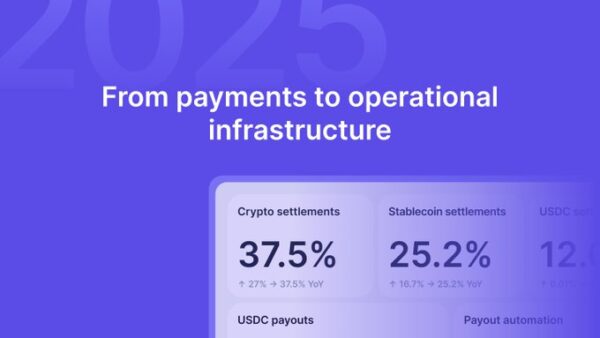
Image Source: X/CoinGate
Merchant settlement behavior offers one of the clearest signs of how crypto payments matured during the year. Fiat settlements fell from 73% in 2024 to 62.5% in 2025. At the same time, crypto settlements rose from 27% to 37.5%. From all CoinGate orders, 25.2% were settled in stablecoins, up from 16.7% the previous year.
MiCA License Boosts Merchant Confidence in Crypto Settlements and Payouts
Settlement data showed a clear shift toward USDC as merchants’ preferred treasury asset. USDC settlements rose from just 0.01% in 2024 to 12.6% in 2025. That change moved the stablecoin from a marginal option into a core part of treasury management.
Many merchants opted to keep crypto on their balance sheets rather than convert funds to fiat immediately. Others relied on FX payouts to convert balances into USDC at the time payouts were executed, giving them greater control over currency exposure.
Payout activity reflected the same operational shift seen across settlements and treasury management throughout 2025. USDC became the primary currency for outbound payments, while automation expanded quickly. About 85% of merchants relied on APIs to execute payouts at scale, signaling a move toward system-driven crypto operations.
Regulatory clarity also played an important role in supporting this transition toward deeper operational use of crypto. In 2025, CoinGate received a MiCA license from the Bank of Lithuania.
Alignment with the European Union’s new crypto framework gave merchants a stronger legal footing. It also increased confidence to use crypto for settlements, payouts, and treasury management.
Image from X/CoinGate
Related Articles
Monad Co-founder: The conspiracy theory that Jane Street is suppressing Bitcoin below $150,000 is unfounded
Yesterday, the US Bitcoin spot ETF experienced a net inflow of $505.89 million.
The Chen Zhi case and the Zhao Changpeng case: The United States profits nearly $20 billion from them
Bitunix News: Iran Accelerates Oil Exports, Middle East Risks Rise, Boosting Safe-Haven Sentiment
Hut 8 reported an annual loss of $248 million, but a $7 billion AI leasing plan is helping to turn the tide.