


Eric Trump's American Bitcoin Crashes 70% But He's Still Buying
Eric Trump co-founded American Bitcoin in March 2025 with Asher Genoot, reaching $8.5B valuation at September peak. Despite stock crashing 70% since IPO, Eric Trump and insiders bought more shares in December 2025, betting on long-term crypto dominance.
Eric Trump’s Journey From Real Estate to Crypto Empire
On a brisk Monday morning before Thanksgiving, a Secret Service motorcade rolled through Vega, a town of fewer than 1,000 people in the Texas Panhandle. Someone of national significance had flown in on a private jet from Florida. “Hey, friends, it’s Eric Trump,” President Trump’s son said in an Instagram post hours later. Behind him, rows of computer servers stretched into the distance. “Welcome to American Bitcoin.”
The post came after the 42-year-old scion toured a data center the length of five football fields—his first visit since it went online in late June. The facility sits on a former cow pasture next to fields of spinning wind turbines, which power the data center up to 45% of the time. “I find great beauty in this,” said Eric Trump, wearing jeans, a blazer, and a button-down as he strolled the rows of servers. “I really do—very different than the kind of real estate that I’m used to.”
This real estate reflects a rare physical footprint for a crypto industry whose value exists primarily on the internet. Over the past few years, the U.S. has quietly become the leader in Bitcoin creation, and American Bitcoin—where Eric Trump is cofounder and chief strategy officer—aims to ride this Bitcoin mining wave. The crypto industry has also become intertwined with a Trump corporate brand best known for traditional real estate.
In just over a year, the Trump family has made at least $1 billion in pretax earnings from multiple crypto ventures that share a common playbook with American Bitcoin: attracting savvy partners and executing complicated transactions that position the family’s business organizations to scoop up profits. According to Fortune’s analysis and data from crypto analytics firm Nansen, the family’s crypto ventures were worth north of $3 billion as of early January.
How American Bitcoin Was Built: The Genoot Partnership
Eric Trump found a partner in 31-year-old Asher Genoot, who had been in Bitcoin mining for several years, starting a company called US Bitcoin and becoming CEO of Hut 8 after the two companies merged in 2023. Genoot works out of Miami and moves in the same circles as the Trumps in southern Florida. “We had about 100 of the same friends,” Eric Trump said.
After meeting a few months earlier, Genoot and Eric Trump started talking business in February 2025, over pizza at a Trump golf club in Jupiter, Florida. Eric and his brother Donald Trump Jr. had just launched a corporate entity called American Data Centers; perhaps there could be a tie-in with Genoot’s company.
Hut 8 already owned several Bitcoin mining facilities across the U.S. and Canada—warehouses of servers close to cheap power sources. “We’re long energy,” Genoot said. “And we build infrastructure assets, whether that be data centers that mine Bitcoin or data centers that go and support AI compute.” Eric Trump added, “I would never have considered mining had I not seen the scale to which they had built.”
What followed was a headspinning series of financial transactions. Genoot and Eric Trump agreed to split off Hut 8’s Bitcoin mining operation into a separate, Trump-linked company. “It has to have the word ‘American’ in it,” Eric Trump recalled saying about the name. Hut 8 retained 80% ownership, and shareholders of American Data Centers received the other 20%; the remainder of Hut 8, meanwhile, became a pure data center and power infrastructure play.
Late in March 2025, the partners unveiled their new project, then raised $220 million in a private equity funding round led by Solari Capital, whose founder, AJ Scaramucci, is son of investor and Trump supporter turned dissident Anthony Scaramucci. In September, American Bitcoin went public, with Genoot as executive chairman.
Understanding American Bitcoin’s Hybrid Business Model
Like some other mining ventures, American Bitcoin employs a hybrid business model that also involves running a “digital-asset treasury.” Digital-asset treasuries raise money by issuing debt and equity, then use that cash to buy crypto for their balance sheets. The business premise, pioneered by Michael Saylor and his company Strategy, relies on the assumption that investors will buy a treasury company’s stock to profit from digital assets without owning them directly.
American Bitcoin’s Dual Revenue Streams
Bitcoin Mining Operations: Generated $64M revenue in Q3 2025 from mining 563 Bitcoin
Digital Asset Treasury: Holds approximately $500M worth of Bitcoin on balance sheet, ranking among top 20 largest Bitcoin holders
Saylor has become one of Bitcoin’s most devoted evangelists and a friend of Eric Trump. He even pitched Eric Trump on mortgaging Mar-a-Lago to buy more Bitcoin. Eric Trump demurred, he said, “But I go, ‘You know…there’s a second-best play, right?’”
American Bitcoin says it has only five employees. While it owns almost 78,000 Bitcoin mining servers, American Bitcoin doesn’t own or operate the Vega facility itself, or employ its technicians; that’s also true of the company’s three other data centers. Instead, American Bitcoin pays Genoot’s Hut 8 to run its mining operations.
“It’s the playbook of take the Trump brand, generate a bunch of attention, get the money, and then pay other people to do the work,” said Austin Campbell, a longtime crypto executive and adjunct professor at New York University who teaches classes on blockchain technology. An American Bitcoin spokesman says of Campbell’s description, “That characterization is inaccurate. American Bitcoin’s leadership and founding partners are actively building the business for the long term.”
The Stock Crash: From $8.5B to 70% Decline
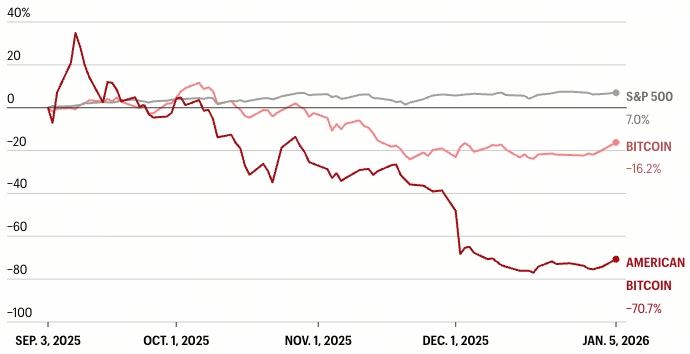
(Source: Fortune)
Shortly after it went public in September, Eric Trump couldn’t have been more ecstatic. American Bitcoin was worth nearly $8.5 billion at its height on September 9, while Hut 8 was valued at more than $3 billion. In the third quarter of 2025, American Bitcoin generated $64 million in revenue, primarily from the 563 Bitcoin it mined during those three months. And as of early January, the company had about $500 million worth of Bitcoin on its balance sheet—enabling it to vault into the top 20 of the largest Bitcoin digital asset treasuries.
But the bigger near-term threat to American Bitcoin is a recent collapse in the crypto market. As of mid-January, Bitcoin’s price was down more than 25% from its mid-autumn peak, after investors grew anxious over signs of a softening U.S. economy. That tumble coincided with a substantial drawdown in American Bitcoin’s stock, which was down more than 70% since its early-September IPO. Other digital asset treasury companies saw their stocks tumble at around the same time.
The volatility has spread to other Trump crypto assets as well. But Eric Trump, in late November, was unperturbed. “I’ve got more conviction on cryptocurrency right now than ever before,” he said. “Volatility is our friend.” In fact, he, Genoot, and other insiders bought more shares of American Bitcoin in December and early January—in time to benefit from a post–New Year bounce.
This insider buying during market panic demonstrates either conviction in the business model or contrarian timing attempting to profit from temporary market dislocations. Critics argue that Eric Trump’s public statements promoting Bitcoin while privately buying shares during crashes could constitute market manipulation. Supporters counter that insiders buying their own company’s stock signals genuine confidence rather than promotional hype.
Unprecedented Conflicts Of Interest Questions
American Bitcoin aligns with President Trump’s push to Americanize key industries, from steel to AI to crypto, and frame them as strategic resources where America should be dominant. That message has been baked into the mining venture’s branding since inception. In his Instagram post, Eric Trump boasted that the business is “using American energy to mine Bitcoin right here on American soil.”
In conversation with Fortune, Eric Trump said he and his father shared the goal of making the U.S. “the crypto capital of the world,” and that Bitcoin mining was central to U.S. domination of the emerging industry. “If we don’t do it, someone else will,” he said.
Like other Trump crypto holdings, American Bitcoin faces scrutiny over potential conflicts of interest. Ethics experts say that the Trump family’s crypto bets have created unprecedented conflicts of interest. “Is he making these decisions because he thinks this is a good thing?” asked Richard Briffault, a professor at Columbia Law School who researches government ethics, in reference to the president’s crypto policies. “Or is he making these decisions because he knows what’s going to have a direct effect on his family’s finances?”
The intersection of family business with presidential power raises questions without clear precedent. President Trump issued an executive order in March 2025 to create a strategic Bitcoin reserve, signed bipartisan legislation to regulate stablecoins, issued crypto-friendly executive orders in reversal of Biden administration cryptoskepticism, and pardoned several people convicted of crypto-related crimes. Each policy directly benefits Eric Trump’s American Bitcoin venture by legitimizing the industry and increasing demand.
In early January, World Liberty Financial applied for a federal banking charter—a Trump crypto company seeking regulatory approval from a decidedly pro-crypto Trump administration. That’s the kind of intersection of the Trump family’s business interests with President Trump’s powers that has raised alarms in Washington.
“Neither the President nor his family have ever engaged, or will ever engage, in conflicts of interest,” said Karoline Leavitt, the White House press secretary, in a statement. She added that the administration “is fulfilling the President’s promise to make the United States the crypto capital of the world.”
Eric Trump has also repeatedly pushed back against intimations of impropriety. He told Fortune that there’s a “wall” between his business interests and his father’s policymaking. “My father has no involvement in the Trump Organization,” he said. “He has no involvement in our crypto business. This is a company that I run, and he does a great job running the United States of America.”
Why Eric Trump Turned to Crypto
Eric Trump says his family’s battle with banks prompted him to turn to crypto. “I happened to become the most debanked human being in the history of debanked human beings,” he said. “Capital One pulled our accounts. JPMorgan pulled our accounts. Bank of America pulled our accounts.”
President Trump and Eric Trump, along with others in their family, have said many banks either stopped doing business with them or refused to take their deposits after the president and many of his supporters disputed the results of the 2020 election. Banking privacy laws have largely prevented banks from commenting on why they might have stopped working with the Trumps.
JPMorgan Chase and Bank of America declined to comment on specific customers’ accounts, and Capital One did not respond to requests for comment. More broadly, the three banks have denied that they debank customers because of political affiliations. “This is false,” wrote lawyers for Capital One in response to a lawsuit the Trumps filed against the bank.
Still, the experience was one the Trumps shared with some crypto entrepreneurs, who believed that they and their companies had been debanked because of regulators’ suspicions about the businesses’ validity. Eric Trump says, “I realized how punitive the financial institutions were in this country, and I fell in love with this new era of finance.” Like other crypto diehards, he sees Bitcoin as an improvement over the middlemen, fees, and delays associated with traditional banking. “It’s cheaper, faster, more transparent than any other form of finance,” he said.
FAQ
What is Eric Trump’s role in American Bitcoin?
Eric Trump is co-founder and chief strategy officer of American Bitcoin, holding ownership stake through American Data Centers. He partnered with Asher Genoot to split off Hut 8’s mining operations into the Trump-branded venture in March 2025.
How much is American Bitcoin worth?
American Bitcoin was valued at $8.5 billion at its September 2025 peak but has declined over 70% since IPO. As of early January 2026, the company holds approximately $500 million worth of Bitcoin on its balance sheet, ranking among top 20 largest Bitcoin treasuries.
Does American Bitcoin actually mine Bitcoin?
Yes, but indirectly. American Bitcoin owns almost 78,000 mining servers across four data centers but doesn’t operate facilities itself. The company pays Hut 8 to run mining operations, employing only 5 direct employees while outsourcing technical operations.
Why did Eric Trump start a crypto company?
Eric Trump states his family was “debanked” by major financial institutions like JPMorgan, Bank of America, and Capital One after the 2020 election disputes. This experience led him to embrace crypto as an alternative to traditional banking systems.
What are the conflict of interest concerns?
Ethics experts argue President Trump’s pro-crypto policies directly benefit Eric Trump’s American Bitcoin venture. Presidential actions like creating Bitcoin reserves, appointing crypto-friendly regulators, and pardoning crypto criminals all increase value of the family’s crypto holdings.
Is Eric Trump buying American Bitcoin stock?
Yes, Eric Trump, Genoot, and other insiders bought more shares during December 2025 and early January 2026 when stock had crashed 70%, demonstrating conviction in the business model despite market volatility.
Related Articles
Digital Asset Funds See $1B Inflows As Bitcoin Leads Market Recovery
The Bitcoin network sees the first block supporting BIP-110, sparking controversy over restrictions on on-chain data usage
Bitwise Sees Bullish Setup for Bitcoin Despite Escalating Geopolitical Shockwaves
Data: If BTC drops below $65,330, the total long liquidation strength on mainstream CEXs will reach $1.929 billion.
ProCap Expands BTC Treasury to 5,457 While Corporate Bitcoin Adoption Accelerates