
Charles Schwab CEO Wurster stated that predictive markets related to economics and finance can provide signals for investors, but he explicitly opposes sports betting, calling it a deviation from their mission. After the CFTC withdrew a political ban, monthly trading volume surged from $2 billion last summer to $17.5 billion in January, with most of the activity in sports contracts.
Charles Schwab categorizes predictive markets into three types, only accepting two
Charles Schwab CEO Rick Wurster told Yahoo Finance reporter Brian Sozzi that predictive markets serve three different functions, but Schwab believes only two are “meaningful” for investors. This tripartite classification provides a clear framework for understanding how traditional financial institutions view predictive markets.
The first category is event probability predictions. “First, predictive markets can let you understand the likelihood of different events happening,” Wurster said. “As an investor, having this information is very helpful.” He added that even if Schwab itself does not operate these markets, it can ultimately provide clients with such probability data directly. This means Schwab might integrate data from platforms like Polymarket or Kalshi as investment research tools for clients.
From an investment perspective, this kind of probability data is indeed valuable. For example, if a predictive market shows the probability of a policy passing rising from 30% to 70%, investors can adjust their holdings in related sectors accordingly. This real-time market consensus is more valuable than traditional polls or expert forecasts because participants are voting with real money, making their motivations more genuine.
The second category involves markets related to financial outcomes. Wurster said these markets are directly related to inflation or employment reports and can be used by investors seeking to hedge or adjust their portfolios around macroeconomic events. “If this inflation report comes out, I could suffer losses, so I want to hedge,” he explained, noting that even though these contracts still carry speculative elements, within an investment framework, they can be meaningful.
This hedging logic is well-established in traditional finance. Investors use options, futures, and swaps to hedge risks related to interest rates, exchange rates, and commodity prices. Predictive markets extend this logic to broader event categories, such as “Will CPI exceed 3%” or “Will the Fed cut interest rates.” Schwab recognizes this application, indicating that traditional brokerages are beginning to accept predictive markets as risk management tools.
But Wurster was candid about the third category—sports betting. “This is an issue we’ve been working hard to overcome, and it runs counter to our mission,” he said. “People generally don’t improve their financial situation by gambling.” Wurster indicated that Schwab prefers to leave this business to companies that position themselves as betting platforms. “We’ll leave this business to FanDuel, Robinhood, and other companies that see themselves as betting companies,” Wurster said.
CFTC policy shift leads to a surge in predictive market trading volume
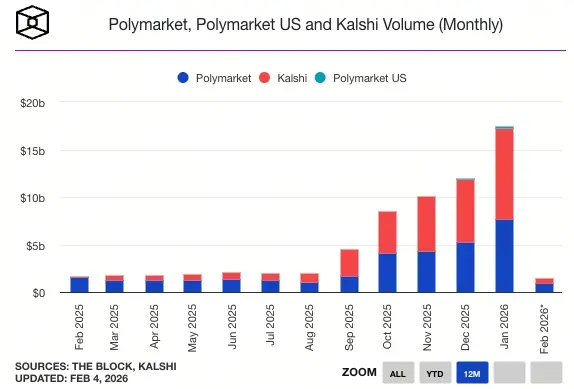
(Source: The Block)
As Wurster made these remarks, predictive markets are rapidly gaining popularity in the U.S., while also facing new regulatory scrutiny. Earlier this week, the CFTC withdrew a proposal from the Biden era aimed at banning political event contracts, marking a policy shift toward allowing regulated event markets to operate under federal oversight. CFTC Chairman Michael Selig said the agency would seek a framework focused on supporting “legitimate innovation.”
This regulatory attitude shift removes the biggest obstacle to explosive growth in predictive markets. During the Biden administration, the CFTC was hostile toward political event contracts, citing concerns about election manipulation and integrity. However, during the 2024 presidential election, Polymarket’s predictions of election outcomes proved far more accurate than traditional polls, providing strong evidence of the value of predictive markets.
Trading volume data shows explosive growth. According to The Block, the monthly trading volume on major platforms Kalshi and Polymarket increased from about $2 billion last summer to nearly $17.5 billion in January. This nearly ninefold increase in less than a year demonstrates an astonishing growth rate in any financial market.
Predictive market trading volume explosion
Summer 2025: approximately $2 billion monthly trading volume
January 2026: nearly $17.5 billion monthly trading volume
Increase: about 9 times
Dominant category: sports event contracts account for most trading volume
However, despite regulatory progress, state regulators are increasingly scrutinizing predictive markets related to sports events. Nevada’s gaming authority recently sued Coinbase, alleging that its sports-related contracts violate state law and constitute illegal gambling. This conflict between federal and state regulation remains a persistent challenge for predictive markets.
Dominance of sports betting in trading volume sparks value controversy
Although Wurster is explicitly opposed to sports betting, in reality, sports contracts still dominate most of the trading volume in predictive markets. This phenomenon reveals an awkward truth: the ideal vision of predictive markets is to become a “market for collective intelligence,” but in practice, the most popular activity is sports gambling.
From a business perspective, the appeal of sports betting is obvious. Sports events occur frequently, results are clear and quickly revealed, and user engagement is high. In contrast, economic data releases or policy events happen much less frequently, and their outcomes are often subject to debate. This difference causes sports contracts to far surpass others in trading volume and user stickiness.
However, this dominant position is precisely what traditional brokerages like Schwab worry about. If predictive markets are mainly used for sports betting, they are unlikely to be seen as serious financial tools. This perception issue could hinder the acceptance and integration of predictive markets by traditional financial institutions.
Wurster’s stance reflects the mainstream position of traditional finance: predictive markets are valuable as information and hedging tools but must be clearly separated from pure gambling. The practical effect of this stance is that large brokerages like Schwab may selectively integrate predictive markets, offering only those relevant to investment decisions, while leaving sports betting to platforms like Robinhood and others.
Wurster said that if Schwab were to directly enter predictive markets in the future, it would do so cautiously and within an investor-first framework. “The most important thing is to provide information for our investors,” he added. “Any product must align with Schwab’s focus on financial planning, research, and client support.”
This cautious attitude reflects the brand considerations of traditional financial institutions. Schwab’s mission is to help clients achieve long-term wealth growth. If predictive markets are perceived as encouraging gambling, it could damage the trust and reputation they have built over the long term.
Disclaimer: The information on this page may come from third parties and does not represent the views or opinions of Gate. The content displayed on this page is for reference only and does not constitute any financial, investment, or legal advice. Gate does not guarantee the accuracy or completeness of the information and shall not be liable for any losses arising from the use of this information. Virtual asset investments carry high risks and are subject to significant price volatility. You may lose all of your invested principal. Please fully understand the relevant risks and make prudent decisions based on your own financial situation and risk tolerance. For details, please refer to
Disclaimer.


