


XRP Today's News: White House Key Negotiation on February 10, ETF Attracts Funds, Decouples from Bitcoin
XRP has risen for two consecutive days, with focus shifting to the White House market structure bill meeting on February 10. It is expected that a consensus on stablecoin yields will boost demand. XRP ETF inflows remain strong, but Bitcoin ETF funds are flowing out. In the short term, February remains bearish, but the medium term is bullish.
The Significance of the White House Negotiation on February 10
On February 10, the White House plans to hold its second meeting with the banking industry and crypto community to discuss stablecoin yields. The U.S. government hopes that U.S. banks and crypto companies will reach an agreement on yields by the end of this month, enabling the Senate to hold a full vote on the Market Structure Bill in the spring. As background, the U.S. House of Representatives submitted the Market Structure Bill to the Senate on July 17, 2025.
However, after Coinbase (COIN) withdrew support for the bill, the Senate Banking Committee delayed the scheduled vote on the draft of the Market Structure Bill set for January 15. Coinbase CEO Brian Armstrong cited several reasons for withdrawing support, including the draft removing incentives for stablecoins and allowing banks to prohibit their competitors.
Before the upcoming midterm elections and the start of political maneuvering, reaching an agreement on yields is crucial for the passage of crypto legislation. Given that the Senate Agriculture Committee has advanced its draft of the Market Structure Bill, it is now the Senate Banking Committee’s turn to follow suit. If U.S. banks and crypto firms can reach a consensus on stablecoin yields, the banking and agriculture committees will need to merge their texts before submitting the full bill to the Senate for review.
It’s worth noting that, despite no Democratic senators voting in favor, the draft of the Agriculture Committee was still passed, increasing uncertainty about the Senate’s full vote outcome. These developments highlight the importance of the February 10 White House stablecoin negotiations. If a compromise is reached, it will boost hopes for a full Senate vote in the spring, which is undoubtedly good news for XRP.
XRP ETF Inflows vs. BTC ETF Outflows
Meanwhile, the strong demand for XRP spot ETFs contrasts sharply with the outflow of funds from Bitcoin spot ETFs, another key bullish factor for XRP. This divergence in capital flows indicates that even during overall market downturns, XRP continues to attract incremental funds, demonstrating a relative advantage.
Bitcoin ETFs have experienced cumulative outflows of over $5 billion in the past three months, indicating systematic withdrawal by institutional investors. In contrast, XRP ETFs, though smaller in scale and newer in launch, have maintained steady or increasing inflows. This contrast may reflect several factors: investors losing confidence in Bitcoin’s short-term prospects, improved regulatory clarity for XRP attracting institutional allocation, and real-world use cases within the Ripple ecosystem providing fundamental support.
XRP remains highly sensitive to regulatory developments related to crypto. After the House of Representatives submitted the Market Structure Bill to the Senate on July 17, 2025, XRP’s price surged 14.69%. In January 2026, influenced by the Federal Reserve’s announcement of a rate hike decision on January 15, XRP’s price soared from $1.8403 to a high of $2.4151 on January 6. However, reacting to delays in the Senate committee’s voting on the rate hike, XRP’s price then plummeted to a low of $1.1227 on February 6.
This “news-driven” price pattern shows that XRP’s short-term trend is highly dependent on legislative progress. Every positive news event can trigger a 10-15% rally, while every negative event can cause a similar decline. This high sensitivity is a double-edged sword: if the February 10 negotiations succeed, XRP could rebound quickly; if they fail again, it could accelerate a drop to $1.0 or lower.
Technical Outlook and Three-Stage Price Targets
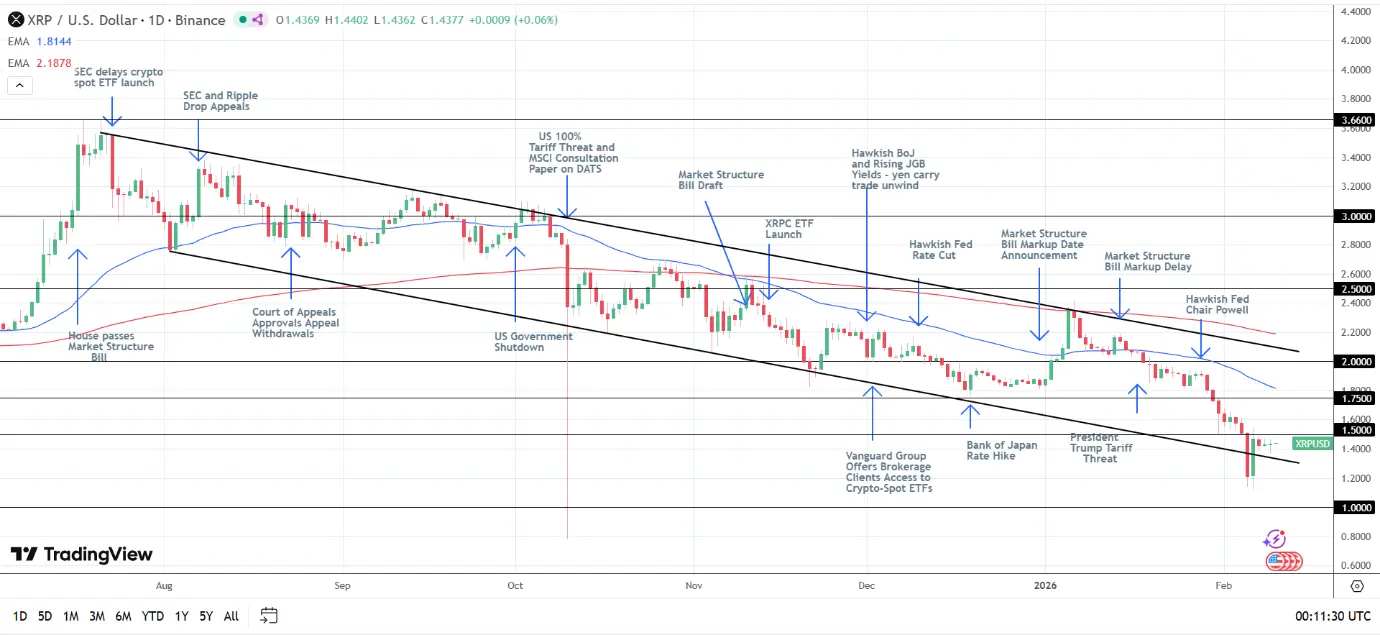
(Source: Trading View)
On February 9, XRP increased by 0.42%, following a 0.57% rise the previous day, closing at $1.4368. The token outperformed the overall crypto market, which declined by 0.13%. Despite the gains, XRP remains well below its 50-day and 200-day moving averages, indicating a downtrend. However, multiple bullish fundamentals continue to offset technical bearish signals, supporting a medium-term bullish outlook.
Key technical levels to watch include: support at $1.00 and then $0.7773; resistance at the 50-day moving average of $1.8144; resistance at the 200-day moving average of $2.1878; and resistance levels at $1.50, $2.0, $2.5, and $3.0. On the daily chart, breaking above $1.50 would allow bulls to target the 50-day moving average and $2.0.
A 12.5% decline confirms a cautious and pessimistic short-term outlook (1-4 weeks), with a target of $1.00. However, optimism remains that the Senate will ultimately pass the Market Structure Bill, and the increasing practical utility of XRP continues to boost demand for XRP spot ETFs, reinforcing medium- and long-term bullish expectations: $2.5 in 4-8 weeks, and $3.0 in 8-12 weeks.
Beyond 12 weeks, these bullish factors could push XRP’s price toward its all-time high of $3.66. Breaking above $3.66 would confirm a target of $5 within 6 to 12 months. These phased targets provide investors with a clear risk management framework.
Related Articles
The US-Iran conflict impacts South Korea's financial markets... Exchange rates and stock markets suffer heavy losses
Middle East conflict impacts Asian stock markets, Bitcoin holds at $67,000, Ethereum and Solana come under pressure and retreat
AI Agent Test: "Bitcoin, USD" Choose One, 36 Models Overwhelmingly Prefer BTC: More Stable and Reliable than Fiat Currency
Yesterday, US Bitcoin spot ETF saw a net inflow of $225 million, while Ethereum ETF experienced a net outflow of $10.8 million.