


2026 Forecast Market Battle: 7 Differentiation Strategies for New Players to Break Through
Author: Jake Nyquist, Founder of Hook Protocol
Translation: Blockchain Knight
By 2026, major institutions will launch entirely new prediction markets.
From the past five years of competition between NFT and perpetual contract exchanges, we have already understood: differentiated products can quickly capture market share.
Although leading platforms currently hold advantages in liquidity and regulation, they carry heavy product and technical debt, making it difficult to respond flexibly to new entrants.
So how should new players compete? In my view, the differentiation in prediction markets revolves around seven key dimensions:
1. Product Quality
Founding teams can create differentiation through front-end user experience, API stability, development documentation, market structure, fee mechanisms, and more.
Most established platforms currently have obvious shortcomings: unreasonable tier settings, opaque fee rules, slow and unstable APIs, and single order types.
A high-quality user experience, especially services tailored for API algorithmic traders, is a lasting core advantage that can help even against channel-strong competitors to establish a foothold.
2. Asset Types and Market Selection
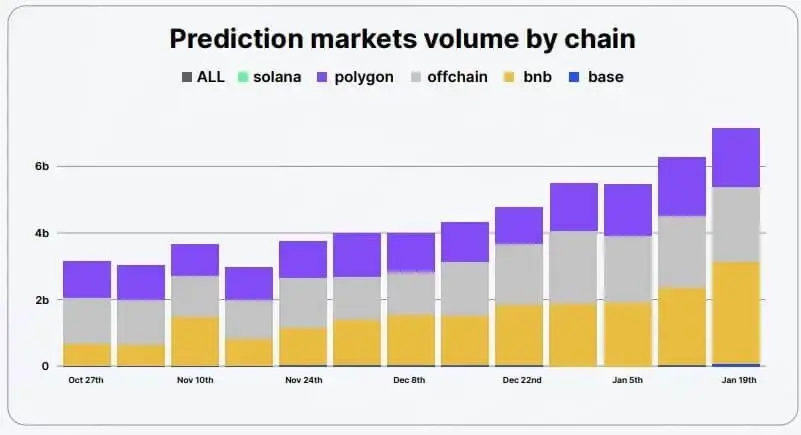
Currently, trading volume in prediction markets is mainly concentrated in sports betting and native crypto markets.
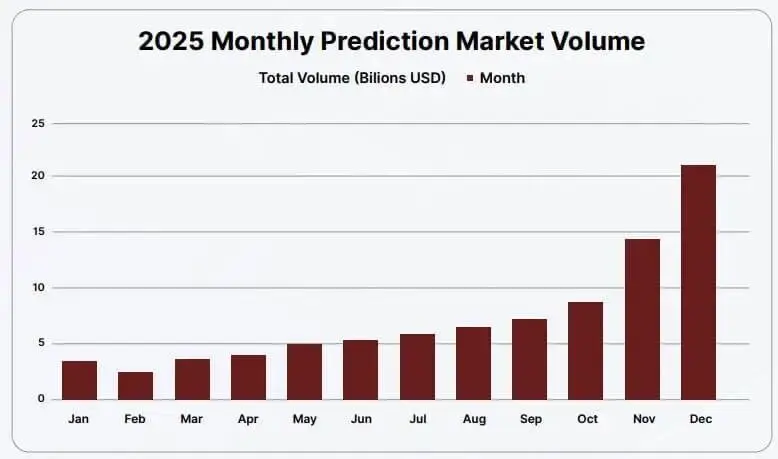
New exchanges can launch exclusive markets unavailable on other platforms. When combined with vertical strategy (point 7), this advantage can be further amplified.
3. Capital Efficiency
Capital efficiency determines how effectively traders can utilize collateral. There are two main approaches:
First, interest-earning collateral: not letting idle funds earn only government bond yields, but providing higher returns—similar to Lighter supporting LP deposits as collateral, and HyENA’s USDE margin perpetual contracts.
Second, margin mechanisms. Due to gap risk, the leverage value of prediction markets is generally underestimated. However, platforms can offer limited leverage for continuous markets or implement portfolio margining for hedging positions.
Exchanges can also subsidize lending pools or act as market-making counterparts to internalize gap risks, rather than passing losses onto users.
4. Oracles and Market Settlement
The reliability of oracles remains a systemic weakness in the industry. Settlement delays and incorrect results can significantly amplify trading risks.
Beyond improving stability, platforms can implement innovative oracle mechanisms: hybrid human-machine systems, zero-knowledge proof-based solutions, AI-driven context-aware oracles, unlocking new markets that traditional oracles cannot support.
5. Liquidity Provision
The survival of an exchange depends on liquidity. Viable paths include: paying for professional market makers, incentivizing regular users with tokens to provide liquidity, and adopting Hyperliquid’s HLP aggregated liquidity model.
Some platforms may also fully internalize liquidity, emulating FTX’s model of relying on Alameda as an internal trading team.
6. Regulatory Compliance
Kalshi, with its US regulatory approval, has achieved embedded distribution with Robinhood and Coinbase, capturing retail traffic that Polymarket cannot reach.
There are still many jurisdictions and regulatory frameworks to explore. Compliant prediction markets can unlock similar channels, such as adapting to US state gambling regulations.
7. Vertical vs. Horizontal Strategies
Horizontal Strategy: Similar to Hyperliquid in perpetual contracts, focusing on building top-tier underlying trading infrastructure, inviting third parties to develop front-ends and vertical scenarios, and encouraging ecosystem builders to add markets and develop revenue-generating front-ends (like Phantom).
Vertical Strategy: Represented by Lighter, which autonomously controls the front-end, launches mobile apps, and creates a seamless user experience, emphasizing integrated experience and direct user connection.
Polymarket’s resistance to deep embedded cooperation versus Kalshi’s open approach exemplifies the trade-offs between these two strategies.
Related Articles
Prediction market platform Fireplace completes $1.5 million pre-seed funding round, led by Frachtis
The probability that Bitcoin will fall back to $60,000 in February on Polymarket is 31%.
The predicted weekly trading volume in the market exceeds 38 million transactions, setting a new record high
On Polymarket, the probability that ROBO's FDV exceeds $200 million on its second day of trading is 69%
The negative probability of "Court orders Trump to refund tariffs" on Polymarket surpasses 80%