


4 US economic signals that could impact Bitcoin during the Presidents' Day holiday week
Bitcoin is preparing to face an important week on the macroeconomic front as its current price hovers near $68,600. After a volatile start to the year, including a sharp correction from the peak above $126,000 in 2025, the cryptocurrency market remains highly sensitive to economic data from the U.S.
Tensions over tariffs, persistent inflation, and the Federal Reserve’s decision to pause interest rate cuts have made risk assets unstable. Additionally, with the U.S. markets closed on Monday for Presidents’ Day, lower-than-normal liquidity could increase volatility as key economic data are released midweek.
Notable U.S. Economic Data This Week
Crypto traders are focusing on four key reports: the January FOMC meeting minutes (Wednesday), initial jobless claims (Thursday), along with the revised Q4 GDP and December PCE inflation reports (Friday).
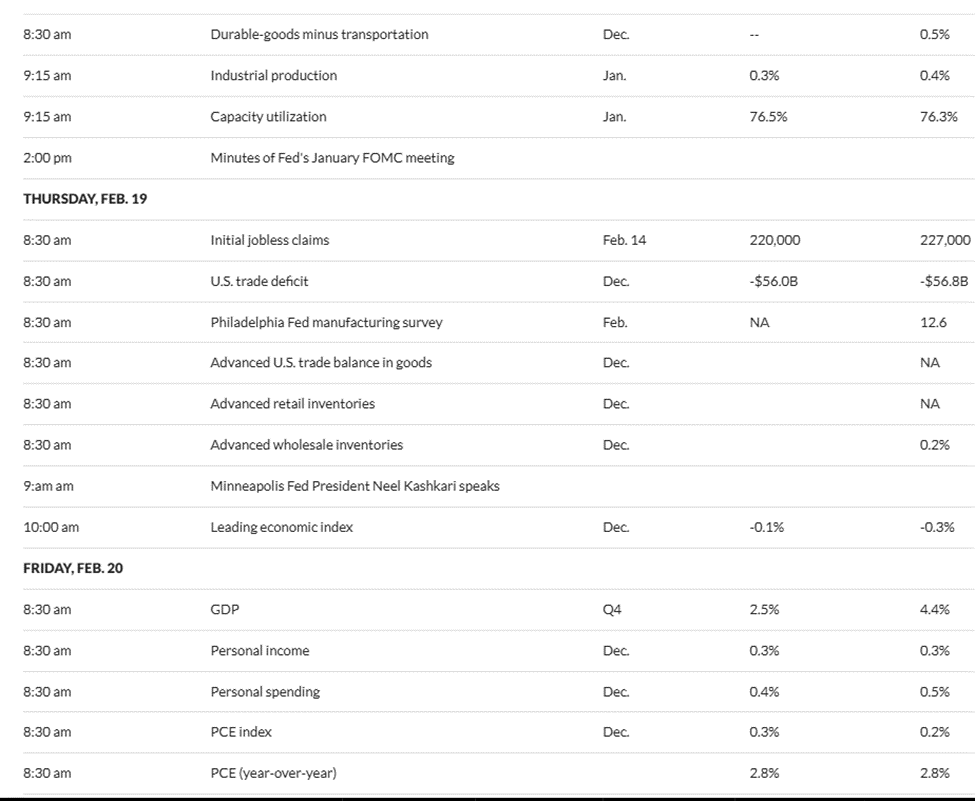 U.S. Economic Data to Watch This Week | Source: Market Watch
According to CME FedWatch data, the market currently assigns only a 9.8% chance of a rate cut by the Fed in March, indicating skepticism about imminent easing.
U.S. Economic Data to Watch This Week | Source: Market Watch
According to CME FedWatch data, the market currently assigns only a 9.8% chance of a rate cut by the Fed in March, indicating skepticism about imminent easing.
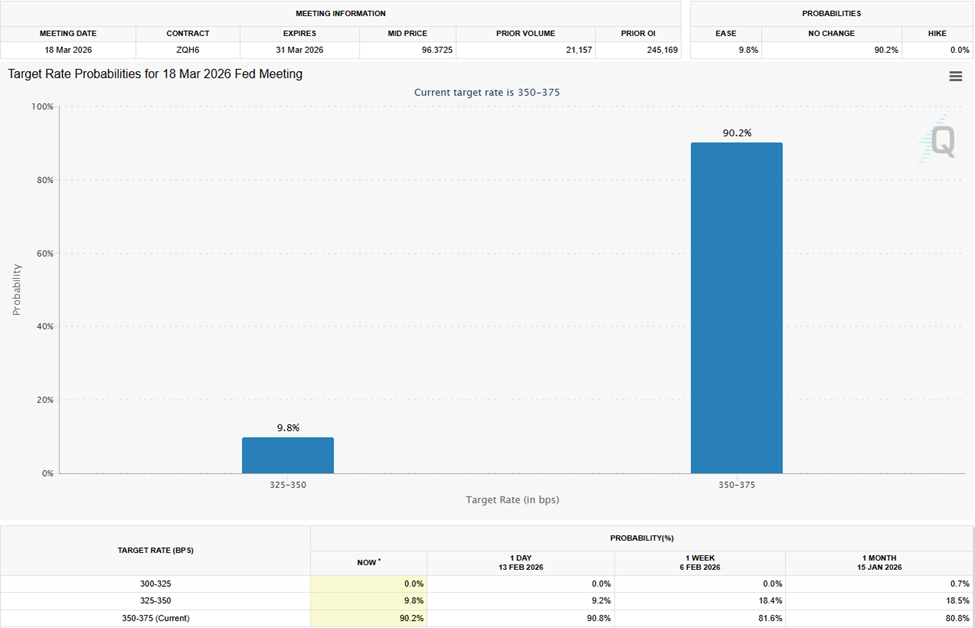 Probability of Rate Cut in March | Source: CME FedWatch Tool
In this context, even small surprises in these reports could determine whether Bitcoin challenges the $70,000 resistance or falls back to the $60,000 support zone.
Probability of Rate Cut in March | Source: CME FedWatch Tool
In this context, even small surprises in these reports could determine whether Bitcoin challenges the $70,000 resistance or falls back to the $60,000 support zone.
January FOMC Minutes
The Federal Open Market Committee (FOMC) meeting minutes will be released on Wednesday, shaping market sentiment for the week.
At the last meeting, the Fed kept rates steady at 3.50%–3.75%, showing caution amid stable economic growth and ongoing service inflation.
The minutes will offer deeper insights into policymakers’ internal discussions, especially regarding inflation risks, labor market strength, and tariff tensions.
If the minutes are “hawkish,” emphasizing persistent inflation or overheating risks, it could reinforce expectations of prolonged high rates. Historically, such signals have caused Bitcoin to drop 3–5% within 24 hours due to rising bond yields and tightening liquidity expectations.
Conversely, if the minutes lean “dovish,” highlighting balanced risks or concerns about slowing growth, it could boost expectations of rate cuts, pushing Bitcoin closer to the $70,000 mark.
Initial Jobless Claims
Thursday’s initial jobless claims report will provide a quick snapshot of the labor market’s health— a key factor in the Fed’s monetary policy strategy.
Current forecasts estimate around 220,000 new claims for the week ending February 14, a slight decrease from 227,000 the previous week.
This uptick may be due to winter storms prompting more households to file for unemployment benefits. If actual claims fall below 210,000, it would strengthen confidence in the resilience of the labor market and reduce the likelihood of near-term easing by the Fed. This scenario could cause Bitcoin to decline 1–3% as markets adjust expectations.
On the other hand, if claims exceed 230,000, concerns about labor market weakening could arise. Past cycles show that signs of labor market deterioration often boost risk assets, as traders anticipate the Fed will soon cut rates. This could push Bitcoin up by 2–4%.
Q4 2025 GDP (Final Revision)
On Friday, the final revision of Q4 GDP is expected to show annual growth of 2.5%, significantly lower than the initial estimate of 4.4%.
If actual growth falls below 2.3%, it would reinforce views of economic weakening and could push Bitcoin higher by 3–6% as markets price in a higher likelihood of Fed easing. Consumer spending—accounting for about 70% of GDP—will be closely watched.
However, if the figure exceeds 2.7%, it could delay expectations of easing, reinforce the “higher for longer” rate stance, and exert downward pressure on the crypto markets.
PCE & Core PCE Index
This week’s highlight will be the December PCE inflation report, the Fed’s preferred inflation gauge.
Current forecasts expect a 0.3% month-over-month increase for both total PCE and core PCE, with annual increases around 2.8%–2.9%.
If actual data come in lower than 0.2% MoM, it would signal ongoing inflation cooling. Such a result could significantly boost chances of rate cuts, driving Bitcoin up 4–8% and possibly surpassing $70,000.
Conversely, if figures exceed 0.3%, concerns over persistent inflation could intensify, causing a 3–5% decline as bond yields rise and easing expectations fade.
Core PCE—excluding volatile food and energy prices—will be a key focus for policymakers and investors alike.
From the Fed’s messaging, labor market strength, GDP revisions, to inflation data, each report this week will directly influence monetary policy expectations for 2026. While Bitcoin remains around $68,600 but well below its 2025 peak, the market will continue to be highly sensitive to any signals regarding liquidity and policy.
Related Articles
Iran Conflict Poses Limited Risk to Bitcoin Hashrate, Despite $7.8 Billion Crypto Sanctions Workaround
CEXt-Linked Whale Opens 20x Leveraged Long Position on 400 BTC Worth $27.3M
Tennessee Bitcoin Reserve Bill has been submitted to the Finance, Fundraising, and Means Committee for review
Bitunix Analyst: Hormuz Risk Escalation, Oil-Gold Chain Activation, BTC Upside Short Liquidity Accumulation
Data: 220 BTC transferred from an anonymous address, routed through intermediaries, and sent to another anonymous address