


Breaking News》The Supreme Court rules that Trump's $175 billion tariffs are illegal! The White House announces contingency plans, Bitcoin hits $68,000
The U.S. Supreme Court tonight ruled 6-3 that Trump’s use of IEEPA to impose tariffs was illegal, affecting up to $175 billion. The market briefly cheered then quickly cooled off, as Trump said, “We will find a way.”
(Background: Can the $2,000 “tariff bonus” announced by Trump truly bring a liquidity feast?)
(Additional context: U.S. Commerce Secretary aims to shift 40% of Taiwan’s semiconductor supply chain to the U.S., rejecting a 100% tariff approach)
Table of Contents
- The list of overturned tariffs: from fentanyl to “D-Day”
- The $175 billion refund issue
- Trump’s backup plan isn’t empty talk, but it’s not a cure-all either
- Why is the market reaction so subdued?
The U.S. Supreme Court announced tonight (20th) at 11 p.m. Taiwan time that, in a 6-3 decision, Trump’s invocation of the International Emergency Economic Powers Act (IEEPA) to impose tariffs globally was unlawful!
Chief Justice Roberts’ core ruling was just one sentence: “IEEPA does not authorize the President to impose tariffs.” He further pointed out that in the half-century of IEEPA’s existence, “no President has ever invoked this law to impose any tariffs, let alone on this scale and scope.”
The court found that “regulatory” power and “taxing” power have long been legally regarded as fundamentally different concepts.
Justice Kavanaugh, in dissent, warned that this ruling would cause “chaos,” and specifically noted:
“The Court today says nothing about whether and how the government should refund the billions of dollars collected from importers.”
The list of overturned tariffs: from fentanyl to “D-Day”
This ruling affects two major categories of tariffs:
First is the “Fentanyl Tariffs” effective February 4, 2025: 25% on Canada and Mexico, 20% on China, citing fentanyl smuggling as a national security threat.
Second is the “D-Day” announced on April 2, 2025, with reciprocal tariffs: a 10% base rate on almost all countries, with some higher—China at 34%, Taiwan at 32%, Vietnam at 46%, the EU at 20%.
According to Penn-Wharton’s budget model estimates, since the implementation of IEEPA tariffs, the total collected amounts to approximately $175 to $179 billion. Over 301,000 importers and more than 34 million customs records have been affected.
However, it’s important to note that this ruling does not impact tariffs imposed under other legal authorities, including Section 232 of the Trade Expansion Act (steel, aluminum, autos) and Section 301 of the Trade Act (China tariffs during the first term).
The $175 billion refund issue
The legal logic is clear: if tariffs were initially illegal, the amounts collected should, in principle, be refunded. An alliance of over 800 small businesses immediately demanded refunds after the ruling. Many law firms had already advised importers in January to submit protective refund claims to the International Trade Court to preserve their rights.
But actual execution is another matter. With 34 million customs records, 300,000 importers, and goods in various clearance stages, this is an administrative and judicial nightmare.
As Kavanaugh stated in his dissent, the court “did not mention any specific mechanism for refunds.” More complicated is that the Trump administration had already included IEEPA tariff revenues in the funding for the tax cut law passed in summer 2025. The $175 billion fiscal shortfall is not just a math problem but a political one.
Trump’s backup plan isn’t empty talk, but it’s not a cure-all either
Before the ruling, Trump stated: “If we don’t win, we will find a solution.” National Economic Council Chair Kevin Hassett immediately announced that the government had prepared “Game Two,” “confident that we can almost immediately implement the President’s policies through alternative authorizations.”
The alternative tools include: Section 232 of the Trade Expansion Act (national security, requiring Department of Commerce investigations), Section 301 of the Trade Act (unfair trade practices, requiring USTR investigation), Section 122 (balance of payments, up to 15%, max 150 days), and Section 338 of the Tariff Act (retaliation against discriminatory trade practices). Trump even mentioned the possibility of re-packaging tariffs as “licenses” under IEEPA.
But none of these substitute authorities can replicate the breadth of IEEPA tariffs. IEEPA allows the President to impose tariffs on almost all countries, on all goods, at any rate, and indefinitely. Alternatives are either narrower in scope (Section 232 requires case-by-case review), lower in rate (Section 122 caps at 15%), or more time-consuming (Section 301 requires formal investigation). Analyses from the Atlantic Council and the Tax Policy Center agree: Trump still has tariff tools, but cannot rebuild the high tariff wall of IEEPA.
In other words, “Game Two” isn’t empty talk, but it’s also not an equivalent substitute. It’s more like downgrading from nuclear to conventional weapons.
Why is the market reaction so subdued?
According to the script, overturning large-scale tariffs by the Supreme Court should be a major boon for risk assets. Tariffs increase import costs → boost inflation → limit rate cuts → suppress risk assets. Removing tariffs should reverse this chain.
But the actual response was: Dow rose 207 points (+0.42%), S&P 500 up 0.52%, Nasdaq up 0.68%. Bitcoin briefly broke above $68,000 but quickly fell back to $67,000, with gains wiped out within half an hour.
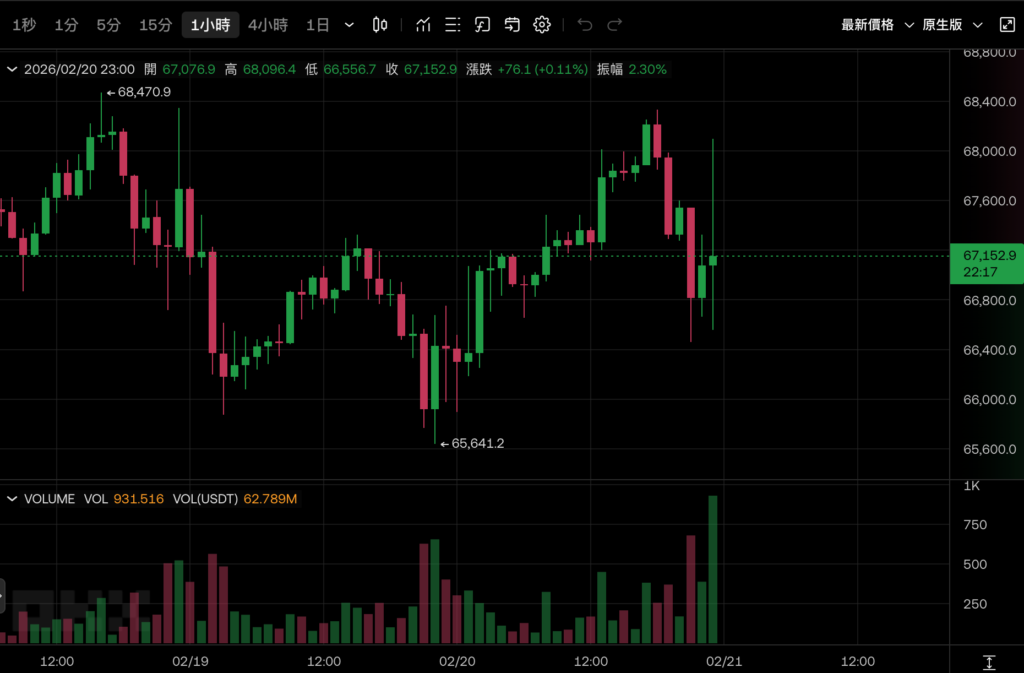
There are three potential reasons. First, the Q4 GDP released on the same day grew only 1.4% (vs. 2.5% expected), and core PCE inflation was 3.0% (vs. 2.9%), with stagflation data impacting sentiment more directly than the tariffs ruling.
Second, the existence of “Game Two” means tariffs won’t truly disappear, only change form.
Third, the market has been numb after four months of continuous shocks—from a 47% drop from October highs, ETF outflows, to Fed hawkishness. In this environment, a “possibly useful but uncertain” positive is not enough to turn sentiment around.
Bitcoin’s oscillations reflect the current market psychology: uncertainty about how long this good news can last.

Related Articles
XRP Ledger Surpasses Solana in RWA Tokenization as Soil Launches Yield Protocol
Sui Integrates Pyth Pro to Power High-Performance DeFi with Real-Time Data
LayerZero Co-founder Clarification: Zero will not issue any new tokens, ZRO is the only asset
Data: Today, the US Bitcoin ETF experienced a net outflow of 2,414 BTC, and the Ethereum ETF experienced a net outflow of 57,543 ETH.
Bitcoin spot ETF saw a net outflow of $166 million yesterday, marking the third consecutive day of net outflows.
Grayscale Investments Launches Sui Staking ETF (GSUI) on NYSE Arca