


Standard Chartered Bank predicts the impact of stablecoins! The U.S. Treasury Department may suspend 30-year bonds for three years
A recent report from Standard Chartered reveals that stablecoin issuers’ demand for U.S. short-term government bonds is accelerating rapidly. It is estimated that by the end of 2028, this new demand will reach $1 trillion. When including the Federal Reserve’s bond purchase programs, the total demand for short-term government bonds could exceed $2.2 trillion. This structural shift may compel the U.S. Treasury to reconfigure its debt portfolio or even suspend 30-year bond auctions for up to three years.
Stablecoins Are Becoming the Invisible Major Buyer of U.S. Treasury Bonds
(Source: Standard Chartered)
Standard Chartered analyst Jeff Kendrick notes in the report that stablecoin issuers typically need to hold large amounts of highly liquid, top-rated assets to maintain their peg stability, with U.S. Treasury bills (T-bills) being the preferred choice. These emerging buyers are quietly transforming the demand structure in the U.S. short-term debt market.
The bank’s forecast figures are striking. By the end of 2028, the additional demand for T-bills driven by stablecoins is expected to range between $800 billion and $1 trillion. When factoring in the Fed’s ongoing bond purchases and the refinancing of maturing mortgage-backed securities, the total demand in the short-term government bond market could reach $2.2 trillion, fundamentally reshaping U.S. debt financing strategies.
Who Is Driving This Demand?
Emerging Market Stablecoins: Expected to account for two-thirds of the total new demand, representing net new capital inflows globally rather than internal fund shifts.
Developed Market Stablecoins: Demand mainly comes from replacing existing holdings, contributing relatively little to market growth.
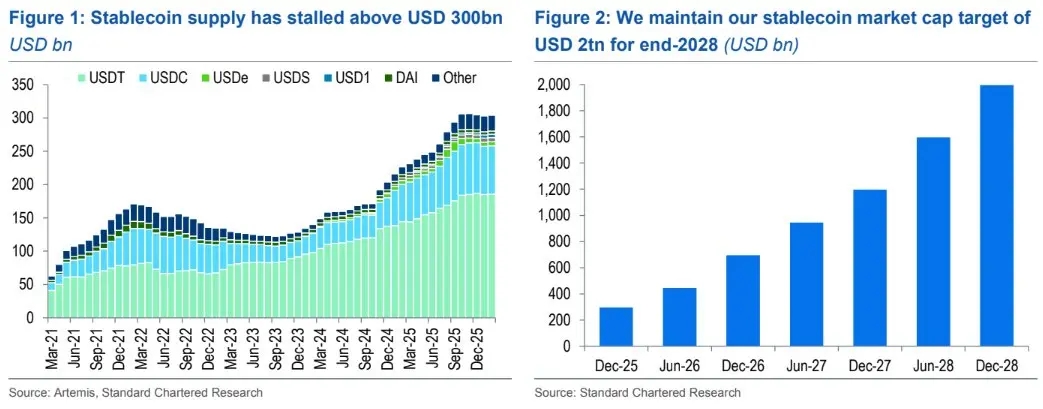
Total Stablecoin Market Cap: Currently around $304 billion, with Standard Chartered predicting it will surpass $2 trillion by 2028.
This structure highlights a key reality: the growth in stablecoin demand is not an internal cycle within the crypto market but is systematically channeling new capital from emerging markets worldwide into the U.S. short-term debt market.
U.S. Treasury Faces a Historic Dilemma: Shortening Debt Maturity
(Source: Standard Chartered)
This enormous demand for short-term securities presents the U.S. Treasury with an unprecedented policy opportunity, as well as a challenging structural choice.
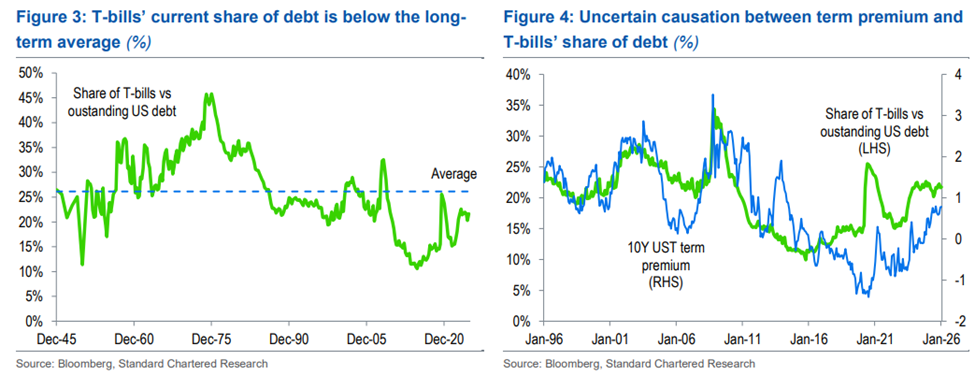
Standard Chartered warns that the Treasury might respond to the excess demand for stablecoins by significantly increasing the proportion of T-bills in its overall debt portfolio, while reducing the issuance of 30-year bonds or even suspending long-term auctions for up to three years. Historically, the Treasury suspended 30-year bond auctions from 2002 to 2006 — but the fiscal deficit environment then was far less severe than today, which is a critical difference highlighted by the bank.
If Treasury Secretary Yellen chooses to increase T-bills’ share by 2.5% over three years, roughly releasing an additional $900 billion in short-term supply, it could offset the excess demand from stablecoins and keep the 10-year Treasury yield within manageable levels.
However, Standard Chartered also cautions that this approach is not without costs. Rising term premiums, ongoing fiscal deficits, and rollover risks could produce more complex effects on the overall yield curve in the medium to long term. The short-term bull flattening effect does not equate to long-term rate stability.
Regulatory Lag Is the Biggest Uncertainty
Although Standard Chartered remains optimistic about the long-term demand for stablecoins, short-term growth has indeed stalled. Currently, the total stablecoin market cap is about $304 billion, still far from the $2 trillion target. The main reasons are recent weakness in the crypto market and the slower-than-expected implementation of regulatory frameworks following the passage of the U.S. “Genius Act.”
The bank characterizes these obstacles as cyclical rather than structural bottlenecks. As regulatory clarity gradually improves, institutional adoption of stablecoins will accelerate, and the profound impact on the U.S. short-term government bond market will follow.
Related Articles
Citrini releases AI Doomsday Report: Software stocks are sold off, IBM plunges 13%
AI panic impacts the crypto market: ETH, SOL, XRP all decline collectively, with increased downward pressure as BTC consolidates sideways
XRP Today News: Drops to a three-week low of $1.35, pressured by AI and tariff negative news
Bitcoin spot ETF experiences five consecutive weeks of net outflows, marking the longest outflow since early 2025.
Tariff Variables and AI Impact: US Stocks Drop, Bitcoin Falls to 63K
Analysis: Bitcoin treasury companies have sold off for three consecutive weeks for the first time, which may lead to increased short-term pressure on BTC.