Market technician Patrick Karim shared a striking long-term chart this week with a simple message:
“Crude Oil. Whatever happens on the Monday open is irrelevant on the longer-term roadmaps. The pathway for higher prices for crude oil has been laid out by silver & gold.”
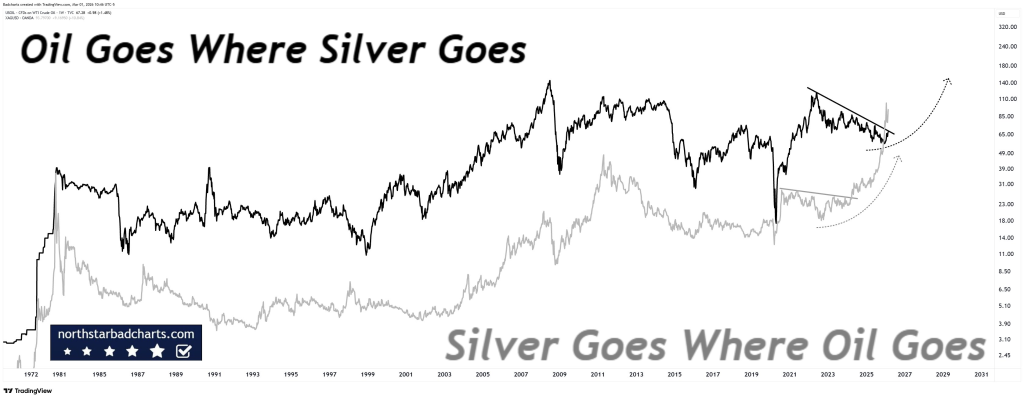
The chart compares decades of price action between crude oil and silver. One line tracks oil. The other tracks silver. The message is visual and blunt: major structural moves in silver tend to precede or align with large directional changes in oil.
This is about multi-year structure.
What the Long-Term Chart Is Showing
The chart stretches back to the 1970s. Across multiple cycles (inflation spikes, recessions, commodity booms, and crashes) oil and silver move in broad alignment during major macro phases.
When precious metals enter structural uptrends, oil often follows.
Right now, silver has already broken into a powerful bull phase. After consolidating for years, it exploded higher, printed new highs, corrected sharply, and is now rebuilding structure near key resistance. The longer-term pattern shows higher highs and higher lows across the macro timeframe.
Oil, by contrast, has been compressing.
Source: X/@badcharts1
On Karim’s chart, crude appears to be forming a large multi-year consolidation with a descending trendline capping recent rallies. Price has pulled back from prior highs but has not broken down structurally. It looks coiled.
There’s also a curved projection sketched on the right side of the chart. That projection mirrors silver’s prior breakout path and implies that oil could follow a similar expansion phase once resistance gives way.
The implication is clear: metals have already signaled the inflationary pressure. Oil may simply be lagging.
Read also: ChatGPT Predicts the Price of Silver and Gold If the U.S.–Iran War Escalates Further
Why Silver and Gold Could Be Leading
Precious metals tend to respond first to monetary instability, currency debasement fears, and geopolitical stress. They move when capital seeks protection.
Energy often reacts later, when inflation pressure feeds directly into supply chains and real-economy pricing.
Silver’s breakout above long-standing resistance indicates that liquidity conditions and inflation expectations are shifting. Gold has also remained structurally strong despite volatility in equities and crypto.
If metals are in the early phase of a broader commodity cycle, oil would not stay suppressed for long.
Karim’s point about the Monday open being irrelevant speaks to this idea. Short-term gaps driven by headlines do not change multi-year trend structure. Weekly and monthly charts define the real roadmap.
As long as crude oil holds its long-term support zones and continues compressing beneath that descending resistance, the setup resembles a classic coil before expansion.
A decisive breakout above that multi-year trendline would likely trigger momentum flows and repositioning across commodity markets.
If silver continues higher, Karim’s thesis indicates oil will not remain behind for long.
Read also: Strait of Hormuz Freeze: Oil Tankers Turn Back as War Risk Insurance Vanishes Overnight
Disclaimer: The information on this page may come from third parties and does not represent the views or opinions of Gate. The content displayed on this page is for reference only and does not constitute any financial, investment, or legal advice. Gate does not guarantee the accuracy or completeness of the information and shall not be liable for any losses arising from the use of this information. Virtual asset investments carry high risks and are subject to significant price volatility. You may lose all of your invested principal. Please fully understand the relevant risks and make prudent decisions based on your own financial situation and risk tolerance. For details, please refer to
Disclaimer.
Related Articles
QCP: Bitcoin remains resilient amid the Hormuz crisis, while AI and tech industries come under pressure
The closure of the Strait of Hormuz has led to rising energy prices, with Brent crude reaching $83 and natural gas up 50%. The South Korean stock index KOSPI fell 20% due to the impact. Bitcoin performed strongly, possibly indicating a shift in risk appetite. The market expects continued volatility, with all parties pressuring Iran to open the strait.
GateNews26m ago
Bitmine buys the dip again! Tom Lee is optimistic about Ethereum with "three major bullish factors" supporting it
Bitmine Immersion Technologies increased its holdings by 51,162 ETH last week, bringing the total to 4.42 million ETH, valued at approximately $8.7 billion, making it the publicly traded company with the largest ETH holdings. Despite market difficulties, Chairman Tom Lee believes the fundamentals of ETH are strong and points out three major positive factors. 68.7% of the company's ETH has been staked, which is expected to generate significant passive income.
区块客29m ago
Dark Week for Asian Stocks! Korea locks out margin traders, Taiwan's many frogs are crying out, and Japan's NISA investors are feeling the pain of the stock market crash
The joint attack by the US and Israel on Iran caused a crash in Asian stock markets. South Korea's KOSPI plummeted nearly 20% over two days, marking the largest decline since 2008; Taiwan's stock market was also affected, with TSMC's market value evaporating nearly 2 trillion yuan, and PTT's stock board experiencing panic selling. The Japanese market also took a heavy hit, with the Nikkei index dropping over 4,000 points in three days. NISA investors are facing their first market crash challenge, and investor panic sentiment is rising. The market has not yet stabilized.
動區BlockTempo45m ago
BTC 15-minute increase of 0.83%: Short covering and on-chain large funds resonate to drive the move
From 08:30 to 08:45 (UTC) on March 4, 2026, BTC recorded a +0.83% return, with a price range of 69,305.8 to 69,914.2 USDT, and an amplitude of 0.88%. In a short period, market attention significantly increased, trading volume expanded compared to usual, reflecting rapid capital flow and heightened volatility.
The main drivers of this movement are partial short covering and concentrated liquidation of leveraged positions. Previously, after BTC retested a key support level, short positions were forced to cover and buy, pushing the price higher. During the same period, the frequency of large on-chain transfers and the average transaction amount increased markedly.
GateNews48m ago
ETF Frenzy for Capital Inflow, Strong Bearish Momentum in Futures: Bitcoin Surges Past $69,000, Can the Short-term Rebound Continue?
Despite ongoing geopolitical uncertainties, the cryptocurrency market has demonstrated remarkable resilience, with Bitcoin breaking through $69,000 today (4) and approaching the $70,000 mark again. Market analysis indicates that this rally is less about investors' "bullish confidence" returning and more about a technical rebound driven by "short covering."
Crypto market maker Enflux pointed out that the market has neither fully priced in the disaster nor placed optimistic bets on a resolution. Last weekend, shorts capitalized on news of Middle Eastern military conflicts, causing Bitcoin to drop to $63,000. However, once the market realized that the situation was not escalating into a full-scale regional war affecting global trade routes, the long-suppressed short positions were quickly hunted down, triggering a short squeeze.
Enflux described in its report that the reaction speed of crypto assets to geopolitical shocks far exceeds that of traditional assets:
When gunfire erupts or sanctions are imposed
区块客51m ago
Goldman Sachs CEO Solomon Warns: US-Iran War Impact Could Trigger Several Weeks of Continuous Crypto Market Decline
Goldman Sachs CEO David Solomon pointed out that the financial markets have not yet fully digested the impact of the US-Iran war, and cryptocurrencies may face further declines. Geopolitical tensions and oil price fluctuations are putting pressure on the markets, and investors should monitor related developments to assess future market trends.
GateNews1h ago


