


SpaceX Bitcoin reserves drop to $545 million, pre-IPO accounting losses become investors' focus
Elon Musk’s SpaceX plans to submit a confidential IPO application to the U.S. Securities and Exchange Commission (SEC) as early as March, with an estimated valuation exceeding $1.75 trillion. However, SpaceX’s Bitcoin holdings have decreased from approximately $78 million in December 2025 to about $54.5 million currently, evaporating over $23.5 million in three months, despite the company not buying or selling any Bitcoin during this period.
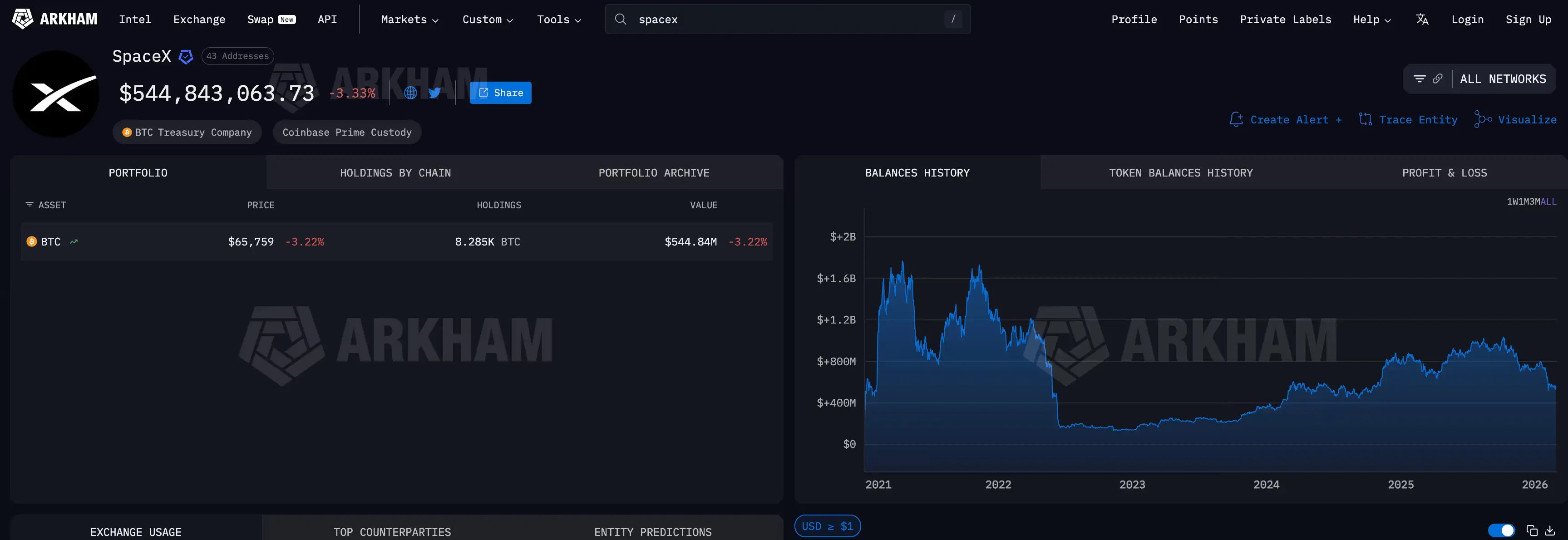
SpaceX’s Bitcoin Holdings and Market Value Decline Path
(Source: Arkham)
According to on-chain data identified by Arkham Intelligence, SpaceX’s Bitcoin holdings are distributed across 43 wallets managed by Coinbase Prime, totaling approximately 8,285 BTC. The holdings have remained relatively stable since early 2026, but the USD value has significantly declined:
- December 2025: When Bitcoin price was near $92,500, 8,285 BTC valued at about $780 million.
- Early February 2026: Amid rumors of SpaceX-xAI merger, Bitcoin was around $78,000, with market value dropping to about $650 million.
- March 1, 2026: The latest data shows the market value has fallen to approximately $545 million.
This means that over three months, without any buying or selling, the paper loss caused by Bitcoin market fluctuations exceeds $235 million. SpaceX’s Bitcoin holdings have a long history, peaking near $2 billion at the end of 2021; the bear market in 2022 drastically reduced this, and over the past two years, the market value has fluctuated between $400 million and $800 million.
Pre-IPO Disclosure Pressure: Tesla’s Precedent
SpaceX’s IPO application will force it to fully disclose its Bitcoin holdings to public market investors for the first time. The timing of this disclosure—coinciding with one of Bitcoin’s most severe corrections in recent years rather than a rally—adds complexity to market interpretation.
Tesla provides the closest precedent. Elon Musk’s electric vehicle company also holds Bitcoin, and during multiple downturns, even without changing its holdings, the company faced repeated negative headlines due to unrealized losses, which somewhat overshadowed its core business performance. Tesla’s total revenue for 2025 was $94.8 billion, with a gross profit of $17 billion. In such a scale of financial reporting, the impact of Bitcoin’s paper fluctuations is relatively limited. SpaceX may face similar dissemination risks.
It is noteworthy that SpaceX’s holding strategy differs fundamentally from Tesla’s: Tesla has bought and sold Bitcoin multiple times in the past; in contrast, Arkham’s on-chain data shows SpaceX has consistently held its Bitcoin through every market cycle without selling, demonstrating a classic “HODL” long-term holding strategy.
Frequently Asked Questions
How will SpaceX’s Bitcoin holdings be disclosed in the S-1 filing?
In the U.S. IPO registration statement (S-1), the company must fully disclose its balance sheet, including digital assets. SpaceX will need to report the amount of Bitcoin held, its historical cost basis, and its fair value at the end of the reporting period. If the value is below the purchase cost, a paper loss must be reflected in the financial statements, which will be an important reference for investors assessing risk.
Will SpaceX’s Bitcoin holdings affect its IPO valuation of over $1.75 trillion?
SpaceX’s core business valuation primarily depends on its rocket launches, Starlink satellite internet, and government contracts. The Bitcoin holdings (around $545 million) constitute a small proportion relative to the overall valuation, so the direct impact is limited. However, Bitcoin’s volatility could generate unstable non-cash gains or losses in future quarterly reports, complicating financial forecasts and potentially affecting institutional investor analysis.
What does SpaceX’s consistent holding through multiple market cycles signal?
According to Arkham Intelligence’s on-chain tracking, SpaceX has not sold any Bitcoin during the significant downturn in 2022 and has remained inactive during subsequent fluctuations. This indicates that SpaceX views Bitcoin as a long-term reserve asset rather than a trading instrument. This strategy is similar to MicroStrategy’s “Bitcoin treasury” approach but contrasts with Tesla’s active trading strategy.
Related Articles
Ruck increased by 108.22% after launching Alpha, current price is 0.0008920 USDT
ETH short-term increase of 1.52%: USDC large-scale burning and macro hedging sentiment resonate to boost buying interest
BTC 15-minute increase of 1.41%: Geopolitical easing and institutional accumulation resonate to drive the rebound
Chainlink Expands Ecosystem with 16 Integrations Across Six Services and Five Blockchains