


Pre-war predictions for Iran? Polymarket traders bet on U.S.-Iran war, making a profit of $1.2 million, raising questions

Polymarket experienced unusual betting activity before the U.S.-Iran airstrikes, with 6 new wallets accurately profiting $1.2 million, sparking insider suspicion and increasing global regulatory pressure.
Funds Precede Smoke, Precise Prediction Sparks Insider Trading Allegations
On February 28, the United States and Israel launched a large-scale airstrike against Iran called “Operation Epic Fury,” causing intense geopolitical turmoil worldwide. However, before physical missiles fell, the decentralized prediction market Polymarket had already seen a surge of capital that outperformed intelligence agencies.
According to on-chain analysis firms Bubblemaps and Lookonchain, six mysterious wallets collectively bet that “the U.S. will attack Iran before February 28,” hours before the strikes, ultimately earning about $1.2 million. Data shows that nearly all these wallets were created in February, with funds transferred within 24 hours of the event. This abnormal trading pattern has led to widespread suspicion of leaked military secrets being exploited for on-chain insider trading.
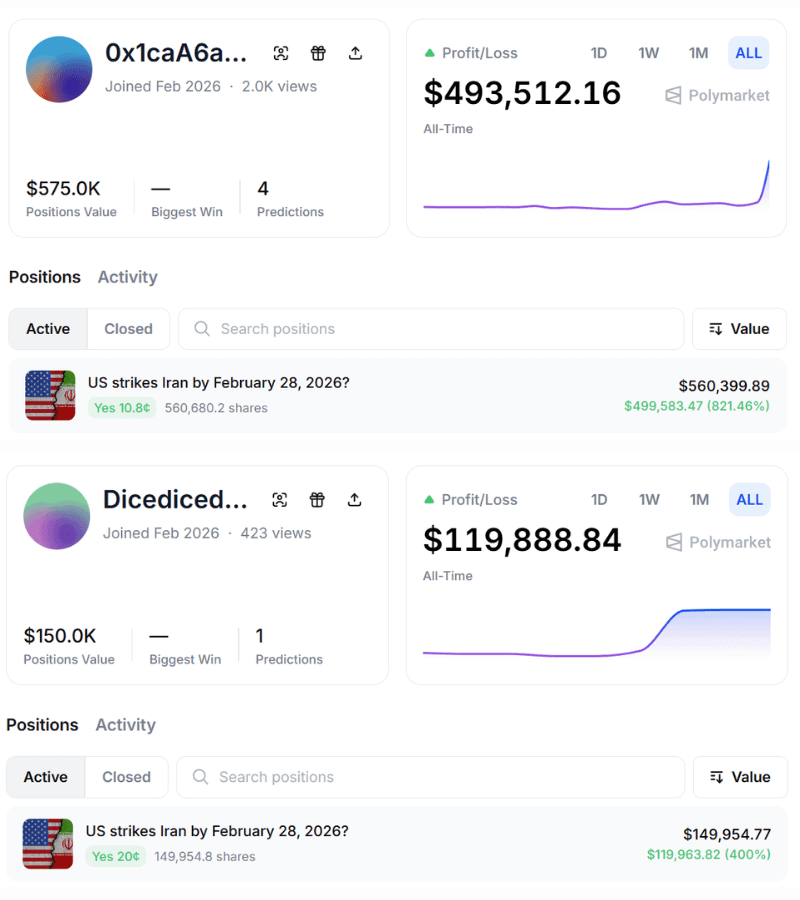
Image source: X/@bubblemaps Six mysterious wallets collectively bet that “the U.S. will attack Iran before February 28,” earning approximately $1.2 million.
These traders, suspected of possessing insider information, achieved astonishing profits. One wallet, created just three days prior, bought 560,000 shares of “Yes” at only 10.8 cents each, holding a large market share. The user invested about $61,000 and after contract settlement, cashed out over $493,000, yielding an 821% return. Another account, “Roeyha2026,” funded $50,000 eleven hours before the attack, betting that the U.S. would go to war before March 1, then quickly cashed out $97,000.
Bubblemaps CEO Nicolas Vaiman pointed out that information about wars or conflicts often circulates among high-level circles before becoming public. Polymarket’s anonymity allows anyone holding a wallet to participate, creating strong incentives for insider trading.
Further Reading
Trump confirms Khamenei’s death, crypto liquidations exceed $600 million, Iran may close the Strait of Hormuz?
Trading Volume Surpasses $500 Million, Prediction Markets Become Geopolitical Battleground
The U.S.-Iran conflict has driven prediction markets to historic trading heights. To date, Polymarket’s series of contracts related to “U.S. strikes on Iran” have surpassed $529 million in total trading volume, making it the platform’s second most popular topic after the 2024 U.S. presidential election. Just for the single date of February 28, bets on whether war will break out have exceeded $90 million.
During weekends when traditional markets are closed, prediction markets serve as the only outlet for investors to gauge geopolitical risks and price them in real time. Even as oil futures and U.S. stocks remain closed, crypto holders have already sketched war probability curves through real-money betting. According to platform rules, settlement conditions include physical strikes such as drones, missiles, or airstrikes; cyberattacks or defensive intercepts are not included. These strict rules have attracted significant professional capital.
Behind the high profits, some traders have suffered heavy losses due to misjudgments. A seasoned user with the account “anoin123” made over $2 million in the past two months by predicting a de-escalation, confidently betting that the U.S. would not launch an airstrike. However, after explosions in Tehran, their holdings worth millions instantly wiped out, with a single-day loss of $7.3 million, turning their overall profit into a loss of $5.3 million.
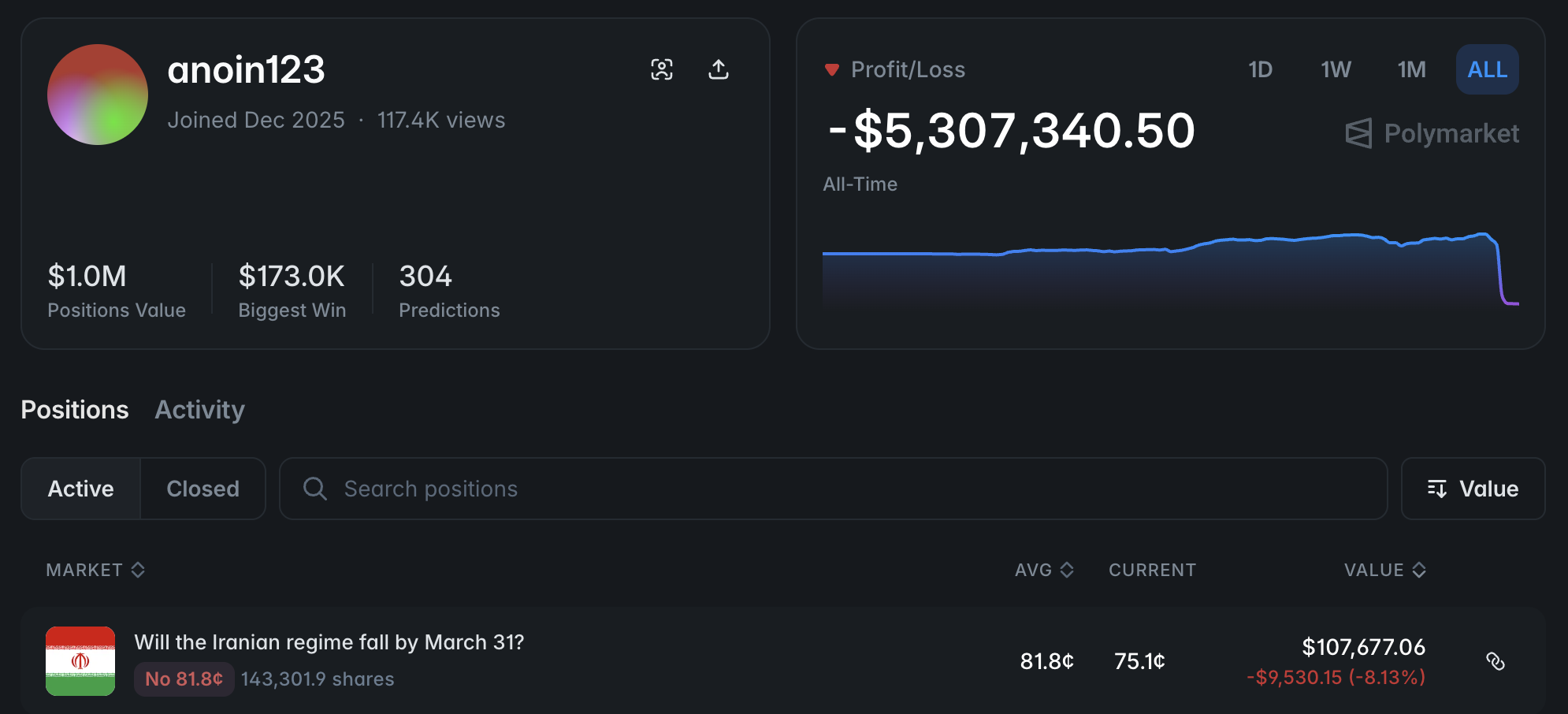
Image source: Polymarket A veteran user “anoin123” strongly bet that the U.S. would not launch an airstrike, ultimately losing $5.3 million.
Additionally, contracts about the death of Iran’s Supreme Leader Khamenei were quickly settled after Iranian state TV confirmed the news. The contract attracted $45 million in funds, with one user, “Curseaaaaaaa,” earning a single profit of $757,000. The market’s rapid response to extreme news has surpassed traditional media.
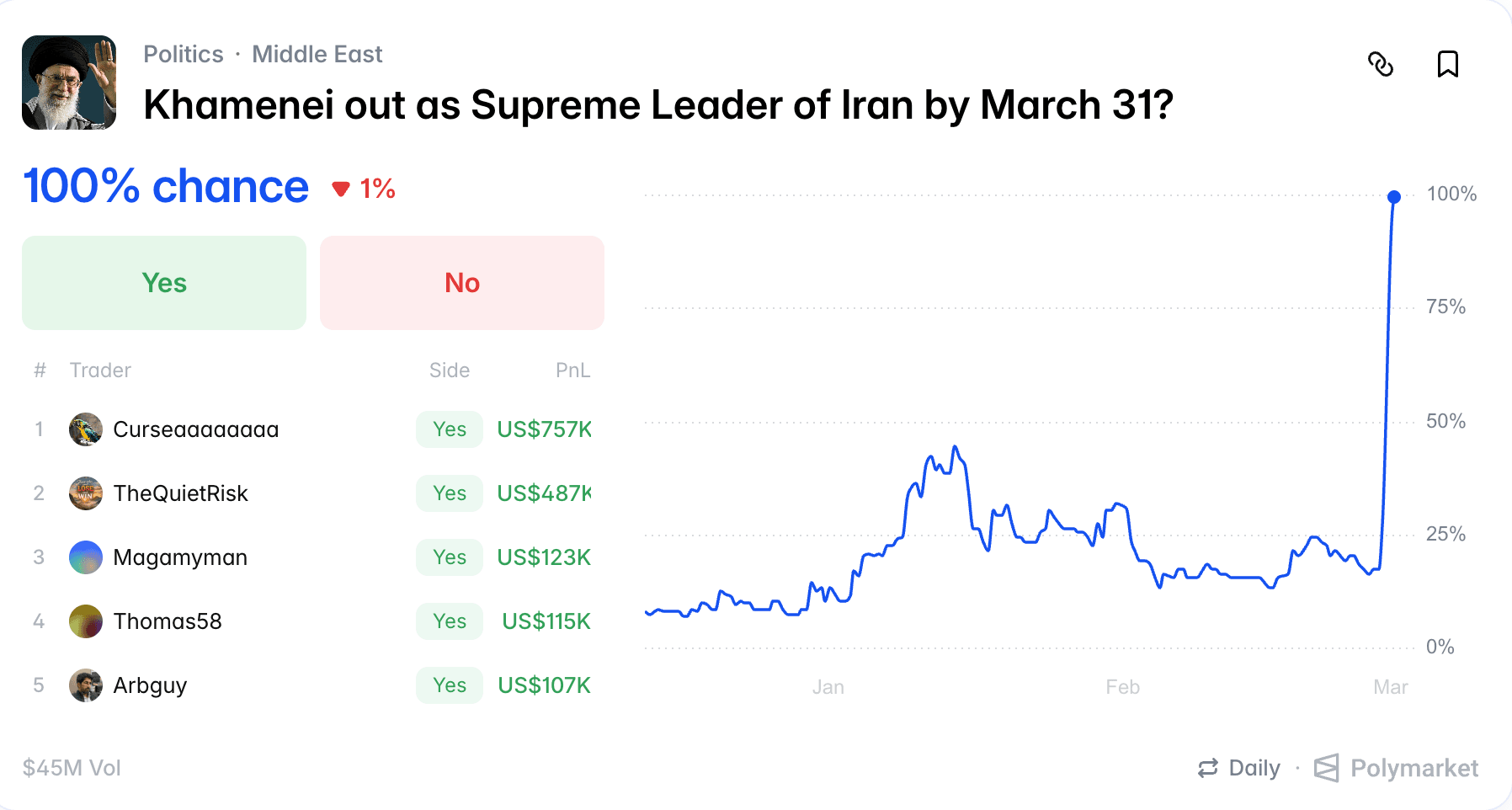
Image source: Polymarket Contracts about the death of Iran’s Supreme Leader Khamenei settled swiftly after confirmation by Iranian state TV.
Global Regulatory Storm, U.S. Lawmakers Propose Bans on Political Participation
Accurate predictions and profits have drawn the attention of regulators. U.S. Representative Ritchie Torres is pushing legislation called the “Public Integrity in Financial Prediction Markets Act of 2026.”
The bill aims to prohibit elected officials, government appointees, and federal employees from participating in any prediction contracts related to political or governmental decisions if they possess nonpublic policy or military intelligence. Regulators worry that insider trading by officials could severely undermine public trust in government integrity. Prediction markets are no longer niche activities of fringe players; their influence can impact political and economic judgments.
Further Reading
Prevent insider trading! 30 U.S. lawmakers push new law banning officials from political prediction markets
Meanwhile, Polymarket faces survival challenges internationally. Countries including the Netherlands, France, Italy, Singapore, Portugal, and Poland have classified these event-driven prediction contracts as “unauthorized online gambling” and have begun blocking access.
The compliant platform Kalshi has adopted a different approach. Its CEO Tarek Mansour publicly distanced the platform from such controversies on social media, emphasizing that markets regulated by the U.S. CFTC are strictly prohibited from listing war-related contracts. He criticized unregulated offshore platforms operating on the legal edge. As trading volumes reach tens of billions, the question remains whether prediction markets are tools for financial forecasting or loopholes for regulatory evasion—an urgent issue for governments worldwide.
The True Test of Truth or Ethical Loophole? The Dual Nature of Prediction Markets
In response to insider suspicion, Polymarket CEO Shayne Coplan remains firm.
He describes prediction markets as the most accurate “crystal ball” humanity has created, with their precision stemming from participants risking real money for their judgments.
He believes that for people on the front lines of conflict, on-chain capital flows are often more reliable than chaotic social rumors. However, when war and human lives are quantified into tradable binary code, and anonymity protects those who might hold the trigger for devastating weapons, technological progress clashes with ethics.
The investigation into these six wallets is ongoing. While Bubblemaps provides capital maps and behavioral analysis, due to the anonymous nature of decentralized wallets, it is difficult to link these accounts to specific government or military personnel unless verified through centralized exchanges’ KYC data.
Similar insider-like incidents have occurred recently, including predictions about the arrest of Venezuelan President Nicolás Maduro, where a trader profited $400,000 before the announcement. The future of prediction markets depends on balancing collective intelligence with preventing insider exploitation.
Further Reading
Venezuelan president arrested! Polymarket users predicted it 40K profit before announcement, U.S. Congress responds
Related Articles
On-chain tracking of Polymarket's Khamenei market insider: 521 addresses precisely lurking, with a few entities targeting with precision
Polymarket: The probability that OPN's FDV surpasses $500 million one day after launch is approximately 67%
Forecast market bets that the amount wagered on Khamenei's assassination reaching death exceeds $500 million, and U.S. senators are calling for restrictions on related contracts.
Kalshi "Iran Leader Resignation" $50 Million Prediction Contract Settles Controversy! CEO: Rejecting Death Arbitrage