


The stock market soars, while crypto heats up slowly? Koreans' all-in bets have never cooled down
Author: Zen, PANews
When it comes to crazy investing, Koreans are serious. The historic surge in the Korean stock market that began in the first half of last year has once again proven this point.
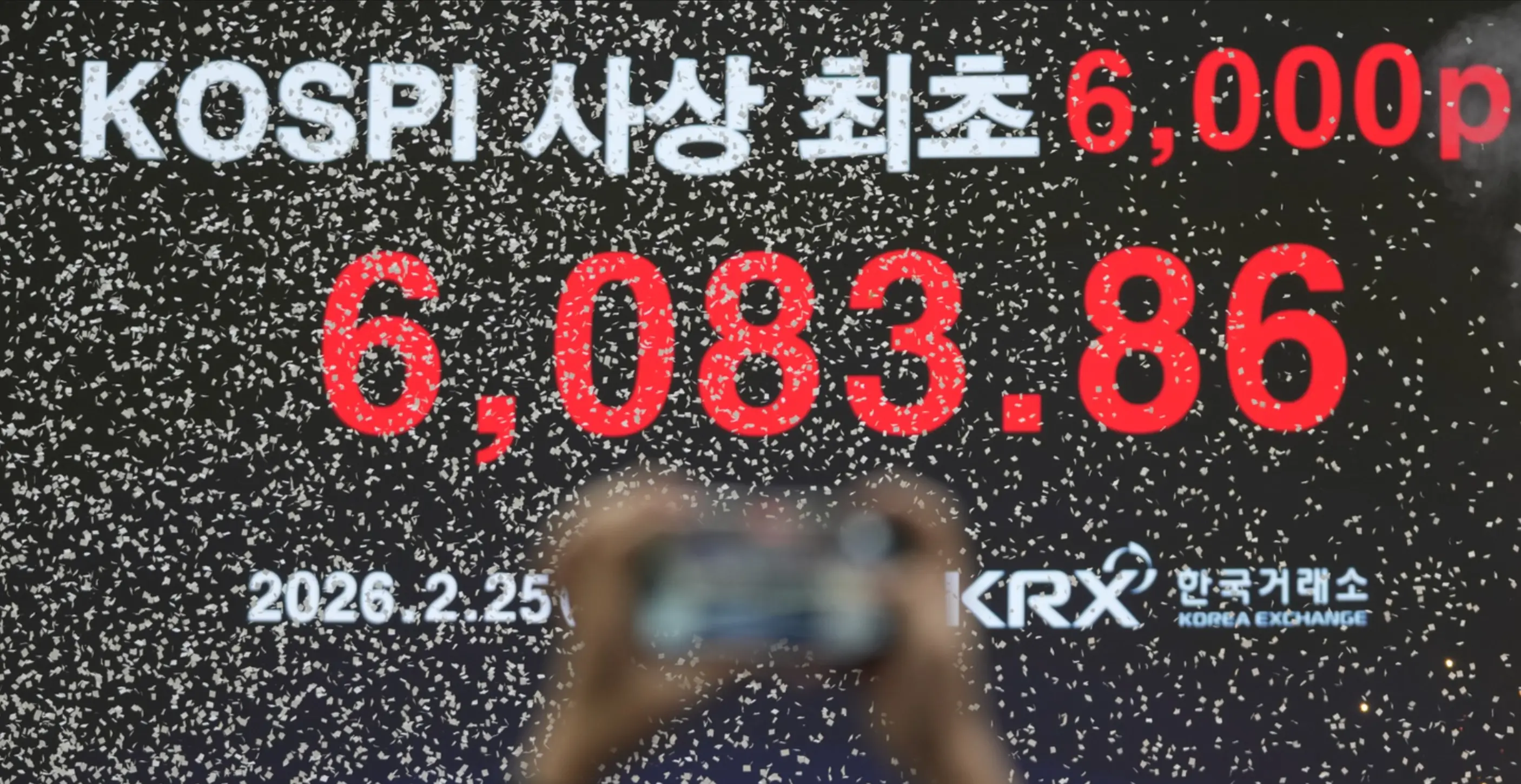
As of the end of February 2026, the Korea Composite Stock Price Index (KOSPI) has risen nearly 50% this year, making it one of the best-performing markets globally.
On February 25, the KOSPI broke through 6,000 points for the first time during trading; the next day, it closed above 6,300 points for the first time, with 10 out of the past 11 trading days recording gains, continuously hitting new highs. On February 28, Samsung Electronics’ market capitalization surpassed $1 trillion, becoming the first Korean company to join the “trillion-dollar club.”
As CryptoQuant founder said: “We Koreans love gambling. Don’t underestimate this country.”
Market Reforms: An Unmissable Catalyst
The takeoff of the Korean stock market is the result of a series of government reforms resonating with global industry dividends.
On January 22, South Korean President Lee Jae-myung had lunch with members of the Korea Democratic Party’s “KOSPI 5000 Special Committee.” Coincidentally, before the lunch, the KOSPI index first broke through 5,000 points during trading. Achieving the “KOSPI 5000 era” has been a long-standing goal emphasized repeatedly by Lee Jae-myung when he was a presidential candidate. Now, that vow has been fulfilled—and even surpassed expectations.
In less than a year, the Korean stock market has risen from 2,300 in April last year to over 6,200 now. Perhaps Lee Jae-myung didn’t expect the market to go so wild, completing in months what took other countries years or decades.
This surge may still be far from over, as strong upward momentum continues to push the KOSPI to new heights. Earlier this month, JPMorgan Chase and Nomura Securities both raised their target levels for Korea’s composite index. JPM predicts the KOSPI will reach 7,500 this year, while Nomura expects it to hit 8,000 in the first half of 2026.
Behind Korea’s strong and crazy stock market, there’s no doubt that the global AI boom has played a significant role. The “arms race” among tech giants in AI has driven up the prices and strategic importance of key storage chips like DRAM and NAND, as well as high-bandwidth memory (HBM). In this context, major storage chip manufacturers Samsung Electronics and SK Hynix, along with high-bandwidth storage supplier NVIDIA, have all seen gains of over 60%.
If the fundamental demand for AI business supports the stock market rally, then government-led reforms are the actual catalyst propelling the surge.
The real structural change in Korea’s stock market is the government targeting the long-standing “Korea Discount” as a policy focus. Through reforms in corporate governance, shareholder returns, market systems, and trading infrastructure, Korea aims to attract foreign and long-term investors willing to assign higher valuation multiples.
Since taking office in June last year, Lee Jae-myung’s government has pushed a more aggressive set of capital market reforms:
- Expanding the scope of fiduciary duty for boards of directors to strengthen accountability to shareholders and capital efficiency;
- Proposing adjustments to dividend-related tax policies to incentivize listed companies to increase dividends and improve shareholder returns;
- Increasing enforcement resources and regulatory tools to crack down on insider trading, market manipulation, and other violations, and unveiling a roadmap for MSCI developed market inclusion.

Before Lee Jae-myung took office, Korea had already initiated trading system reforms in March last year. The country launched its first alternative trading system, Nextrade (NXT), extending stock trading hours from 8:00 to 20:00 (including pre-market and after-hours), with lower fees and longer trading times to attract participants. At the same time, Korea ended its longest-ever short-selling ban, emphasizing systemic reforms and stricter enforcement to improve market transparency and price discovery—an important factor for foreign investors seeking “predictable market rules.”
Putting these factors together, Korea’s market boom is not just riding the AI wave but also driven by a series of policy reforms. To some extent, industry narratives raise profit expectations, while institutional reforms push up valuation ceilings.
The rise of KOSPI is not merely an AI-themed rally; behind it is also a major government hand leading institutional reforms and value reappraisal.
Slow Progress of Korea’s New Cryptocurrency Policies
Compared to the rapid surge in the stock market, new crypto policies appear more cautious, even somewhat slow.
As an extension of the “Korea Discount” and market re-pricing plans, Korea’s approach to crypto regulation is evolving. It has shifted from early passive oversight focused on fraud and AML to a systemic approach aimed at protecting users, regulating markets, and institutionalizing the industry.
In terms of exchanges and market order, the “Virtual Asset User Protection Act,” which took effect in July 2024, clearly mandates virtual asset service providers to securely custody user deposits and assets, establish stricter custody and management obligations, and provides a legal basis for punishing unfair trading behaviors like insider trading and price manipulation. This aligns with the transparency and accountability goals seen in stock market reforms.
Last year, Korea’s Financial Services Commission (FSC) outlined plans to introduce spot ETFs for virtual assets and develop stablecoin regulation frameworks in a policy briefing to the National Policy Planning Committee. Korea’s crypto reforms do not mean a short-term full embrace of digital assets; rather, they feature layered openness, cautious progression, and even some delay.
In February 2025, FSC announced a regulatory roadmap, planning to allow about 3,500 listed companies and licensed investors to trade virtual assets starting in the second half of 2024. However, according to Seoul Economic Daily, the draft “Listed Company Virtual Asset Trading Guidelines” was only communicated and finalized in January this year, with official implementation likely to be more broadly scheduled within this year. The gap between announcement and execution reflects Korea’s gradual regulatory approach and slow implementation pace.
Regarding crypto ETFs, Korea’s stance has historically been conservative. After the U.S. approved a Bitcoin spot ETF in January 2024, Korean authorities stated they would not evaluate the need to follow suit in the short term. However, over the past year, Korea has shifted from principled rejection to cautious acceptance. The government’s 2026 economic growth plan mentions establishing a comprehensive regulatory framework for issuance, circulation, and trading of digital assets via the “Basic Law on Digital Assets,” with plans to introduce spot ETFs and stablecoin regulation.
Discussions around the Korean won stablecoin have been heated in recent months, but authorities remain cautious, and no concrete results have emerged. The biggest challenge is the issuer of the stablecoin. The banking sector, represented by the Bank of Korea, emphasizes that without bank involvement, KYC/AML compliance may be inadequate and could impact Korea’s capital openness and financial stability.
While policy directions are loosening and legislative frameworks are being drafted, actual implementation at the regulatory and participant levels remains slow. This is the true picture of Korea’s crypto market. Overall, Korea’s approach to both capital markets and digital assets follows a similar phased process: first clarifying responsibility boundaries, disclosure, and enforcement tools, then gradually expanding participation and funding through phased entry and productization.
Passion, Resilience, and Wealth Aspiration of Koreans
Since mid-last year, as Korean investors flooded into the stock market, mainstream media and social media have occasionally portrayed a pessimistic view that “Koreans are no longer trading crypto.”
These reports and claims are partly supported by FSC data—by mid-2025, the average daily trading volume of Korea’s top five exchanges was about 6.4 trillion won, down roughly 12% month-over-month; according to data submitted to the National Assembly by the Financial Supervisory Service, total crypto trading volume in Korea last year fell about 11%. This indicates a genuine decline in activity in Korea’s crypto market.
However, when compared to global trading volumes, the situation is more complex. The global crypto market has entered a winter phase, and the contraction is not limited to Korea.
On the contrary, amid the global crypto winter, Korea’s market resilience remains impressive.
CryptoQuant data shows that after peaking in Q4 2024, Korea’s share of the global crypto market has remained steady between 8% and 11% since 2025. In recent months of negative sentiment and liquidity drought, Korea’s market share surprisingly even slightly increased.
Another sign of resilience is the continuous growth in the number of Korean crypto users. FSS reports show that the number of crypto trading accounts increased from 8.91 million in 2024 to 9.91 million last year. Despite the decline in total trading volume, the number of participants and market penetration are still rising, indicating a solid market foundation.
Stock markets and crypto markets have never been a zero-sum game.
In Korea, whether it’s the KOSPI surpassing 6,000 points or the millions of crypto investors, both reflect the same social mindset: in a highly competitive, increasingly stratified society, ordinary people have an intense desire to break barriers and achieve wealth jumps.
The “Korea Discount” aims to eliminate valuation gaps in the capital market, while Koreans’ relentless investment enthusiasm is driven by a desire to erase the “discount” on their own destiny. As stock market dividends are being realized, nearly ten million Koreans still hopeful about crypto are patiently waiting for another “KOSPI 5000 era” in digital assets.
Related Articles
Hyperliquid's active retail investor count has significantly increased, with a preference for high-leverage trading.
Cryptocurrencies in Picture as JPMorgan Trims Non-Oil Growth for Gulf Economies
Crypto Markets Hold Ground Amid Rising Iran Tensions
Solana Drops to $78 as Bulls Guard $75 Support
The CLARITY Act is expected to pass by mid-year! JPMorgan: "8 Major Bullish Factors" ignite the cryptocurrency market in the second half of the year
Tokenized Gold Dominates Public Price Discovery Over Weekends