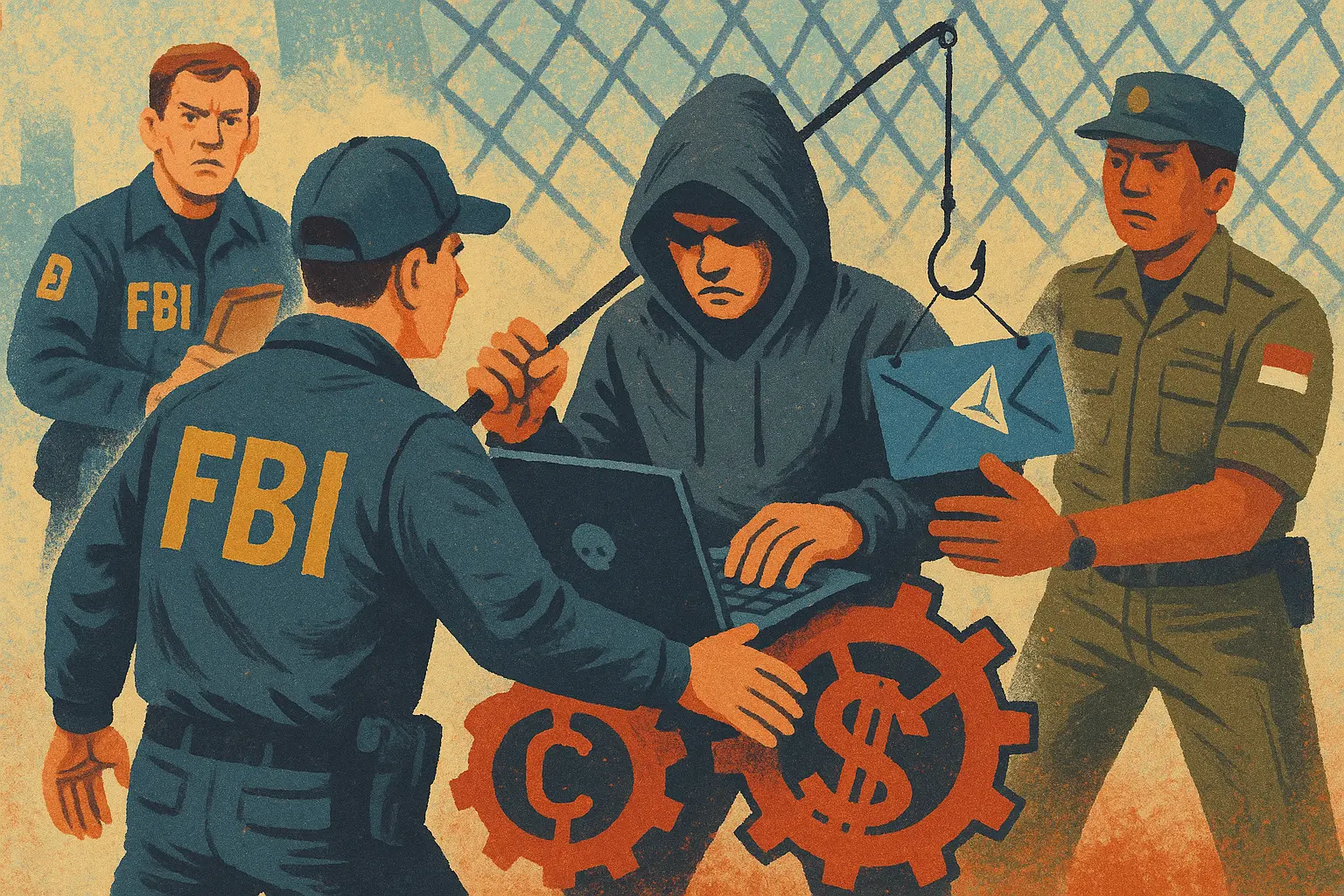
The Federal Bureau of Investigation (FBI) Atlanta Field Office and Indonesia’s National Police jointly announced on April 14 that they successfully dismantled the W3LL phishing network infrastructure, seized key technical equipment directly linked to fraud totaling more than $20 million, and detained the suspected developer GL. This operation was supported by judicial assistance from the Office of the U.S. Attorney for the Northern District of Georgia, and marks the first joint crackdown by law enforcement agencies from the two countries against a hacker platform.
How the W3LL phishing network works: a criminal tool from $500 and up
The core design of the W3LL phishing toolkit is to create nearly indistinguishable fake login pages that prompt victims to voluntarily enter account credentials. Attackers can purchase tool usage rights for as little as about $500 through the underground market W3LLSTORE, allowing it to spread rapidly within criminal circles. It has accumulated roughly 500 threat actors actively using it, forming a highly organized ecosystem of cybercrime.
However, the most destructive feature of the W3LL phishing network is its man-in-the-middle (AiTM) attack technology. Attackers can intercept the victim’s login session in real time and simultaneously steal authentication tokens at the exact moment the user enters their username and password. This means that even if the account has multi-factor authentication protections enabled, the attacker can hijack the already-verified session the instant verification completes, rendering MFA protection effectively useless.
Crime scale and the trail of evolution
The history of the W3LL phishing network spans multiple years, showing a clear evolution path aimed at resisting law enforcement:
2019–2023: The W3LLSTORE underground market was active, enabling the circulation of transactions involving more than 25,000 stolen credentials
After the market was shut down: Operators shifted to encrypted communication apps, continuing to distribute re-packaged tools to evade law enforcement tracking
2023–2024: Toolkit packages caused more than 17,000 victims worldwide
April 14, 2026: The U.S.-Indonesia joint action successfully seized the infrastructure, and the developer GL was taken into custody
The entire criminal ecosystem is highly organized, from tool development and market sales to actual attack execution, forming a complete cybercrime supply chain.
U.S.-Indonesia security cooperation: a new arena for coordinated crackdowns on cybercrime
The timing of this joint seizure operation carries diplomatic significance. On April 13, the United States and Indonesia formally announced the establishment of a major defense partner relationship, with a framework covering military modernization, professional education, and joint exercises in the Indo-Pacific region. The seizure operation targeting the W3LL phishing network shows that bilateral security cooperation has officially expanded into the domain of cybercrime law enforcement.
Of particular note is that phishing threats against cryptocurrency holders are still escalating. In January 2026, in a single month alone, cryptocurrency investors lost more than $300 million due to phishing attacks, indicating that even though this W3LL phishing network crackdown has achieved results, the overall threat environment remains far from optimistic.
Frequently asked questions
Why can the W3LL phishing toolkit spread widely within the cybercrime community?
The rapid adoption of the W3LL toolkit comes down to two main factors: the extremely low entry cost of $500, and the ability of other tools to rarely bypass multi-factor authentication. The combination of a low barrier and high effectiveness makes it a preferred attack tool for organized cybercrime groups, forming a stable sales and supply chain in the underground market.
How is multi-factor authentication (MFA) bypassed by the W3LL toolkit?
The W3LL toolkit uses man-in-the-middle (AiTM) attack technology to immediately hijack the already-verified login session and authentication tokens the moment the victim completes MFA verification. This allows attackers to log into the target account as the victim without needing to know the second factor, causing traditional MFA protection mechanisms to fail.
How can cryptocurrency users effectively defend against this kind of advanced phishing network attack?
Key defensive measures include: using hardware security keys (such as YubiKey) instead of SMS or app-based OTPs as the multi-factor authentication method— the former can effectively resist AiTM attacks; carefully verifying the authenticity of the domain name before visiting any platform; and avoiding clicking login links in emails or messages from unknown sources.
Disclaimer: The information on this page may come from third parties and does not represent the views or opinions of Gate. The content displayed on this page is for reference only and does not constitute any financial, investment, or legal advice. Gate does not guarantee the accuracy or completeness of the information and shall not be liable for any losses arising from the use of this information. Virtual asset investments carry high risks and are subject to significant price volatility. You may lose all of your invested principal. Please fully understand the relevant risks and make prudent decisions based on your own financial situation and risk tolerance. For details, please refer to
Disclaimer.
Related Articles
Brazil Bans Polymarket, Kalshi in Prediction Market Crackdown
Brazil has enacted a sweeping ban on prediction markets and betting platforms, including the two leading platforms Polymarket and Kalshi, according to local media and government filings. The Banco Central do Brasil issued a resolution prohibiting the platforms due to non-compliance with local
CryptoFrontier1h ago
Polish Crypto Exchange Zondacrypto CEO Flees to Israel as $97M Fraud Probe Deepens
Polish prosecutors have opened a fraud investigation into cryptocurrency exchange Zondacrypto after chief executive Przemysław Kral departed for Israel, where his citizenship could prevent extradition, leaving up to 30,000 users facing losses tied to an inaccessible cold wallet holding 4,500
Coinpedia3h ago
Litecoin Reorg Undoes MWEB Privacy Layer Exploit
Litecoin underwent a deep chain reorganization on Saturday after attackers exploited a zero-day vulnerability in its MimbleWimble Extension Block (MWEB) privacy layer, according to the Litecoin Foundation. The incident resulted in a three-hour reorg that erased invalid transactions from the
CryptoFrontier4h ago
US Sanctions Iran-Linked Crypto Wallets Holding $344M Frozen by Tether
U.S. Treasury Secretary Scott Bessent announced sanctions on multiple wallets linked to Iran as part of President Donald Trump's efforts to increase economic pressure on the country, according to CNN. The move follows Tether's freeze of $344 million in USDT on Tron, which has been linked to
CryptoFrontier4h ago
CFTC Sues New York as 38 AGs Back Kalshi Prediction Market Ban
New York Attorney General Letitia James joined a bipartisan coalition of 37 other attorneys general and the District of Columbia on Friday in urging Massachusetts' top court to uphold a preliminary injunction against prediction market platform Kalshi, while the U.S. Commodity Futures Trading Commiss
CryptoFrontier5h ago
CFTC sues New York State: Defend the federal exclusive jurisdiction over prediction markets
CFTC4/24 filed a lawsuit against the State of New York in the U.S. Federal Court for the Southern District of New York, arguing that the event contracts are subject to federal exclusive jurisdiction, and seeking a permanent injunction to stop state law from interfering with CFTC-registered entities. The core issue is field preemption; if they win, Polymarket, Kalshi, and others in the U.S. will have compliance and market positioning dominated by the federal framework, and the influence of state law will be weakened.
ChainNewsAbmedia6h ago


