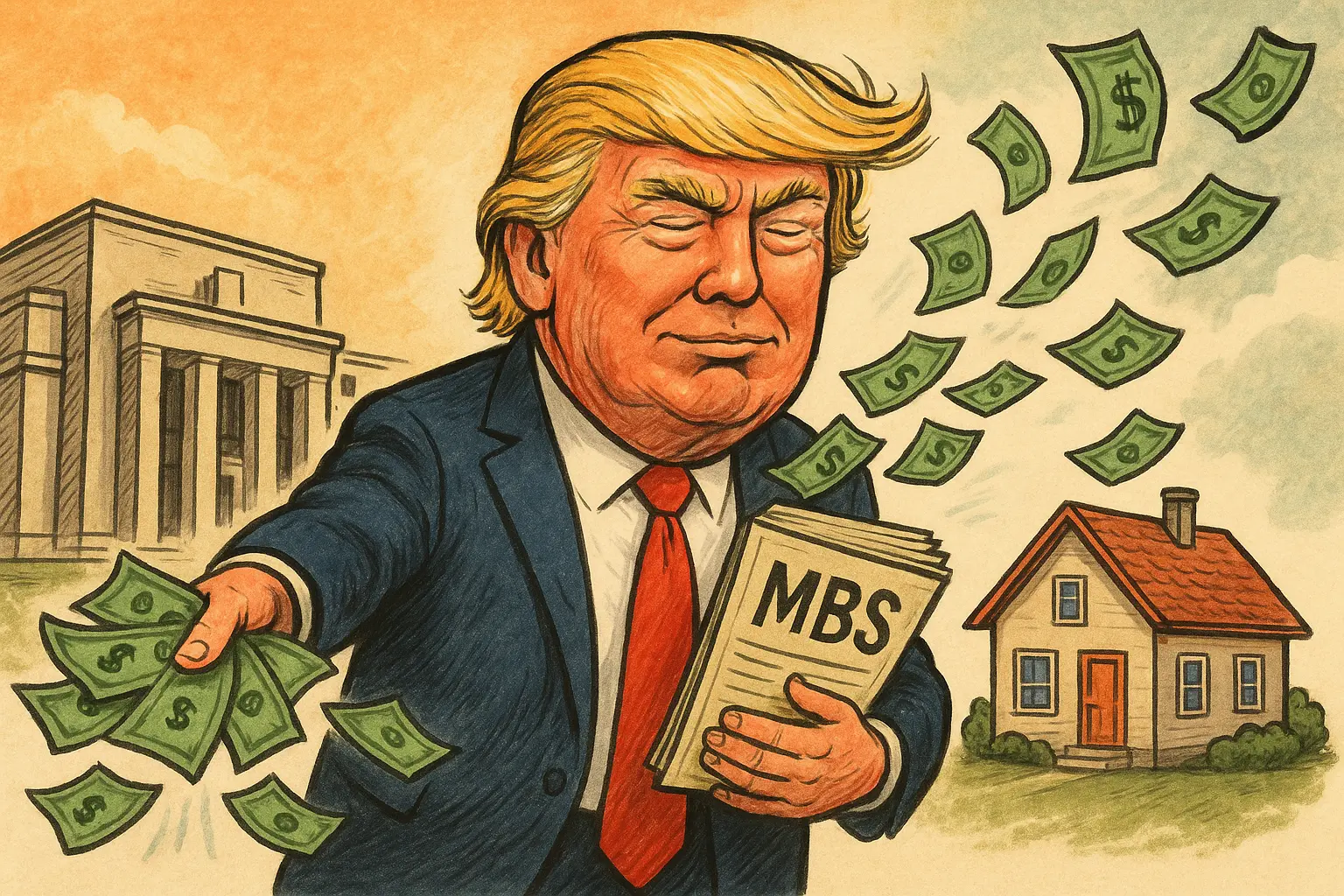
Trump announces $200 billion mortgage bond purchase plan, with Fannie Mae and Freddie Mac each buying $100 billion, without congressional approval. Aims to lower mortgage rates to 6.16%. Similar to 2008 QE but led by president rather than central bank. Housing crisis heavily damaged approval ratings, Fed cut rates by 75 basis points, yet mortgage rates remain elevated.
Operating Mechanism and Power Boundaries of Trump’s Version of QE
Trump posted on “Truth Social” stating he is “directing relevant representatives to purchase $200 billion worth of mortgage bonds”. “This move will push mortgage rates down, reduce monthly payments, thereby increasing people’s home-buying capacity,” Trump wrote. “This is one of several measures I am rolling out to restore housing affordability, which is precisely what the Biden administration destroyed.”
He added that during his first term he decided not to sell Fannie Mae and Freddie Mac, allowing these two institutions to accumulate “$200 billion in cash,” and he announced this decision precisely “based on this reason.” This statement reveals Trump’s forward-thinking layout—preserving the two entities during 2017-2021 left ammunition for current policy operations.
Bill Pulte, director of the U.S. Housing Finance Agency, told the Financial Times that this bond purchase will be executed jointly by Fannie Mae and Freddie Mac. These government-sponsored enterprises’ core function is to acquire mortgages from lending institutions and repackage them as mortgage-backed securities. “We will fully leverage Fannie Mae’s strength to reverse the damage caused by former President Biden over the past four years, with specific measures including but not limited to strategic, large-scale purchases of mortgage bonds,” Pulte said. He added that this measure does not require congressional approval.
Under existing agreements between Fannie Mae, Freddie Mac, and the U.S. Treasury Department, mortgage investments held by these two companies (each) cannot exceed $225 billion. As of November 2025, both companies hold approximately $124 billion each in these investment portfolios, meaning they can each purchase an additional $100 billion in mortgage-backed securities. This figure exactly aligns with Trump’s announced $200 billion plan, showing this is the maximum scale executable within existing regulatory frameworks.
Three Major Differences Between Trump’s QE and Fed QE
Decision-making body differs: Trump directs the two entities through executive order, Fed QE decided independently by FOMC
Funding source differs: The two entities use their own cash, Fed QE prints money from thin air to purchase assets
Single target asset: Only purchases mortgage bonds, Fed QE also includes Treasury bonds and corporate debt
Political motivation apparent: Directly responds to housing crisis to boost approval ratings, Fed emphasizes policy independence
The Stubbornness of 6.16% Mortgage Rates and Policy Dilemma
Despite multiple Federal Reserve rate cuts, the currently most popular 30-year fixed-rate mortgage average rate remains as high as 6.16%. The Fed lowered the federal funds rate target range by 75 basis points last year, bringing short-term rates to the 3.5-3.75% range. This “short-end down, long-end stable” phenomenon reflects market concerns about persistent inflation and fiscal deficits.
Mortgage rates typically correlate with 10-year Treasury yields rather than directly with the federal funds rate. When markets expect long-term inflation pressure or continued government debt expansion, 10-year Treasury yields remain elevated, and mortgage rates follow suit. This explains why a 75 basis point Fed rate cut resulted in only a marginal mortgage rate decline from 7% to 6.16%, far less than expected.
Trump previously pressured the Federal Reserve for significant rate cuts to stimulate the economy and reduce borrowers’ costs. But the Fed emphasizes policy independence and refuses to bow to political pressure. This stalemate prompted Trump to seek alternatives, directly purchasing mortgage bonds through the two entities, bypassing the Fed to achieve the goal of lowering mortgage rates.
His large-scale bond purchase plan proposed this time mirrors the Fed’s policy measures following the 2008 financial crisis. At that time, Fed policymakers purchased bonds issued by Fannie Mae and Freddie Mac to fortify the financial system and stimulate economic recovery. However, the key difference is that 2008 QE was an emergency measure responding to financial system collapse, while 2026 Trump QE is an active intervention when the financial system is stable, to lower mortgage rates and boost political support.
Housing Crisis and Trump’s Political Calculation on Approval Ratings
Since the pandemic, prices of various necessities have surged significantly, with many Americans stating they struggle to maintain a decent standard of living, leading to criticism of Trump. It’s worth noting that this American president previously claimed the housing affordability crisis was a “hoax.” But facts prove that housing cost pressures, including elevated mortgage rates, have become one of the most pressing challenges facing American lawmakers.
This policy shift reflects political pressure Trump faces. The 2026 midterm elections are approaching, and housing affordability directly influences middle-class voters’ voting intentions. If mortgage rates can drop below 5% before the elections, it would significantly boost Trump and Republicans’ electoral prospects. This political calculation makes the $200 billion QE look more like an electoral strategy than economic policy.
From a market perspective, $200 billion in mortgage bond purchases will drive bond prices up and yields down, thereby lowering mortgage rates. But this artificial intervention may distort market price signals, and if inflation resurfaces, the Fed will be forced to raise rates again, offsetting Trump’s QE effects. This policy contradiction may emerge in the second half of 2026.
Overall, Trump’s personal QE marks direct intervention of executive power in monetary policy. Though the $200 billion scale doesn’t match the Fed’s historical QE, it sets a precedent for presidents bypassing central banks to implement QE-like policies. The long-term impacts on Fed independence and market confidence warrant attention.
Tuyên bố miễn trừ trách nhiệm: Thông tin trên trang này có thể đến từ bên thứ ba và không đại diện cho quan điểm hoặc ý kiến của Gate. Nội dung hiển thị trên trang này chỉ mang tính chất tham khảo và không cấu thành bất kỳ lời khuyên tài chính, đầu tư hoặc pháp lý nào. Gate không đảm bảo tính chính xác hoặc đầy đủ của thông tin và sẽ không chịu trách nhiệm cho bất kỳ tổn thất nào phát sinh từ việc sử dụng thông tin này. Đầu tư vào tài sản ảo tiềm ẩn rủi ro cao và chịu biến động giá đáng kể. Bạn có thể mất toàn bộ vốn đầu tư. Vui lòng hiểu rõ các rủi ro liên quan và đưa ra quyết định thận trọng dựa trên tình hình tài chính và khả năng chấp nhận rủi ro của riêng bạn. Để biết thêm chi tiết, vui lòng tham khảo
Tuyên bố miễn trừ trách nhiệm.
Bài viết liên quan
Giá dầu tăng vọt, kỳ vọng hạ lãi suất đột nhiên nguội đi! Circle hưởng lợi, vượt mục tiêu giá 100 USD
Gã khổng lồ stablecoin của Mỹ Circle gần đây đã tăng gần 8% do giá dầu tăng vọt và kỳ vọng giảm lãi suất đột ngột giảm nhiệt, lập đỉnh mới trong 4 tháng. Morgan Stanley đã nâng mục tiêu giá của công ty lên 100 USD, mặc dù vẫn duy trì xếp hạng "trung lập", nhưng lạc quan hơn về triển vọng lợi nhuận. Các nhà phân tích cho rằng, nếu Cục Dự trữ Liên bang duy trì lãi suất cao, doanh thu của Circle sẽ hưởng lợi, nhưng cạnh tranh thị trường và áp lực từ quy định vẫn cần cảnh giác.
区块客3giờ trước
Trump buộc bảy tập đoàn công nghệ lớn ký "Chịu trách nhiệm chi phí tăng giá điện"!Trung tâm dữ liệu AI tiêu thụ 12% điện năng của toàn Mỹ, cử tri nổi giận trở thành động lực thúc đẩy
Trong bài phát biểu về tình hình quốc gia, Trump đã công bố "Cam kết bảo vệ phí", yêu cầu bảy tập đoàn công nghệ lớn tự chịu chi phí điện năng cho các trung tâm dữ liệu, nhằm giảm bớt sự bất mãn của cử tri do giá điện tăng cao. Tuy nhiên, cam kết này thiếu tính pháp lý ràng buộc, cơ chế thực thi không rõ ràng, khiến tính hiệu quả của nó bị nghi ngờ. Nhu cầu điện năng của các trung tâm dữ liệu có thể khiến tiêu thụ điện toàn nước Mỹ tăng lên 12%, trở thành tâm điểm chính trị.
動區BlockTempo8giờ trước
Gate ngày báo (5 tháng 3): Zerohash nộp đơn xin giấy phép ngân hàng ủy thác tại Mỹ; Paradex khởi động airdrop thế hệ đầu tiên
Bitcoin đã phục hồi lên 72,980 USD vào ngày 5 tháng 3. Zerohash đã nộp đơn xin giấy phép ngân hàng ủy thác quốc gia, dự kiến cung cấp tài sản kỹ thuật số và các dịch vụ khác. Paradex đã khởi động airdrop sơ khai và điều chỉnh mô hình kinh tế token. Ngoài ra, thị trường chứng khoán Mỹ tăng trưởng nhờ dữ liệu kinh tế hỗ trợ, tâm lý thị trường tích cực, nhà đầu tư kỳ vọng tích cực vào tương lai của Bitcoin.
MarketWhisper10giờ trước
Tại sao Bitcoin hôm nay lại tăng giá? Iran phát đi tín hiệu đàm phán, Trump công bố bảo hiểm thương mại năng lượng trên biển
Bitcoin đã vượt mốc 72.000 USD vào ngày 5 tháng 3, được thúc đẩy bởi ba yếu tố vĩ mô chính: tiếp xúc ngoại giao giữa Iran và CIA Mỹ, các quan chức Cục Dự trữ Liên bang ủng hộ giảm lãi suất, cam kết bảo vệ các tàu chở dầu của Mỹ nhằm giảm thiểu rủi ro cung cấp năng lượng. Dữ liệu kinh tế mạnh mẽ càng hỗ trợ tâm lý rủi ro của thị trường.
MarketWhisper11giờ trước
Nhà phân tích Wintermute: Vốn đã bắt đầu chuyển hướng theo giai đoạn sang tài sản mã hóa, BTC vượt trội hơn thị trường chứng khoán Mỹ có thể do dòng vốn luân chuyển
Nhà phân tích Wintermute Jasper De Maere chỉ ra rằng, trong hai tháng gần đây, hiệu suất của tài sản mã hóa kém hơn so với các loại tài sản khác, nhưng trong bối cảnh thị trường hiện tại, tài sản số có thể có lợi thế nhờ tính tương đối độc lập với các yếu tố vĩ mô. Ông cảnh báo rằng, hiệu suất trong tương lai có thể yếu đi do áp lực lạm phát gây ra bởi căng thẳng địa chính trị, thị trường trong ngắn hạn vẫn sẽ có biến động cao.
GateNews20giờ trước
70% tài sản đặt cược vào Bitcoin! Tỷ phú Mexico kêu gọi "mua nhanh khi giảm giá", và cha giàu cũng tăng thêm khoản đầu tư
Tỷ phú Mexico Ricardo Salinas Pliego đặt cược lớn vào Bitcoin, cho rằng nó có thể phòng chống lạm phát và tượng trưng cho tự do cá nhân.清崎 cảnh báo sắp xảy ra sụp đổ thị trường chứng khoán, tiếp tục tăng cường mua Bitcoin và kim loại quý, không giảm niềm tin. Họ đều cho rằng Bitcoin có tiềm năng giá trị dài hạn, mức giá hiện tại giảm là cơ hội mua vào tốt.
区块客21giờ trước


