


Fed rate cut expected in December! Stopping QT activates $8 trillion in liquidity, Bitcoin aims for $100,000 by year-end
Whether Bitcoin can reach $100,000 before New Year’s Eve depends on how investors react to the Fed’s policy shift and how the market responds to the soaring debt levels of major tech and AI companies. The Fed officially ended its quantitative tightening policy on December 1, and a rate cut is locked in for this week. U.S. money market funds have reached a record $8 trillion, and rising tech credit risks may drive capital flows into scarce assets like Bitcoin.
Fed Ends QT: Liquidity Inflection Point
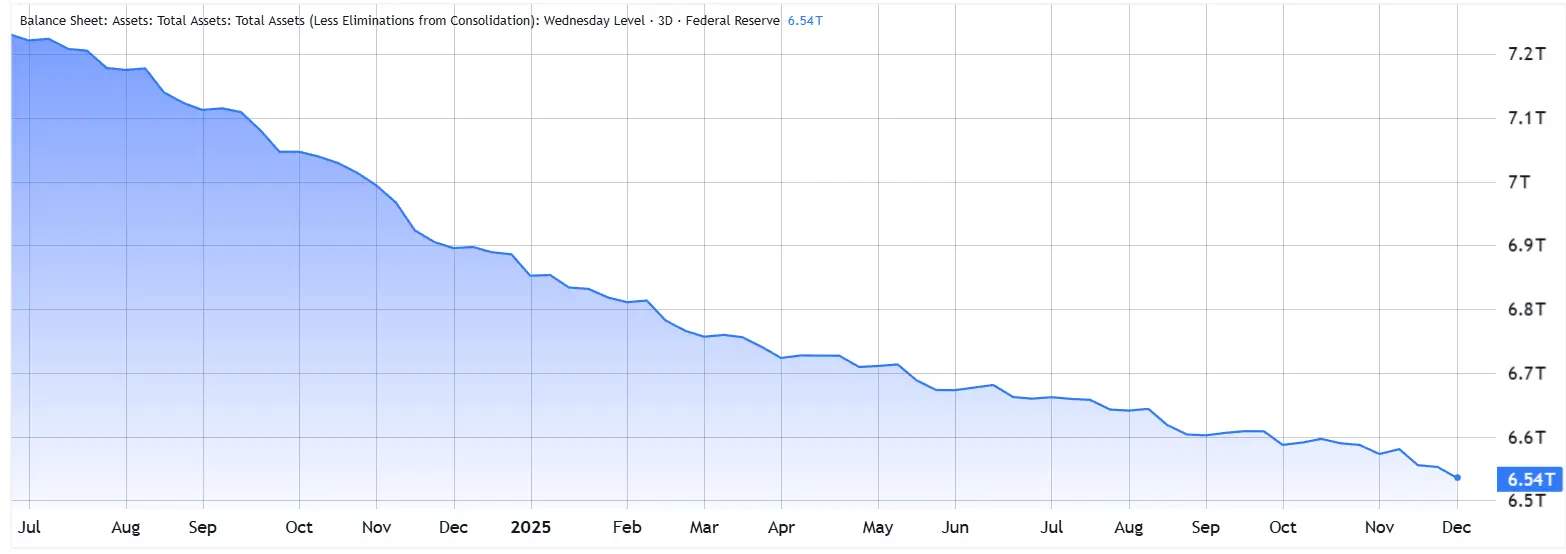
(Source: Trading View)
The most critical factor is the Fed’s cessation of quantitative tightening (QT). QT refers to the process by which the Fed allows Treasury and mortgage-backed securities to mature without reinvesting the proceeds, thereby draining liquidity from the financial system. The Fed officially ended this program on December 1, marking a major turning point in monetary policy. In the past six months, the Fed’s balance sheet has shrunk by $136 billion, significantly reducing cash reserves and putting considerable pressure on market liquidity.
Ending QT means the Fed is no longer actively pulling liquidity from the market, creating a more favorable macro environment for risk assets like Bitcoin. During QT, tighter liquidity led investors to favor cash and short-term fixed-income assets, putting pressure on non-yielding assets like Bitcoin. Now, with QT over, market liquidity will gradually improve, creating conditions for increased risk asset allocation.
The market is actively anticipating the next stage of rate cuts, based on expectations of lower interest rates. According to CME FedWatch Tool data, the bond futures market sees an 87% chance of a Fed rate cut at Wednesday’s meeting, and the market expects three rate cuts by September 2026. This high probability of rate cuts signals growing confidence in the Fed’s policy pivot.
Lower interest rates and increased systemic liquidity fundamentally weaken demand for fixed-income assets. As the Fed cuts rates, yields on newly issued bonds decline, making them less attractive to institutional funds. According to Bloomberg, U.S. money market funds have now reached a record $8 trillion. This massive pool of funds is currently parked in low-yielding money market instruments. Once the Fed cuts rates, the opportunity cost of holding these funds will rise significantly, prompting fund managers to seek higher-yielding investment targets.
Threefold Benefits for Bitcoin from the Fed’s Policy Shift
Improved Liquidity: Ending QT stops liquidity drains, offering a friendlier environment for risk assets
Lower Interest Rates: Rate cuts reduce the opportunity cost of holding non-yielding assets, increasing Bitcoin’s relative appeal
Capital Reallocation: $8 trillion in money market funds faces declining yields, seeking alternative investment targets
This macro shift provides structural support for Bitcoin. In a low interest rate environment, investors are more willing to take risks for higher returns, and Bitcoin, as a scarce asset and inflation hedge, will become a key direction for capital reallocation.
Tech Credit Fears Drive Capital into Scarce Assets
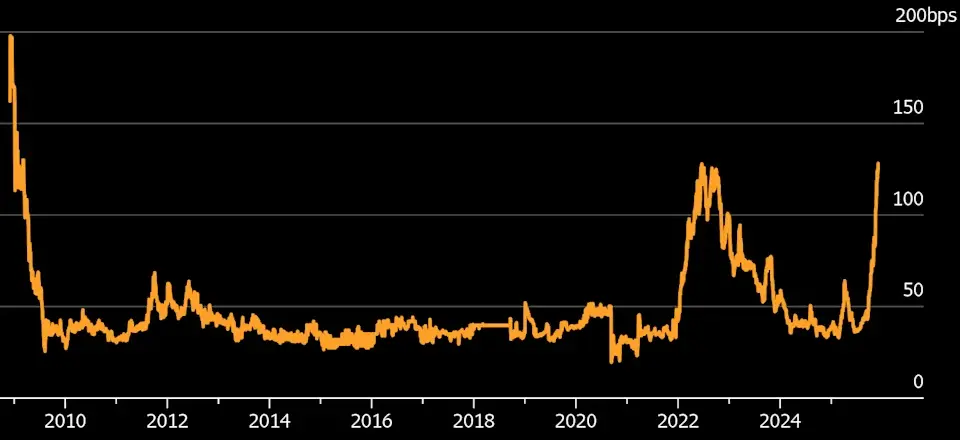
(Source: Bloomberg)
Structural risks emerging in the stock market, especially among tech companies, further fuel potential capital rotation. The cost of using credit default swaps (CDS) to protect Oracle Corporation (ORCL) debt from default has soared to its highest level since 2009. As of the end of August, Oracle’s total debt stood at $105 billion, including lease obligations. This is an astonishing figure for a tech company, reflecting aggressive leverage for AI infrastructure investments.
According to Bloomberg, Oracle is counting on OpenAI to generate hundreds of billions in revenue. The company is the largest non-bank bond issuer in the Bloomberg US Corporate Bond Index. A Citi credit strategy report notes, “Investors are increasingly concerned about how much more bond supply is coming.” These concerns reflect fears of an AI investment bubble, with worries that debt-driven spending may not deliver adequate returns.
Investors are wary of this high-risk move, which includes Donald Trump’s “Genesis Mission,” a national plan aiming to double US scientific productivity through AI and nuclear energy. The surge in demand for debt protection indicates extreme market unease about debt-fueled spending. When CDS costs soar, it typically means market confidence in corporate debt repayment is falling, which could trigger broader credit tightening.
Bank of America strategist Michael Hartnett believes that if the Fed signals a prolonged hold on rates, the likelihood of a broad economic slowdown will rise significantly. This uncertainty, coupled with a desire for growth that is less reliant on stimulus, enhances the appeal of Bitcoin’s scarcity, as institutional capital seeks to reduce exposure to traditional tech stocks. Bitcoin, with its fixed supply of 21 million, is unaffected by corporate financial decisions or management errors, offering a risk profile distinct from traditional tech stocks.
Multiple Catalysts Converge for Bitcoin to Hit $100,000 by Year-End
On Friday, Bitcoin’s price fell 4% to a low of $88,140, with a cumulative decline of 19% since last November. Meanwhile, the S&P 500 Index is less than 1% from its all-time high. This sharp divergence may soon end, with Bitcoin poised for a strong rebound. Key drivers include major central bank policy shifts and mounting credit pressures.
This perfect storm could push Bitcoin past the psychologically significant $100,000 mark before year-end. Technically, Bitcoin is currently in a correction phase but hasn’t broken key support levels. A 19% pullback is a healthy correction within a bull market, laying a stronger foundation for the next rally. Once the Fed officially announces a rate cut, market sentiment could reverse quickly.
The Fed’s formal end to liquidity tightening, combined with positive expectations for rate cuts, provides huge bullish factors for Bitcoin’s price. Due to the massive scale of AI-related debt and soaring tech credit risks, capital is structurally shifting toward scarce assets. This trend sets the stage for Bitcoin to break through the $100,000 barrier in the coming months.
In terms of timing, the December Fed meeting will be a critical juncture. If rate cuts occur as expected, it will immediately send a positive signal, prompting capital to flow out of money market funds and seek higher-yielding investment opportunities. Even if just 1% of the $8 trillion fund pool flows into the Bitcoin market, that would generate $80 billion in new demand—enough to drive a significant increase in Bitcoin’s price. Coupled with capital reallocation triggered by rising tech stock credit risks, Bitcoin has a realistic chance of breaking $100,000 before year-end.
Related Articles
Non-farm payrolls may unexpectedly increase by only 70,000! White House: It's not an employment recession, but a productivity revolution
Kevin Wash's Federal Reserve New Policy! Using AI to tame inflation, refusing to be a big buyer of U.S. bonds
Charlie Munger: How do I respond when assets drop by 50%?
Wosh is about to succeed as Federal Reserve Chair! The probability of a rate cut in June skyrocketed to 46%, boosting risk assets.
Trump to Announce Federal Reserve Chair! Bitcoin-Friendly Kevin Wash's win rate soars to 95%
Gate Daily (January 30): Trump declares a national emergency and Cuban tariffs; The United States will announce a new chairman of the Federal Reserve next week