


Jerome Powell repeating 2019 tactics? Fed mouthpiece: Half of officials oppose rate cuts, triggering internal conflict
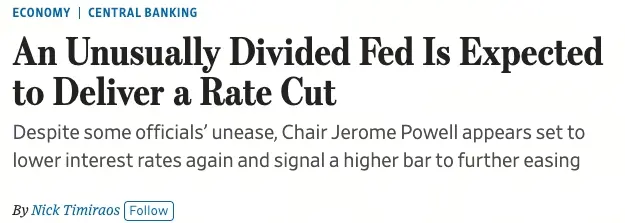
Wall Street Journal reporter Nick Timiraos, known as the “Fed’s mouthpiece,” revealed that as many as 5 out of the 12 voting members of the Federal Reserve have publicly expressed reservations about rate cuts, and 10 out of the 19 total members believe there is no sufficient reason for easing. The market expects Fed Chair Powell to repeat his 2019 strategy: first lowering rates to the 3.50%-3.75% range, then adding stricter policy thresholds in the statement.
Hassett’s Aggressive Rate Cut Remarks Heighten Policy Uncertainty
(Source: The Wall Street Journal)
Kevin Hassett, Director of the White House National Economic Council, publicly expressed an aggressive view on the future path of rate cuts during Tuesday’s Wall Street Journal CEO Council event. He stated: “There is ample room to cut rates in the coming months. If the data supports it—as it does now—I do think there is room for further cuts.” When the host asked whether this meant rate cuts could exceed the widely expected 25 basis points, he responded clearly: “That’s right.”
This stance aligns closely with Trump’s repeated calls for faster and more aggressive rate cuts, prompting the market to reassess the Fed’s policy focus for the next two years. Hassett is widely considered the front-runner to succeed Powell, whose term ends in May 2026. In a Politico interview on Tuesday, Trump emphasized that he hopes the next Fed Chair will “act immediately to promote rate cuts.”
However, Hassett has also sought to uphold the “independence” of the Fed. He said, “If you become Fed Chair, you have to do the right thing. If inflation rises from 2.5% to 4%, of course you can’t cut rates. I will rely on my own judgment, not political orders.” This statement attempts to balance Trump’s expectations with central bank independence, but its credibility remains in question.
Powell Faces the Toughest Consensus Battle of His Term
Fed officials began their final two-day policy meeting of the year on December 9 local time, and internal divisions are unusually pronounced. According to multiple sources, nearly half of the decision-makers may be skeptical or even opposed to immediate rate cuts. Such a level of division is extremely rare during Powell’s tenure, marking his toughest “consensus defense battle.”
The main disagreement centers on “which risk is greater”: Hawks worry that cutting rates now could lead to discovering, months later, that inflation is more persistent than expected. As Dallas Fed President Logan recently pointed out, with inflation still well above target, the current policy rate of about 4% is “not as restrictive as it seems.” On the other hand, doves worry that waiting until the labor market deteriorates significantly to act could result in irreversible economic damage. San Francisco Fed President Daly has warned that the labor market “is already showing weakness,” with a risk of sudden deterioration.
The Double Bind of Inflation and Employment
Stubbornly High Inflation: Recent inflation has stalled at a high level, making some officials increasingly cautious about further rate cuts—a significant change from the environment when Powell pushed for cuts in September and October.
Cooling Labor Market: Does slower job growth signal weak business demand (supporting rate cuts), or is it due to a lack of new labor supply caused by reduced immigration (opposing rate cuts)? The two interpretations point to entirely different policy directions.
Delayed Data Releases: Due to the previous prolonged U.S. government shutdown, key economic data has been released late, forcing the Fed to make decisions without the latest information. Comprehensive data will be released next week.
2019 Playbook: Cutting Rates with Safeguards
Despite facing unusually high opposition, the market generally expects Powell to favor a 25-basis-point rate cut. Wall Street Journal reporter Nick Timiraos pointed out that the core issue this week is whether Powell can secure enough internal support to keep dissenting votes under control.
His possible strategy: first lower rates to the 3.50%-3.75% range, then add stricter future policy thresholds in the post-meeting statement to reassure hawkish officials. This “cut but with safeguards” approach is very similar to Powell’s 2019 tactics amid internal divisions. In 2019, facing strong pressure from Trump and internal disagreement, Powell opted for three precautionary rate cuts, but each time emphasized this was a “mid-cycle adjustment,” not the start of an easing cycle.
Former senior Fed economist and current Citigroup Global Chief Economist Nathan Sheets said he personally leans against rate cuts, but is not strongly committed. He described the current situation as “60/40” and emphasized that neither choice is likely to have catastrophic consequences. This reflects the difficulty even professional economists have in making clear judgments under current complex conditions.
Three Major Variables in the 2026 Policy Path
At its January 2026 meeting, the Fed will have more data, so policy thresholds will be clearer—but also more uncertain. If Powell wants to signal a “pause in rate cuts” in the current environment lacking new data, he will face major communication risks. Another structural issue is whether the policy rate is already close to “neutral.” Powell has previously argued that labor market risks mean rates should be closer to neutral to reduce pressure on the economy.
Trump has recently made several attempts to weaken the influence of Biden-appointed Fed governors, such as trying to remove Lisa Cook, but has not yet succeeded; the case will be heard by the Supreme Court next month. If future leadership becomes more politicized, the likelihood of the Fed implementing aggressive rate cuts will increase. Former senior Fed adviser and current BNY Mellon Chief Economist Vincent Reinhart warned: “If the Fed becomes more politicized, the committee may try to speed up the pace of rate cuts as much as possible. This could become a key turning point.”
Related Articles
Non-farm payrolls may unexpectedly increase by only 70,000! White House: It's not an employment recession, but a productivity revolution
Kevin Wash's Federal Reserve New Policy! Using AI to tame inflation, refusing to be a big buyer of U.S. bonds
Charlie Munger: How do I respond when assets drop by 50%?
Wosh is about to succeed as Federal Reserve Chair! The probability of a rate cut in June skyrocketed to 46%, boosting risk assets.
Trump to Announce Federal Reserve Chair! Bitcoin-Friendly Kevin Wash's win rate soars to 95%
Gate Daily (January 30): Trump declares a national emergency and Cuban tariffs; The United States will announce a new chairman of the Federal Reserve next week