


Trump angrily slams Powell for too small a rate cut! The Federal Reserve should cut interest rates by 50 basis points
US President Donald Trump harshly criticized the Federal Reserve’s latest interest rate cut decision during a roundtable with corporate executives at the White House, stating that a 25 basis point reduction is too small and should be “at least doubled” to 50 basis points. Trump directly named Federal Reserve Chair Jerome Powell, calling him “a rigid person” and criticizing the small and slow rate cut. He also revealed plans to interview Fed Governor Waller before the evening, who, along with National Economic Council Director Hassett, is a leading candidate to succeed Powell.
Trump’s Pressure Escalates: From Implication to Public Attack
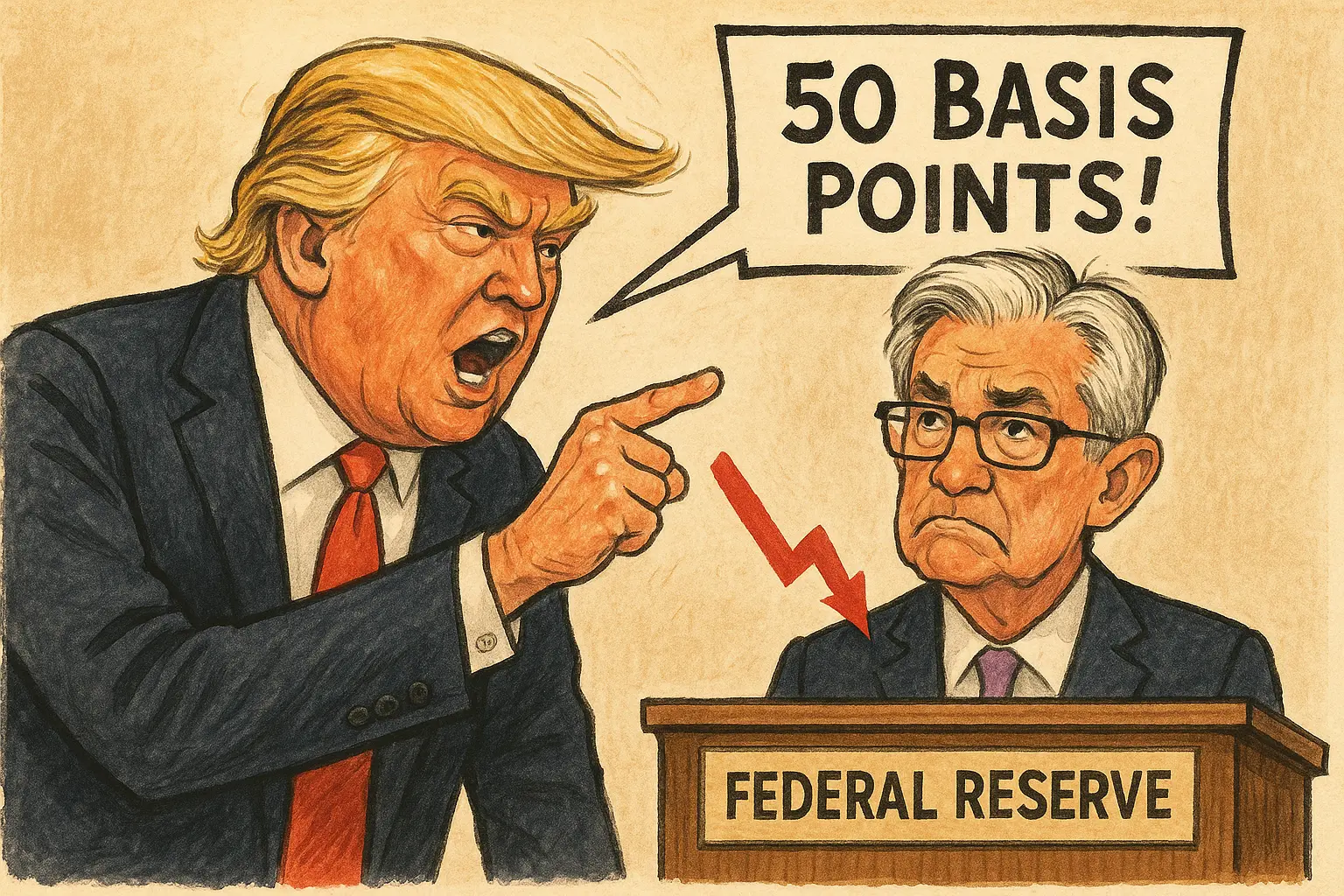
Since the start of his second term, Fed Chair Jerome Powell has been one of Trump’s main critics. Trump believes the Fed has been too slow in cutting interest rates, which has hampered economic performance. However, this public criticism at the White House roundtable is one of Trump’s most direct and sharpest attacks on Powell. Calling the Fed chair “a rigid person” is extremely rare in American political tradition, as presidents usually avoid directly insulting the leaders of independent institutions.
Trump’s core dissatisfaction lies in the magnitude and timing of rate cuts. He believes that a 25 basis point cut is “too small” and should be at least doubled to 50 basis points. This stance aligns with that of dovish Fed official Miran, who at the same day’s FOMC meeting advocated for a one-time 50 basis point cut. Trump’s public stance effectively supports the dovish faction within the Fed, attempting to influence monetary policy through political pressure.
At the roundtable, Trump also complained that the Fed has historically raised interest rates when economic data were strong, a practice he says “stifles growth.” He stated, “We need to go back to the old days: when we release excellent data, it doesn’t mean we should hike rates and try to halt (growth).” This logic contradicts traditional monetary policy principles, which generally involve raising rates when the economy is overheating to prevent inflation, and lowering rates during economic weakness to stimulate demand. Trump favors “unilateral easing,” meaning cutting or maintaining low interest rates regardless of economic conditions.
For a long time, Trump has pressured the Fed for larger rate cuts to accelerate economic growth. His remarks again criticize Powell, indicating that this pressure not only persists but is escalating. Trump revealed plans to interview Waller, a Fed governor, beforehand—a move that openly hints at personnel arrangements and puts pressure on the current chair, implying “your time is running out, I am already looking for a successor.”
Powell’s Rare Counterattack: Tariffs Are the Real Inflation Culprit
In response to Trump’s public attack, Powell unusually struck back at a press conference. Although his language remained cautious, his sharp remarks clearly targeted the White House’s trade policies. Powell said that the rate cut was “a very close call,” but it left room for the Fed to “monitor how the economy evolves” for future policy.
More pointedly, Powell directly attributed some inflation pressures to the Trump administration’s tariff policies: “These readings are higher than at the start of the year, with goods inflation rebounding, reflecting the impact of tariffs.” He pointed out that increases in two key inflation indicators are related to tariffs, causing national inflation levels to be “slightly elevated.” Such a direct attribution of blame to the White House is extremely rare in Fed history.
Powell’s logic is clear: Trump criticizes the Fed for raising rates too little, but it is Trump’s tariffs that have pushed up inflation, limiting the Fed’s room to cut rates. If the Fed were to cut rates sharply amid inflation pressures, it could trigger runaway inflation expectations, ultimately requiring more aggressive rate hikes to correct, which would harm the economy. This counterattack—“Your policies prevent me from meeting your demands”—demonstrates the central bank’s effort to maintain independence under political pressure.
Three Core Disputes Between Trump and Powell
Rate Cut Magnitude: Trump advocates at least 50 basis points; Powell insists on a gradual 25 basis points
Inflation Responsibility: Trump sees slow rate cuts as a problem; Powell points to tariffs raising prices as the limiting factor
Policy Independence: Trump pressures to align with economic growth; Powell emphasizes data-driven, independent decision-making
Such public confrontations are not unprecedented in U.S. history. During his first term, Trump also criticized Powell multiple times and even threatened to dismiss him. However, Fed rules stipulate that the president has no authority to dismiss the chair over policy disagreements; they can only serve until their term ends. This system is designed to protect the independence of the central bank from political interference.
Fed Divisions and Future Chair Contenders
The Fed announced a third rate cut of 25 basis points to a range of 3.5% to 3.75%, marking the third such cut this year. However, this decision was passed with a 9-3 vote amid increasing internal division, the most dissenting votes since 2019. Two hawkish officials wanted to hold rates steady, while dovish Fed Governor Miran advocated for a one-time 50 basis point cut. The final 25 basis point cut was a compromise amid a “tripartite struggle.”
This internal division provides ammunition for Trump’s criticisms. He can point out that even within the Fed, there are advocates for larger cuts, proving his stance isn’t entirely unreasonable. Waller, who Trump plans to interview, served as a Fed governor during the 2008 financial crisis and has crisis management experience with a relatively dovish stance. If Waller takes the helm, the Fed’s policy might align more closely with Trump’s expectations.
However, changing personnel cannot resolve the fundamental contradictions. The inflation caused by tariffs, as Powell pointed out, still exists. If Trump continues to push tariff policies, any Fed chair will face the same dilemma: cutting rates will fuel inflation, while not easing will invite presidential criticism. The root of this policy contradiction lies in Trump’s simultaneous pursuit of “low interest rates” and “high tariffs,” which are mutually conflicting in their economic effects.
Related Articles
Non-farm payrolls may unexpectedly increase by only 70,000! White House: It's not an employment recession, but a productivity revolution
Kevin Wash's Federal Reserve New Policy! Using AI to tame inflation, refusing to be a big buyer of U.S. bonds
Charlie Munger: How do I respond when assets drop by 50%?
Wosh is about to succeed as Federal Reserve Chair! The probability of a rate cut in June skyrocketed to 46%, boosting risk assets.
Trump to Announce Federal Reserve Chair! Bitcoin-Friendly Kevin Wash's win rate soars to 95%
Gate Daily (January 30): Trump declares a national emergency and Cuban tariffs; The United States will announce a new chairman of the Federal Reserve next week