


Trump's appointed conditions for the Federal Reserve chair: must be a "super dove" and immediately cut interest rates.
U.S. President Trump recently stated that he will soon announce the nomination for the next chair of The Federal Reserve (FED) to replace the current chair Powell, whose term ends in May next year, and said that the person he nominates must be a “super dove.” The list of candidates has been narrowed down to four, and Trump indicated that he will make a decision this week or “in the coming weeks.”
The triple political intentions demanded by the “Super PI”
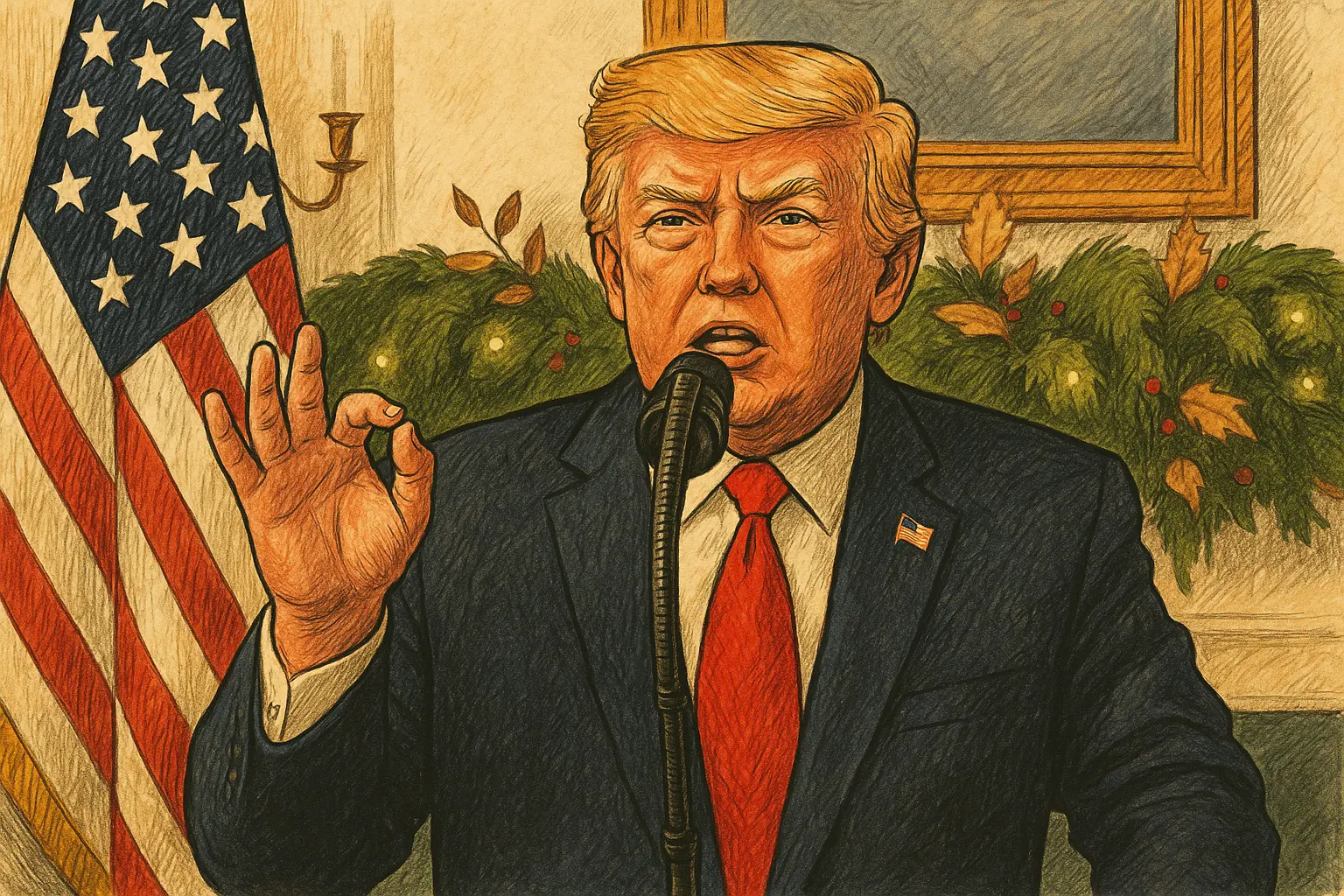
Trump publicly demands that the next chairman of the Federal Reserve (FED) must be a “super dove,” which is extremely rare in American history. The Federal Reserve (FED) is designed to be an independent institution, and its chairman should make decisions based on economic data rather than political pressure. However, Trump is breaking this tradition by making policy positions a prerequisite for appointments.
The meaning of “super dovish” is very clear: willing to significantly cut interest rates, even when inflation has not fully returned to the 2% target and the unemployment rate remains low. Trump stated more bluntly in an interview with The Wall Street Journal that interest rates should be “lowered to 1%, or even lower.” Reducing from the current range of 3.5%-3.75% to 1% means a further rate cut of 250 basis points, equivalent to 10 cuts of 25 basis points.
Trump's political intentions are threefold. The first is to lower mortgage costs to stimulate the real estate market. High housing prices are the biggest pain point for the American middle class, and reducing interest rates can lower mortgage rates, making it more affordable for people to buy homes. This is extremely important for Trump's political base, as families who own property are more likely to support the Republican Party.
The second is to boost the stock market, creating an illusion of economic prosperity. The stock market is highly correlated with Trump's political standing, and he often uses new stock market highs as proof of his achievements. A low-interest-rate environment boosts stock market valuations, allowing Trump to claim that “the economy is thriving under my leadership” during the 2026 midterm elections and future re-election campaigns.
The third is to weaken the dollar and enhance export competitiveness. Trump has consistently criticized the strong dollar for harming American manufacturing, as a strong dollar makes American goods more expensive in the international market. Lowering interest rates will weaken the dollar, making American exports more competitive, which aligns with Trump's “America First” trade policy.
Trump's Three Major Motives for the “Super Dove” Request
Lower Mortgage Costs: Stimulate the real estate market and please the political base of the middle class.
Boosting the Stock Market to Create Prosperity: New highs in the stock market can serve as a showcase for achievements, benefiting mid-term elections and re-election.
Weaken the Dollar to Aid Exports: Low interest rates suppress the dollar exchange rate, enhancing the international competitiveness of American manufacturing.
However, this politicized monetary policy is highly risky. A significant interest rate cut during a non-recession period could reignite inflation, create asset bubbles, and damage the credibility of the Federal Reserve (FED). If the Federal Reserve (FED) is seen as yielding to political pressure, the credibility of its future policies will be greatly undermined, long-term harming the status of the dollar as a global reserve currency.
Ranking of the four candidates by their PI degree
The candidate list has been reduced to four people, and Trump stated, “I think each of them is a good choice.” Based on public information and Trump's hints, the four candidates roughly include: National Economic Council Director Kevin Hassett, former Federal Reserve Governor Kevin Warsh, Federal Reserve Governor Christopher Waller, and Vice Chair for Supervision Michelle Bowman.
Kevin Hassett is considered the most dovish candidate. He currently serves as the Director of the National Economic Council and is a core member of Trump's economic team. Hassett publicly stated this month that the so-called “phantom inflation” is distorting the Federal Reserve's decision-making judgments, and the true potential inflation level is much lower. This viewpoint provides theoretical support for significant interest rate cuts. Hassett's biggest advantage is his close relationship with Trump and policy consistency, aligning with Trump’s requirements for a “super dove.” However, the downside is the lack of internal experience with the Federal Reserve, which may pose credibility challenges early in his tenure.
Kevin Warsh served as a member of the Federal Reserve (FED) from 2006 to 2011 and was involved in decision-making during the 2008 financial crisis. Warsh was a popular candidate for the chair of the Federal Reserve (FED) in 2018, but ultimately Trump chose Powell. Warsh's advantages are his experience with the Federal Reserve (FED) and connections on Wall Street, but his relatively hawkish stance in the past may not fully align with Trump's “super dove” requirements. If Warsh were selected, he might need to commit to changing his stance during the confirmation hearing.
Christopher Waller is a member of the Federal Reserve (FED) Board of Governors and previously served as the head of the research department at the St. Louis Federal Reserve, with extensive experience in monetary policy theory and practice. Trump said the two would meet again on Wednesday and praised Waller as “great” and “well-qualified.” Waller supported a 25 basis point rate cut in last week's interest rate decision and stated in a recent speech that the rate cut has had a positive impact on the job market. This relatively dovish stance makes him a potential candidate.
Michelle Bowman is the Vice Chair responsible for regulation at The Federal Reserve (FED), appointed as a governor during Trump's first term. She recently led the withdrawal of the 2023 policy restricting banks' cryptocurrency operations, demonstrating a crypto-friendly stance. Trump expressed appreciation for Bowman but did not explicitly confirm whether she is among the final candidates. If Bowman is nominated, she would be the first female chair in the history of The Federal Reserve (FED), which holds symbolic significance in politics, but her stance on monetary policy is relatively neutral and may not be “super dovish.”
Key Highlights and Market Impact This Thursday
The selection process for the new Chairman of the Federal Reserve (FED) continues this week. Trump stated that he is uncertain whether he will announce a candidate before the end of the year, but a decision will be made “within the next few weeks.” The market is closely watching whether Trump will bring a “surprise” before Christmas. If an announcement is indeed made, it will have a significant impact on the financial markets.
On the data front, local time this Tuesday, the United States will announce the preliminary GDP figures for the third quarter of this year, with the market expecting a seasonally adjusted annual growth rate of 2.5%. This data is extremely critical as it will verify whether the U.S. economy is indeed “growing steadily” as stated by the Federal Reserve (FED). If GDP confirms strong growth, it will raise questions about why the Federal Reserve (FED) lowered interest rates during an overheated economy. Analysts suggest that in the second quarter of this year, U.S. consumers pulled forward demand for durable goods due to “tariff panic,” which may negatively impact consumer data for the third quarter.
Last week, the three major U.S. stock indexes had mixed performances, with the Dow Jones Industrial Average falling 0.67% for the week, the S&P 500 rising 0.10%, and the Nasdaq increasing by 0.48%. Concerns about the overvaluation of the AI industry persist, but data released last Thursday showed that U.S. inflation for November cooled more than expected, boosting market expectations for the Federal Reserve (FED) to cut interest rates next year, which supported the stock market.
In terms of commodities, international oil prices have fallen cumulatively, with the main contract price of U.S. crude oil futures dropping 1.36% for the entire week, and the main contract price of Brent crude oil futures falling 1.06% for the week. Investors are closely monitoring the progress of peace negotiations between Russia and Ukraine, and concerns about a global oversupply of crude oil have intensified. In the precious metals futures sector, driven by optimistic demand prospects and geopolitical tensions, international gold prices rose last week, with the main contract price of New York gold futures increasing 1.36% for the entire week.
Due to the traditional holiday season at the end of the year in the United States, the US stock market will close three hours early this Wednesday local time, and many European stock markets will either be closed or close early on the same day. This Thursday, the US stock market and many European stock markets will be closed all day, and trading in US precious metal futures, crude oil futures, and foreign exchange will be suspended for the entire day. This shortened trading time and holiday closures mean that liquidity will be severely drained, and any unexpected news could trigger significant volatility.
For the cryptocurrency market, Trump's public demand for a “super dovish” Federal Reserve (FED) chairman is a significant positive. If the new chairman indeed lowers interest rates drastically as Trump wishes, a low-interest-rate environment will drive funds into risk assets like Bitcoin. However, this politicized monetary policy also brings risks: if rate cuts lead to a rebound in inflation, the Federal Reserve (FED) may be forced to tighten policies suddenly, causing a greater impact on the market. A deeper risk is the damage to the credibility of the US dollar; if the Federal Reserve (FED) becomes a policy tool of the White House, international investors' confidence in the dollar may waver, which could instead benefit Bitcoin's long-term status as a non-sovereign currency.
The market will hold its breath for Trump’s final decision in the coming weeks. This is not only about a personnel appointment but also concerns the future direction of U.S. monetary policy, the continued independence of The Federal Reserve (FED), and the stability of global financial markets. For investors, it is essential to prepare for two scenarios: if a dovish chair takes office and significantly lowers interest rates, allocate risk assets; if a chair with strong independence takes office and resists political pressure, allocate defensive assets. Until uncertainty is clarified, diversification is the most prudent strategy.
Related Articles
Non-farm payrolls may unexpectedly increase by only 70,000! White House: It's not an employment recession, but a productivity revolution
Kevin Wash's Federal Reserve New Policy! Using AI to tame inflation, refusing to be a big buyer of U.S. bonds
Charlie Munger: How do I respond when assets drop by 50%?
Wosh is about to succeed as Federal Reserve Chair! The probability of a rate cut in June skyrocketed to 46%, boosting risk assets.
Trump to Announce Federal Reserve Chair! Bitcoin-Friendly Kevin Wash's win rate soars to 95%
Gate Daily (January 30): Trump declares a national emergency and Cuban tariffs; The United States will announce a new chairman of the Federal Reserve next week