


Santiment: Smart money rushes to buy $3.2 billion worth of BTC, retail investors panic and flee while whales scoop up the dip

Santiment shows smart money has accumulated 36,322 BTC over 9 days, worth approximately $3.21 billion, while retail investors are panicking and selling off. Trump tariffs caused BTC to drop 7%, but contrarian buying indicates a long-term bullish divergence. Cryptocurrency fear and greed index drops to 32.
Smart Money Accumulates 36,322 BTC in 9 Days, Retail Investors Panic and Flee
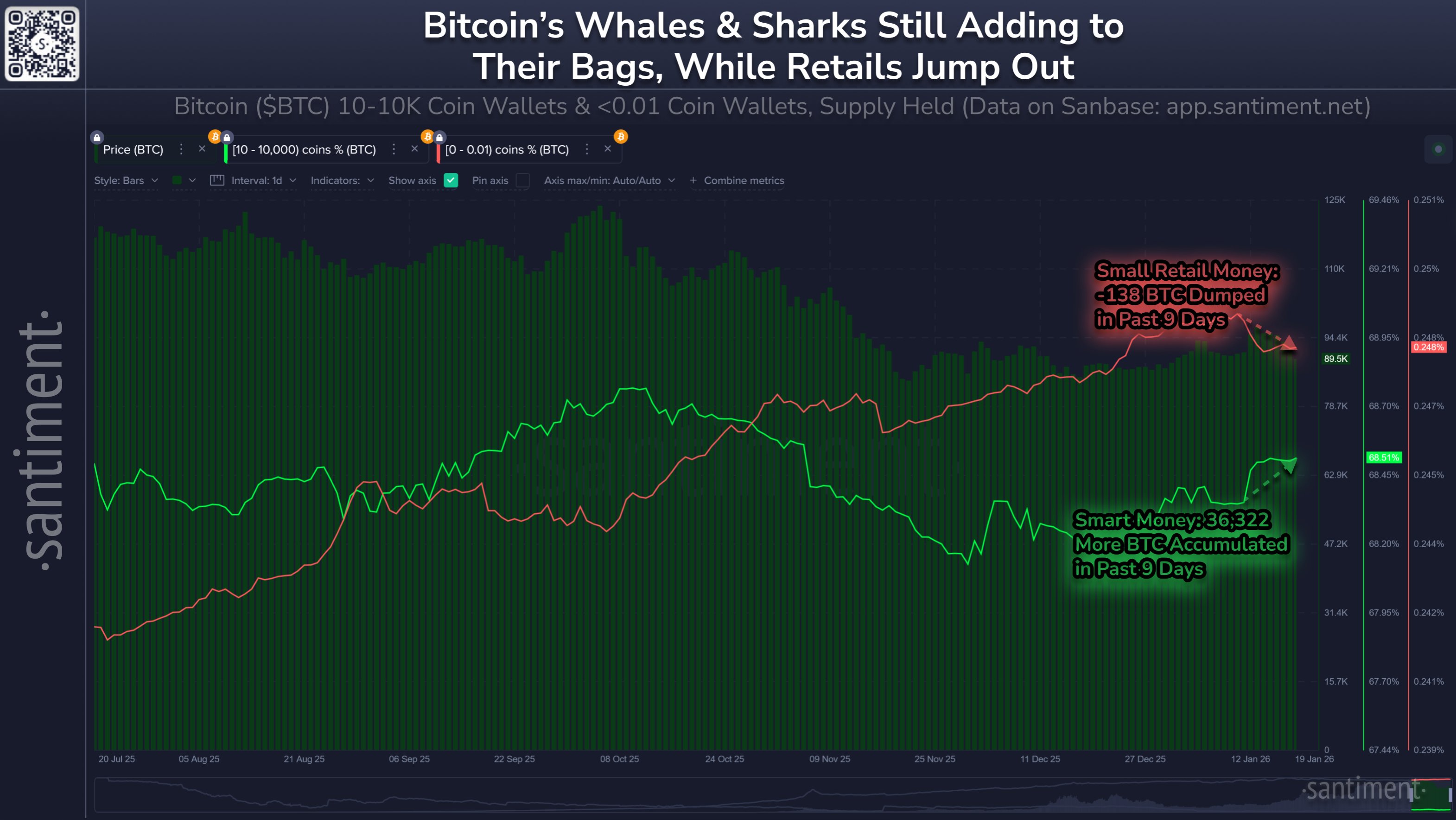
(Source: Santiment)
According to Santiment analysts, over the past nine days, Bitcoin whales and sharks have accumulated 36,322 BTC, while retail investors are selling off, suggesting the crypto market may be in a “best breakout condition.” “Bitcoin whales and sharks are still continuing to accumulate,” Santiment posted on X on Tuesday. Previously, Bitcoin had fallen 4.55% within 24 hours, with a trading price of $89,110 at the time of writing.
Between January 10 and January 19, Bitcoin wallets holding 10 to 10,000 BTC (also known as “smart money”) accumulated Bitcoin worth $3.21 billion. This group is regarded as “smart money” in the crypto market because they typically possess deeper market insights, more professional analysis capabilities, and a longer-term investment horizon. Unlike emotionally driven retail investors, smart money’s buying decisions are often based on fundamental and technical research.
Santiment reports that during the same period, retail wallets (holding less than 0.01 BTC) sold 132 BTC (about $11.66 million). This starkly contrasting behavior pattern is a classic market bottom signal. When retail investors panic and sell, smart money often buys against the trend. Historical data shows similar “smart money buying, retail selling” patterns at Bitcoin bottoms in 2018, 2020, and 2022.
Santiment states: “The best condition for crypto breakouts is smart capital buying while retail investors sell.” Setting aside geopolitical issues, this pattern continues to signal a long-term bullish divergence. This “bullish divergence” means that although prices are falling or sideways, smart money behavior shows confidence in the future, and the divergence often indicates an imminent trend reversal.
Last week, CryptoQuant CEO Ki Young Ju also said: “Retail investors have exited the Bitcoin market, while whales are buying.” This cross-platform analyst consensus further strengthens the credibility of the smart money accumulation thesis. When multiple independent data sources point to the same conclusion, the reliability of the signal greatly increases.
Trump Tariff Threat Sparks Retail Panic Selling
Since Donald Trump took office in January 2024, Bitcoin has experienced volatility whenever the U.S. president proposes new tariffs. On Monday, Trump announced tariffs on eight European countries as part of his plan to annex Greenland, causing Bitcoin to drop nearly 7%. This geopolitical uncertainty has become a primary trigger for retail panic selling.
However, smart money’s reaction to these short-term policy risks is quite different. They see the tariff threat-induced price decline as a buying opportunity rather than a signal to exit. This cognitive difference stems from varying investment timeframes. Retail investors tend to focus on daily or even hourly price fluctuations, while smart money’s investment horizon is usually months or years. For the latter, Trump’s tariff policies are seen as temporary, and Bitcoin’s long-term value as a global asset remains unchanged.
Deeper analysis suggests that smart money may believe Trump’s tariffs could accelerate uncertainties in the dollar credit system, pushing more capital into non-sovereign assets like Bitcoin. When traditional financial systems become turbulent due to policy chaos, Bitcoin’s role as “digital gold” as a safe haven is reinforced. This logic is reflected in Santiment’s “long-term bullish divergence” thesis.
However, Santiment also notes that Bitcoin has gained the highest discussion rate growth on crypto social media, including comparisons with metals like gold and silver, which hit record highs on Monday amid escalating geopolitical tensions. This increased discussion activity indicates that, despite retail selling, their attention to Bitcoin remains high, potentially setting the stage for contrarian entry points.
Fear Index at 32 and Market Structure Centered on Bitcoin
Other crypto indicators show that market participants remain cautious compared to other cryptocurrencies and continue to focus heavily on Bitcoin. The crypto fear and greed index, updated on Tuesday, shows a “fear” score of 32. The index ranges from 0 (extreme fear) to 100 (extreme greed), and a reading of 32 indicates a clear fear state in the market.
The fear and greed index is one of the most commonly used sentiment indicators in crypto, combining volatility, market momentum, social media sentiment, Bitcoin dominance, and search trends. When the index is in the fear zone, it often signals excessive pessimism, which is viewed as a contrarian buying opportunity. Smart money is actively buying at a fear index of 32, exemplifying this contrarian strategy.
Based on the performance of the top 100 altcoins relative to Bitcoin over the past 90 days, the altcoin season index shows a “Bitcoin score” of 29 out of 100. An altcoin season index below 25 indicates a “Bitcoin season,” where market funds are concentrated in Bitcoin; above 75 indicates an “altcoin season,” with funds dispersed across various altcoins. The current score of 29 suggests the market remains highly focused on Bitcoin, with no significant shift into altcoins yet.
This market structure is significant for smart money accumulation strategies. When the market is “Bitcoin-centric,” Bitcoin’s price movements have a decisive influence on the entire crypto market. Once Bitcoin breaks out and enters an upward cycle, it will attract more capital, creating a self-reinforcing positive cycle. Smart money accumulating Bitcoin at this stage aims to seize this structural opportunity.
Crypto analyst Will Clemente posted on X: “Objectively, based on Bitcoin’s price action, it’s hard to get excited about it.” This pessimistic sentiment is exactly the environment smart money seeks for buying. When market sentiment is extremely pessimistic and even analysts see no hope, it is often the closest point to the bottom.
Long-term Bullish Divergence and Optimal Breakout Conditions
Santiment’s core thesis is “long-term bullish divergence.” This concept refers to a divergence between price action and smart money behavior. When prices decline or consolidate sideways, but smart money continues accumulating, this divergence often signals an imminent directional breakout. Historical experience shows that once such divergence forms and persists for weeks, subsequent rallies tend to be very strong.
“Crypto breakouts are best when smart capital buys while retail investors sell,” summarizes Santiment’s core contrarian logic. Market bottoms often form amid retail despair and quiet smart money entry. When retail investors lose confidence after continuous declines, smart money sees an undervaluation opportunity. This behavioral pattern repeats in every market cycle.
However, Santiment also acknowledges geopolitical uncertainties. “Setting aside geopolitical issues,” this phrase hints that factors like Trump tariffs and Greenland disputes may continue to exert short-term downward pressure. While smart money accumulation signals a long-term bullish outlook, it does not mean prices will rebound immediately. The market may take weeks or months to digest external shocks before entering a genuine rally.
For ordinary investors, this analysis provides a clear operational framework. Following smart money means gradually buying during market panic rather than chasing rallies. When the fear and greed index is at 32 in the fear zone, it is an ideal time to build positions gradually. However, patience is required, as it may take time from the bottom to a real upward move.
Related Articles
Bitcoin Bounces Back! IPO Genie ($IPO) Emerges as High-Conviction Presale Play
Jiuzi Holdings reaches a strategic agreement to acquire 10,000 Bitcoins transfer from a certain strategic investor
Analysis: The CLARITY Act's expected warming effect combined with the fiat devaluation logic regression is driving BTC to strengthen against the trend
Spanish police dismantle an illegal Bitcoin mining farm, suspected of electricity fraud exceeding 860,000 euros
