


Does the rise of privacy coins mean that a bear market is imminent?
Writing by: Eric, Foresight News
Every bull market cycle has some signs. Looking back, among these signs, the sudden explosion of privacy tokens has never been absent.
The underlying reason behind this recurring event is the same: there’s nothing left to hype. When all concepts and narratives have run out of room for speculation, the final dance of capital often chooses the topic of “privacy,” a subject that has persisted since 2014.
At the end of a bull market, it makes logical sense to hype privacy. After the hype subsides, many people usually suddenly realize what Web3’s original purpose is during the void between bull and bear phases, then shout about making privacy and decentralization great again. But in the end, it’s just another round of hype.
Although the process is similar each time, the triggering conditions are not exactly the same.
2017 can be considered the heyday of privacy tokens because there were no standout DApps at the time, and the industry was still searching for direction. Back then, ZEC, XMR, and DASH were absolute “hotcakes,” with discussions even surpassing Bitcoin. ZEC and XMR introduced “technological innovations” with zero-knowledge proofs and ring signatures respectively, while DASH combined PoW and PoS.
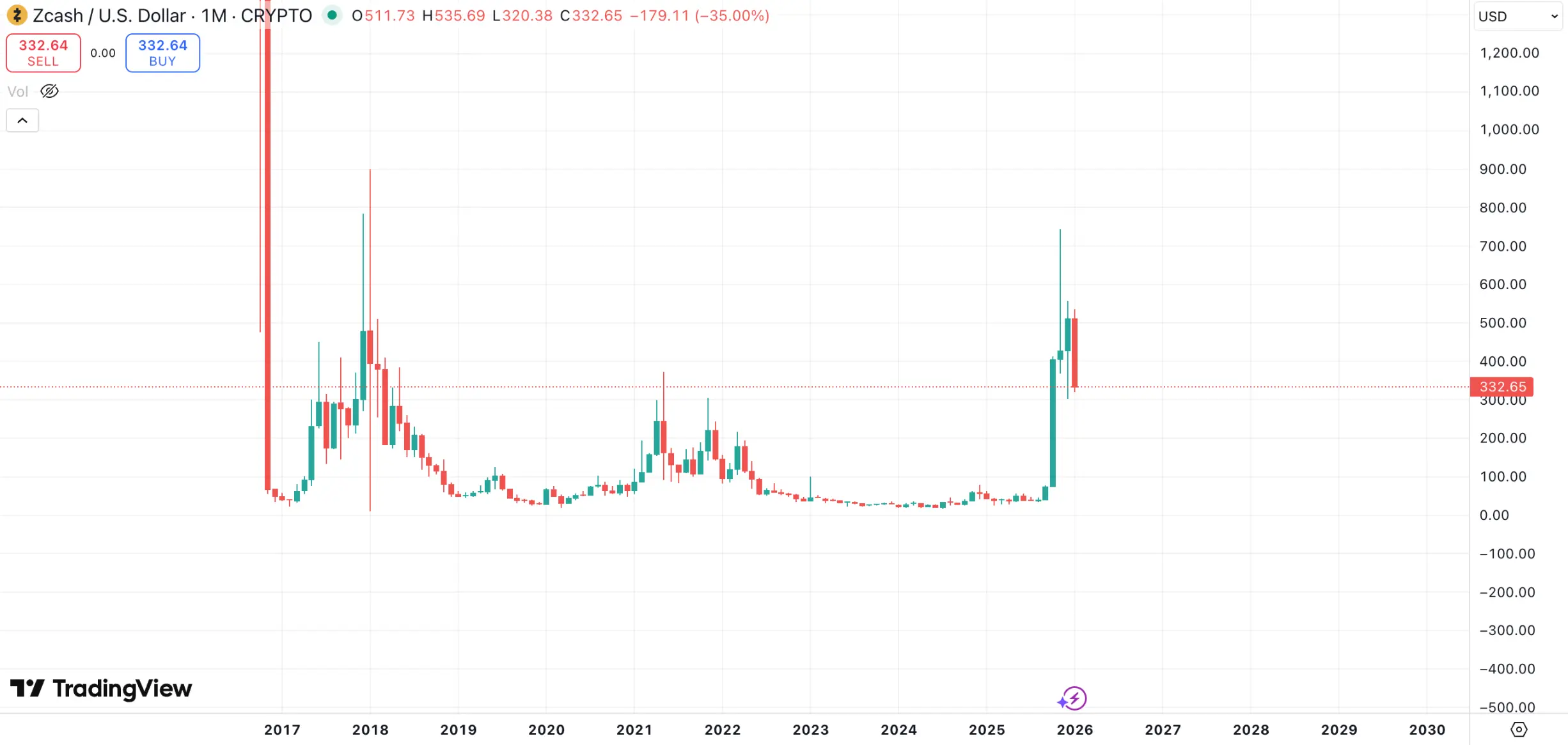
Readers who haven’t experienced that period might find it hard to understand the market’s obsession with such tokens at the time. There was controversy over whether Bitcoin was the absolute core of cryptocurrencies, and many tokens claiming to be “better Bitcoin” were aggressively competing. ZEC’s price once surged to $30,000 in early 2018, while Bitcoin’s highest price in that cycle was less than $20,000.
By late 2021 and early 2022, it was pure hype around the privacy concept. After the explosive growth of DeFi, NFTs, and the Metaverse, projects like Aleo received hundreds of millions of dollars in funding, with investors including SoftBank, a16z, and Tiger Global. At that time, the market briefly believed that after the application boom, privacy could finally move from concept to reality.
Perhaps because everyone was making money and got caught up in the hype, no one truly cared whether privacy was a real necessity for the masses, or whether those with demand were willing to pay the corresponding costs just to ensure privacy. The result was that while privacy solutions were implemented, they were often superficial.
In this cycle, the rise of privacy tokens like ZEC began in September 2025. Looking back, it’s hard to pinpoint specific reasons why it surged 20 times in three months. If we had to find a reason, it might be because it was “less compliant.”
2025 can be described as the year when cryptocurrencies faced comprehensive regulation. Several Western countries introduced regulatory laws, and even supporters of crypto development couldn’t escape rules on identity verification and anti-money laundering. DeFi was also not spared. As a result, although cryptocurrencies were no longer classified as securities, in essence, they were not much different from trading securities. Government scrutiny of individuals remained strict, and only to avoid hindering innovation did regulators temporarily relax oversight of projects and institutions.
Additionally, the arrest of scammer Qian Zhimin in the UK and the subsequent seizure of Bitcoin by authorities revealed an unspoken truth: even if you hold the private keys, handing them over to law enforcement is not difficult. When this reality is brought to light again, it may trigger some investors to shift their holdings into privacy tokens.
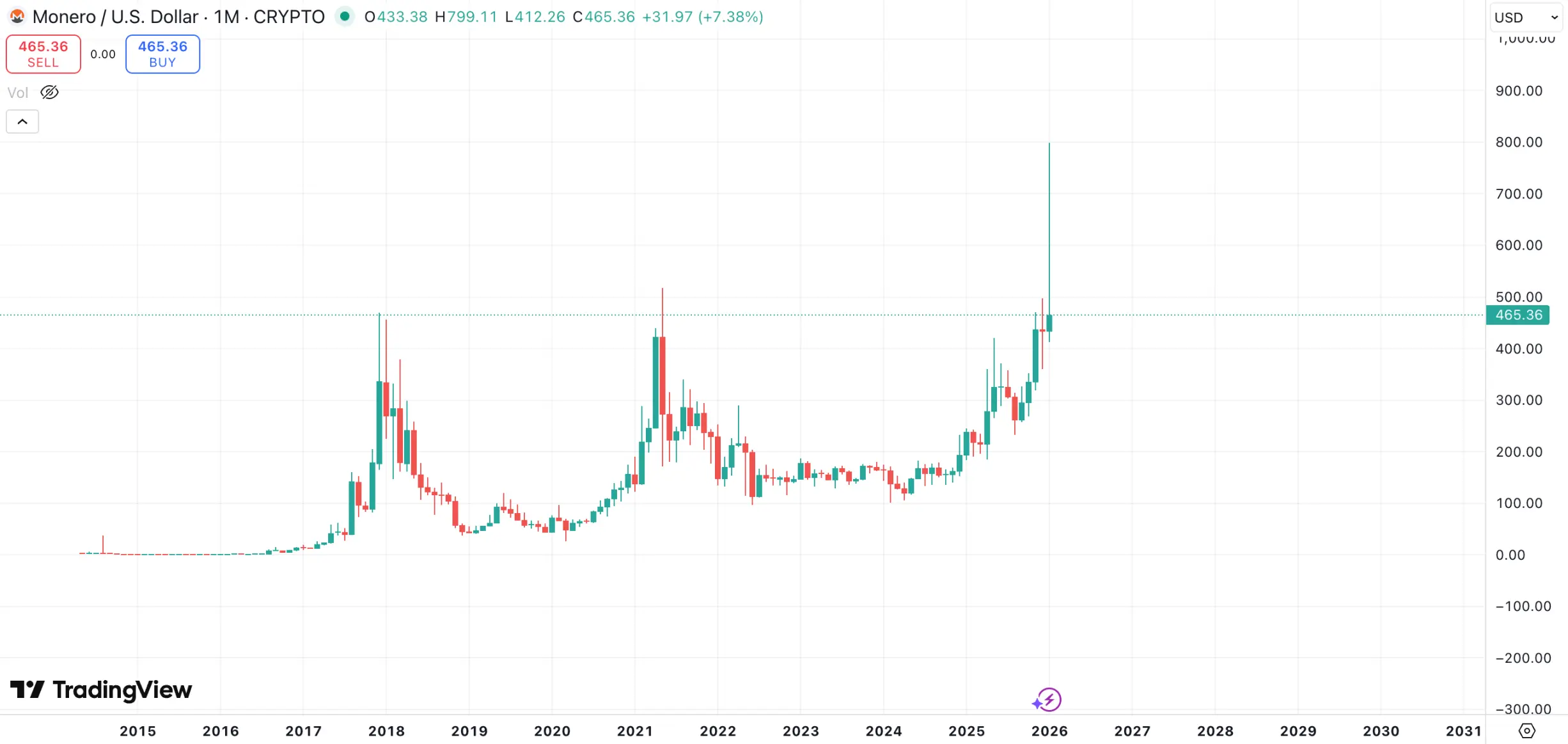
However, events like BitMEX co-founder Arthur Hayes’s calls, and a16z’s mention of “privacy as a service,” all occurred after November. From the market trend, these seem more like cover-ups for dumping rather than drivers of price increases. XMR, for example, held up for two months due to high-level capital fleeing Iran and hackers converting hundreds of millions of dollars worth of Bitcoin into XMR, but it also quickly retreated after peaking.
While it’s not certain that the bull market has definitely ended, at least at the end of the previous cycle, many well-known figures and institutions promoted privacy, and the similar storyline should serve as a warning for us.
The fact that privacy concepts have persisted since 2014 without dying out is because they genuinely meet certain gray-area needs. However, they conflict with actual “privacy” demands. In reality, most people’s idea of privacy protection isn’t about making data completely untraceable but about preventing easy exposure. In financial transactions, dark pools serve a similar purpose: large funds can operate without impacting the market or being targeted by others. But this doesn’t mean transaction information can’t be verified.
In Web3, the concept of privacy can sometimes be overly extreme. Zcash’s private transactions are optional, while XMR defaults to privacy, with sender, receiver, and amounts untraceable on-chain. This was a core reason why, in 2025, over 70 global cryptocurrency exchanges delisted XMR. For most people, there seems to be no sufficient reason to use XMR solely for privacy. Moreover, the process of purchasing XMR is itself traceable, and engaging in XMR transactions might be perceived as engaging in illegal activities.
Simply put, most people just want their activity records to be protected and respected, not completely hidden; regulators cannot accept channels that seem almost tailor-made for money laundering. With current technology, on-chain anonymous transfers of USDT are also feasible. There’s little reason to use a targeted asset solely for privacy.
Web3 has discussed privacy for over ten years, but it seems to always avoid the question “What level of privacy do we actually need?” Without finding real scenarios, privacy tokens may forever be the last scapegoat in sector rotations.
Related Articles
Here’s the Kaspa (KAS) Price If Big Players Keep Averaging Down
Analysis: Bitcoin treasury companies have sold off for three consecutive weeks for the first time, which may lead to increased short-term pressure on BTC.
Dogecoin Could Rally 443% as Analysts Point to Key Macro Support
Here’s the Pump.fun ($PUMP) Price If $301M in Buybacks Keeps Rolling