


Bitcoin ETFs Attract $88M as Ethereum Flows Stall to Near Zero
Bitcoin retains stable institutional demand as Ethereum ETF flows remain thin and volatile.
Spot Bitcoin ETFs recorded solid inflows on Feb. 20, while Ethereum products drew little new capital. Data shows most demand remains concentrated in a few major issuers. At the same time, monthly trends indicate momentum has slowed since mid-2025. Flow patterns continue to favor Bitcoin over Ethereum in both scale and stability.
IBIT Leads $88M Bitcoin ETF Inflow While Growth Momentum Slows
Bitcoin spot ETFs pulled in $88.04 million in net inflows on Friday, with capital once again clustered around two issuers. BlackRock’s IBIT absorbed $64.46 million, accounting for roughly 73% of daily flows. Fidelity Investments’s FBTC added $23.59 million. All other Bitcoin funds finished flat.
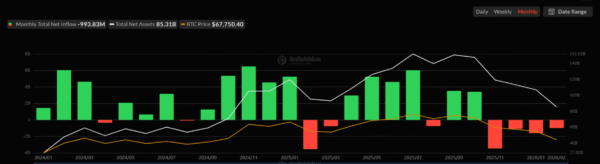
_Image Source: _SoSoValue
IBIT’s cumulative net inflows now stand at $61.30 billion, reinforcing its dominance within the Bitcoin ETF market. No competing product approaches that scale.
Mid-last year, BTC investment vehicles delivered several strong months with $5 billion to $8 billion in inflows. However, the trend flipped to a sharp multi-billion dollar outflow in November. And this trend continued in the two months that followed. In the current month, these funds continue to run well below earlier expansion phases.
Although cumulative assets remain near record levels, on-chain data shows that growth has cooled. Even so, recent inflows suggest stabilization rather than a fresh wave of acceleration.
Ethereum ETFs Stall as Daily Inflows Barely Reach $17K
While its Bitcoin counterparts posted positive flows, Ethereum spot ETFs painted a weaker picture. Total net inflows on Feb. 20 came in at just $17,210, a fraction of Bitcoin’s $88 million haul.
BlackRock’s ETHA added $1.78 million, while Fidelity Investments’s FETH saw a $2.45 million outflow. 21Shares’s TETH gained $687,000, and other funds were flat. ETHA’s cumulative net inflows now stand at $11.88 billion.
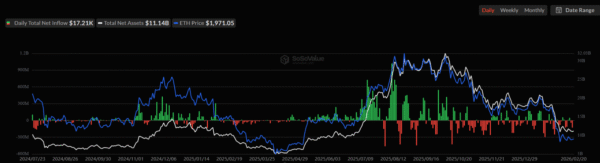
_Image Source: _SoSoValue
In contrast, Grayscale Investments’s ETHE still carries a historical net outflow of $5.19 billion, showing continued capital rotation away from older structures.
Daily data also points to higher volatility in Ethereum flows. Jan. 30 recorded $252.9 million in outflows. Feb. 11 and Feb. 12 saw $129.2 million and $113.1 million in redemptions, followed by another $130.2 million exit on Feb. 19. A few rebound sessions near $50 million offered relief, but swings remain sharp.
Cumulative Ethereum ETF inflows sit near $11.52 billion, with total net assets around $11.14 billion. By comparison, IBIT alone exceeds $60 billion in cumulative inflows.
Bitcoin Consolidates Institutional Lead as ETH Flows Lack Depth
Bitcoin continues to hold a larger and more stable institutional base, while Ethereum flows remain more reactive to short-term price moves and macro headlines. Recent data shows momentum has cooled for both assets, but volatility in Ethereum ETFs remains noticeably higher.
ETF flows act as a real-time signal of institutional risk appetite. Friday’s inflows confirm capital is still entering Bitcoin products in meaningful size. Ethereum figures, by contrast, point to thinner demand and less consistent allocation. Without steady multi-week accumulation in ETH funds, the gap in institutional adoption between Bitcoin and Ethereum could widen further.
Related Articles
Bitunix Analyst: US and Japan May Be Planning Joint Intervention, Rate Cut Expectations Fluctuate Again
Data: In the past 24 hours, the entire network has liquidated $375 million, with long positions liquidated at $291 million and short positions at $83.7468 million.
Bitcoin has fallen for five consecutive months, dropping below $63,000 again.
Bitcoin payments are being adopted in real-world scenarios, with Satlantis entering the event ticketing market through the Lightning Network.
Satlantis Brings Native BTC Payments to Live Events
Bitcoin Treasury Company Empery Digital shareholders publicly demand the CEO's resignation and the liquidation of all BTC