


The Federal Reserve is seeking 60 days of feedback on the proposal to eliminate "reputation risk," benefiting the crypto industry.
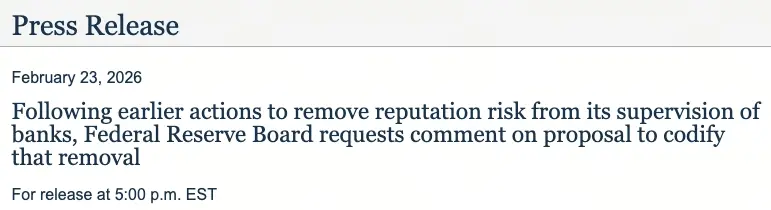
The Federal Reserve Board officially launched a 60-day public comment period on February 24 for a proposal aimed at explicitly removing “Reputational Risk” from the bank supervision and examination framework through regulation, starting from the publication of the proposal in the Federal Register. Bitcoin Magazine noted that if the proposal is formally approved, it could significantly alleviate the long-standing de-banking regulatory pressures faced by crypto companies.
Background of the Proposal: “Reputational Risk” as a Regulatory Controversy
(Source: Federal Reserve)
“Reputational Risk” was originally an assessment indicator within the banking supervision framework, referring to the potential loss a institution might suffer due to negative public perception. However, in practice, this concept has been criticized for lacking clear financial quantification standards, becoming highly subjective, and potentially serving as a tool for regulators to pressure financial institutions.
Bowman explicitly stated in a declaration that refusing to provide financial services based on clients’ political stance, religious beliefs, or legal business activities constitutes illegal behavior and does not align with the Federal Reserve’s regulatory framework. The Federal Reserve Board announced in June 2025 that “Reputational Risk” would no longer be included in routine bank examinations. The purpose of this proposal is to formalize that declaration into regulation, giving it greater legal authority.
Core Content of the Proposal and Its Impact on Crypto Industry Regulation
The main focus of this proposal is to shift the supervisory emphasis from subjective reputation judgments to quantifiable substantive financial risk indicators, reaffirming that financial institutions cannot deny or terminate services based solely on clients’ legal activities.
Three Key Points of the Proposal
-
Official Removal of “Reputational Risk” Clause: Legally eliminate reputational risk as a basis for bank supervision and examination.
-
Protection of Legal Business Financial Services: Clearly prohibit de-banking based on clients’ lawful activities.
-
Enhancement of Regulatory Transparency: Ensure regulatory actions are based on actual financial risks, strengthening predictability and consistency of rules.
The proposal also clarifies that this change does not alter the Federal Reserve’s existing expectations for banks to maintain sound risk management and compliance; the scope of adjustment is limited to the definition and application boundaries of “Reputational Risk.”
For the cryptocurrency industry, this proposal has direct practical implications. In recent years, many crypto firms have reported accounts being closed without cause by banks, a phenomenon widely believed to be related to regulatory pressure using the “Reputational Risk” framework. If the proposal is enacted into law, the regulatory basis for de-banking crypto companies will be explicitly regulated by law.
Frequently Asked Questions
What is “Reputational Risk,” and why has it become a regulatory controversy?
Reputational Risk refers to the potential loss a financial institution might suffer due to negative public perception. In banking regulation, this concept has been criticized for lacking objective quantification standards and is suspected of being used selectively against certain client groups (including crypto firms), without clear financial risk justification.
What is “de-banking,” and what specific impact does it have on the crypto industry?
De-banking refers to banks terminating or refusing to provide financial services to specific clients. The crypto industry has long been troubled by this, with many exchanges and blockchain companies reporting unexpected account closures, affecting daily operations—especially during the tighter regulatory environment of 2022 to 2023.
When will this proposal take effect, and how can the public submit comments?
The proposal is open for a 60-day comment period starting from its publication in the Federal Register. During this time, the public can submit written comments to the Federal Reserve Board. Whether the proposal is ultimately enacted into law will depend on the feedback received and subsequent legislative procedures.
Related Articles
Bitunix Analyst: US and Japan May Be Planning Joint Intervention, Rate Cut Expectations Fluctuate Again
Data: In the past 24 hours, the entire network has liquidated $375 million, with long positions liquidated at $291 million and short positions at $83.7468 million.
Bitcoin has fallen for five consecutive months, dropping below $63,000 again.
Bitcoin payments are being adopted in real-world scenarios, with Satlantis entering the event ticketing market through the Lightning Network.
Satlantis Brings Native BTC Payments to Live Events
Bitcoin Treasury Company Empery Digital shareholders publicly demand the CEO's resignation and the liquidation of all BTC