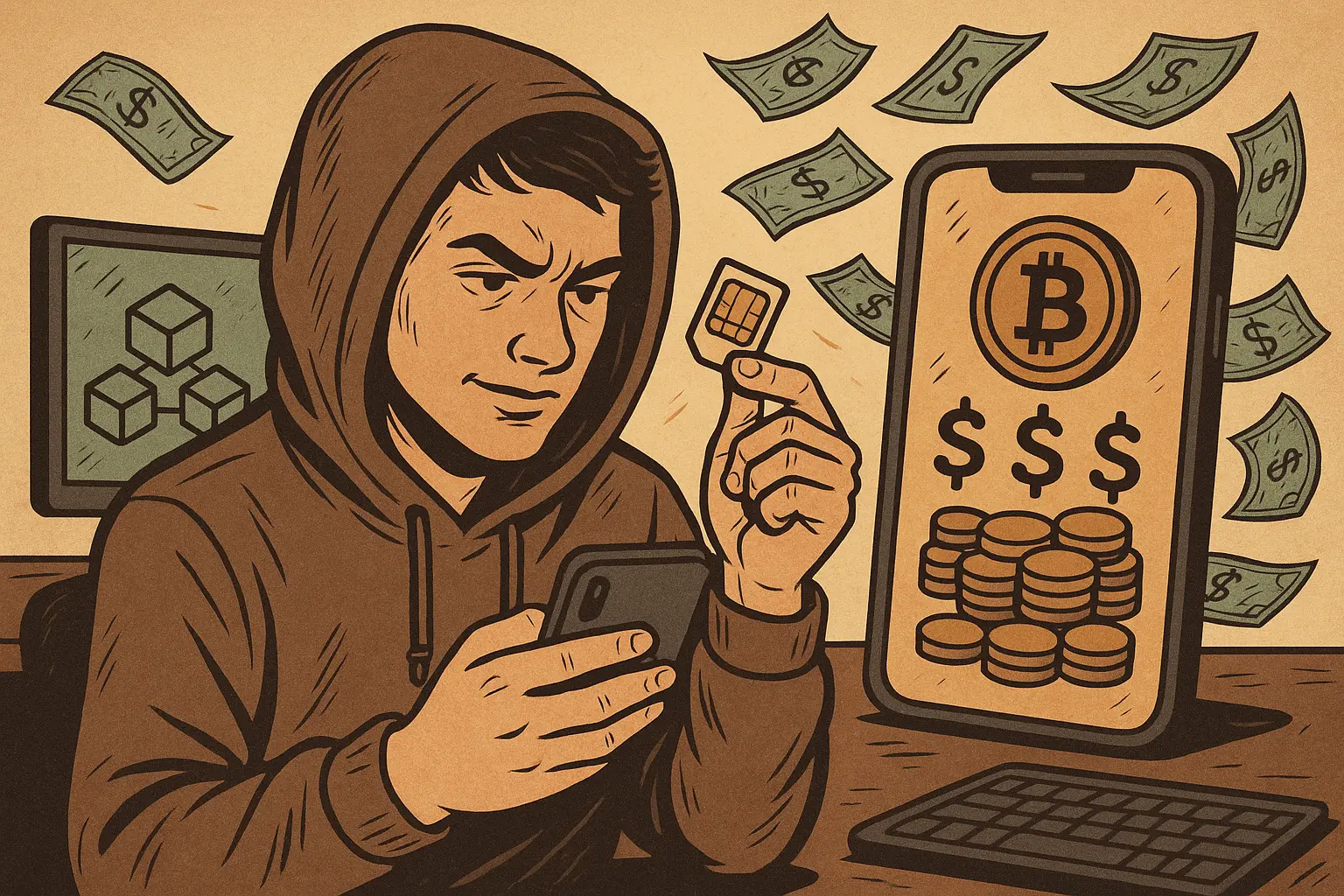
A 21-year-old Manhattan resident, Nicholas Truglia, is accused of carrying out a SIM swap attack—emptying cryptocurrency investor Michael Terpin’s account—through SIM card exchanges, causing more than $23 million in losses, and he is also facing 21 counts of felony charges. The most widely circulated detail of the case is not the massive amount that was stolen, but a tweet the suspect himself posted: “Stole $24 million, yet still can’t seem to make friends.”
How SIM Swap Attacks Empty Crypto Accounts in Just a Few Hours
A SIM swap attack is a highly targeted social engineering technique. The attacker tricks or bribes customer service representatives at telecommunications companies to transfer the victim’s mobile phone number to a SIM card controlled by the attacker. Once the attacker gains control of the phone number, they can use the “forgot password” feature to bypass two-factor authentication (2FA) through SMS verification codes, and then access email accounts, exchange accounts, and crypto wallets.
Michael Terpin said that on January 7, 2018, he was the victim of a SIM swap attack, and more than $23 million in crypto assets in his account were transferred out in a very short period of time. Afterward, he filed a civil lawsuit against Truglia, stating: “I filed this lawsuit as part of my ongoing efforts to pursue the losses from the theft.”
The Suspect’s Self-Inflation: A Complete Profile Revealed by a Sworn Statement
A sworn statement submitted by Truglia’s former partner, Chris David, details the suspect’s lifestyle habits and mental state while he was stealing, providing a wealth of firsthand information for the entire case.
Key Details Recorded in Chris David’s Sworn Statement
A Luxurious Material Life: Rolex watches, a $6,000-per-month apartment, $100k in cash kept in a closet
Calling Himself a Robin Hood: claiming he “takes from the rich, but doesn’t give to the poor”
Publicly Praising SIM Swap Behavior: boasting about having carried out a SIM swap attack on his father through a Twitter account, @erupts
Claiming He Will Never Get Caught: “How can they prove my story is wrong? No one can put me in prison. I’m willing to bet my life on it.”
Other Behavior Recorded: David’s sworn statement also mentions that Truglia has a habit of dodging restaurant bills
Among all the details, the one with the most lasting impact is that tweet—“Stole $24 million, yet still can’t seem to make friends.” This publicly shared statement, filled with self-mockery, ultimately became part of the court filing documents and also became a widely cited warning example throughout the crypto security community.
Case Outcome and Long-Term Lessons for Crypto Security
Truglia was arrested in Manhattan in November 2018, and was then extradited to California, facing 21 felony charges. His case is a representative early example of SIM swap attacks targeting holders of high-net-worth crypto assets, and it also vividly reveals the core weakness of phone-number-based 2FA verification: the attacker doesn’t need to compromise devices—just controlling a single phone number is enough to take over a large number of associated accounts.
The case prompted the crypto community to discuss more broadly the need to upgrade verification methods, encouraging more users and institutions to move away from SMS 2FA toward authenticator apps (Authenticator App) or hardware security keys.
Frequently Asked Questions
What is a SIM swap attack, and why are crypto assets especially vulnerable?
A SIM swap attack is a social engineering method in which the attacker tricks telecommunications providers into transferring the victim’s phone number to their own SIM card. Since the reset process for most crypto exchange accounts relies on SMS verification codes, once the attacker obtains control of the number, they can completely bypass 2FA, making crypto assets a highly fragile target.
What impact did Michael Terpin’s case have on crypto security?
Terpin’s lawsuit against Truglia is one of the most representative SIM swap cases in crypto security history. It drove widespread discussion across the industry about assigning responsibility to telecommunications providers, and it also pushed the crypto community to more actively advocate abandoning SMS 2FA and switching to safer hardware-based verification solutions.
How can you effectively defend against SIM swap attacks?
Key protections include: replacing SMS 2FA with a hardware security key or an authenticator app; requesting SIM lock settings or an account PIN from telecommunications providers; avoiding directly linking important crypto asset accounts to phone numbers; and regularly reviewing the verification methods of all accounts to reduce asset exposure if a phone number is transferred away.
Disclaimer: The information on this page may come from third parties and does not represent the views or opinions of Gate. The content displayed on this page is for reference only and does not constitute any financial, investment, or legal advice. Gate does not guarantee the accuracy or completeness of the information and shall not be liable for any losses arising from the use of this information. Virtual asset investments carry high risks and are subject to significant price volatility. You may lose all of your invested principal. Please fully understand the relevant risks and make prudent decisions based on your own financial situation and risk tolerance. For details, please refer to
Disclaimer.
Related Articles
Republican Sen. Tillis: The criminal investigation into Powell is over; it will no longer block Wash from serving as chair.
Republican Sen. Tom Tillis posted on the X platform on Sunday, announcing that after the U.S. Department of Justice (DOJ) concluded its criminal investigation into Federal Reserve Chair Jerome Powell’s involvement in the Federal Reserve headquarters renovation project, he will no longer block the procedure for confirming Kevin Warsh’s nomination as Federal Reserve chair, and said he is “looking forward” to supporting Warsh’s appointment.
MarketWhisper1h ago
Chainalysis: The EU's 20th round of sanctions covers RUBx, the digital ruble, and Meer exchanges
According to an analysis published by blockchain intelligence firm Chainalysis on April 24, the EU has recently released its 20th round of sanctions against Russia. For the first time, it treats the entire Russian cryptocurrency industry as a whole for sanctions purposes, rather than targeting only individual entities. The scope of this round of sanctions includes the Kyrgyz exchange Meer, the ruble-backed stablecoin RUBx, and Russia’s central bank digital currency (CBDC), “Digital Ruble.”
MarketWhisper1h ago
Research reveals: Polymarket players take home 30% of profits by winning 3% of the positions—more than 70% of players absorb all losses
A new study analyzes Polymarket’s trading records from 2023–2025 and shows that only 3.14% of experienced winners control more than 30% of the profits. Crowd participation alone is not enough to explain overall accuracy; at the same time, it tracks 1,950 highly suspicious insider trading accounts that, while not driving predictions, amplified price volatility. The case shows that large bets were placed and profits were made before the U.S. announced developments regarding Venezuela. The research questions “wisdom of crowds” and emphasizes the need for increasingly strict regulation.
ChainNewsAbmedia3h ago
France: More than 40 crypto investor kidnappings in 2026, involving leaked tax data
According to Market Forces Africa, reported on April 27, incidents of kidnapping and violent attacks targeting cryptocurrency investors in France have increased sharply. On the X platform, Telegram founder Pavel Durov said that since the beginning of 2026, he has recorded 41 cases of cryptocurrency investor kidnappings, averaging one incident every 2.5 days, and that they are linked to a leak of French tax records.
MarketWhisper3h ago
Chainalysis: EU's New Sanctions on Russia Mark 'a New Era' of Crypto Enforcement
The blockchain intelligence agency highlighted that the recently issued sanctions package against Russia was perhaps the most comprehensive crypto-focused action by the EU, targeting the whole Russian cryptocurrency sector rather than individual actors, including the digital ruble in full and the
Coinpedia3h ago
Hubei cybersecurity police received a Second Class Merit Award, solving the province’s first “hundred-million-yuan” virtual-coin theft case in 70 days
According to a report by Hubei Daily on April 27, Guo Tingyu, a police officer from the Cyber Security Brigade of the Qingshan Branch of the Wuhan Municipal Public Security Bureau, was recently awarded the Individual Second-Class Merit. Guo Tingyu graduated from Huazhong University of Science and Technology with a degree in computer science. In 2023, he passed the civil service exam to join the police force. In early 2024, he took charge of the first virtual currency theft case in all of Hubei Province. After nearly 70 days of investigation and case-solving, the amount of involved funds exceeded 100 million yuan, and all five suspects were fully dealt with in accordance with the law.
MarketWhisper4h ago


