
The Tisza Party (Tisza), led by Hungarian opposition leader Péter Magyar, won a decisive victory in the parliamentary election, ending Viktor Orbán’s 16-year rule. The strict “verification” system and criminal penalty mechanisms implemented by the Orbán government are widely viewed as going beyond the EU’s coordinated framework under the Markets in Crypto-Assets Regulation (MiCA), and are expected to be repealed after the new pro-EU government takes office.
Election Results and Political Shift: The End of a 16-Year Reign
Tisza’s victory is widely seen as one of the most historically significant political turning points in Hungary in recent years. Early predictions showed that Tisza would secure an absolute majority of seats in parliament, and Orbán is reported to have conceded defeat. Political analyst Ian Bremmer characterized the result as a “historic victory for the people of Hungary.”
EU Commission President Ursula von der Leyen also publicly said she expects to rebuild a relationship of coordination and alignment with EU institutions, stating, “Tonight, the heart of Europe is beating even stronger in Hungary.” This remark directly points to the years-long tensions between Hungary and Brussels over the rule of law and economic policy, which are expected to be fully normalized under the leadership of the new government.
Hungary’s Crackdown on Crypto: Controversial Rules Beyond the MiCA Framework
During Orbán’s time in power, Hungary’s financial regulator implemented a strict “verification” system requiring all cryptocurrency exchanges to obtain special certification, with criminal penalties for those who fail to comply. Legal observers and industry participants believe these measures go far beyond the scope of members’ obligations set by MiCA. The European Commission has brought infringement proceedings against Hungary over the additional restrictions mentioned above, becoming a rare precedent of the EU taking legal action due to a member state’s overreaching crypto regulation.
Key Controversies in Hungary’s Crypto Regulation During the Orbán Era
“Verification” Thresholds: Exchanges must obtain special certification to operate legally; the certification process is cumbersome and carries high administrative costs
Criminal Penalty Mechanism: Acts that fail to meet the verification requirements may face criminal prosecution, far exceeding the framework of administrative sanctions under MiCA
EU Infringement Proceedings: The European Commission has determined that the relevant provisions are incompatible with MiCA and has formally initiated legal procedures
Revolut Pauses Services: Global fintech platform Revolut paused its Hungarian crypto services during its crackdown action in 2025
Industry Impact: Revolut May Return, and the MiCA Unification Process Accelerates
 (Source: Polymarket)
The new pro-EU stance of the government brings three layers of predictable impacts. First, the “verification” regime and related criminal penalties are expected to be abolished, which would resolve the infringement proceedings with the European Commission and restore regulatory clarity for crypto businesses operating in Hungary. Second, platforms such as Revolut that paused Hungarian services due to regulatory barriers are expected to re-enter the market once institutional obstacles are removed. Third, unilateral expansionary regulatory policies beyond the MiCA framework—one of the EU’s most representative cases—are set to collapse with the change of government, strengthening the overall progress of the EU in promoting a unified digital assets market and reducing pressure on other member states to set up their own local rules.
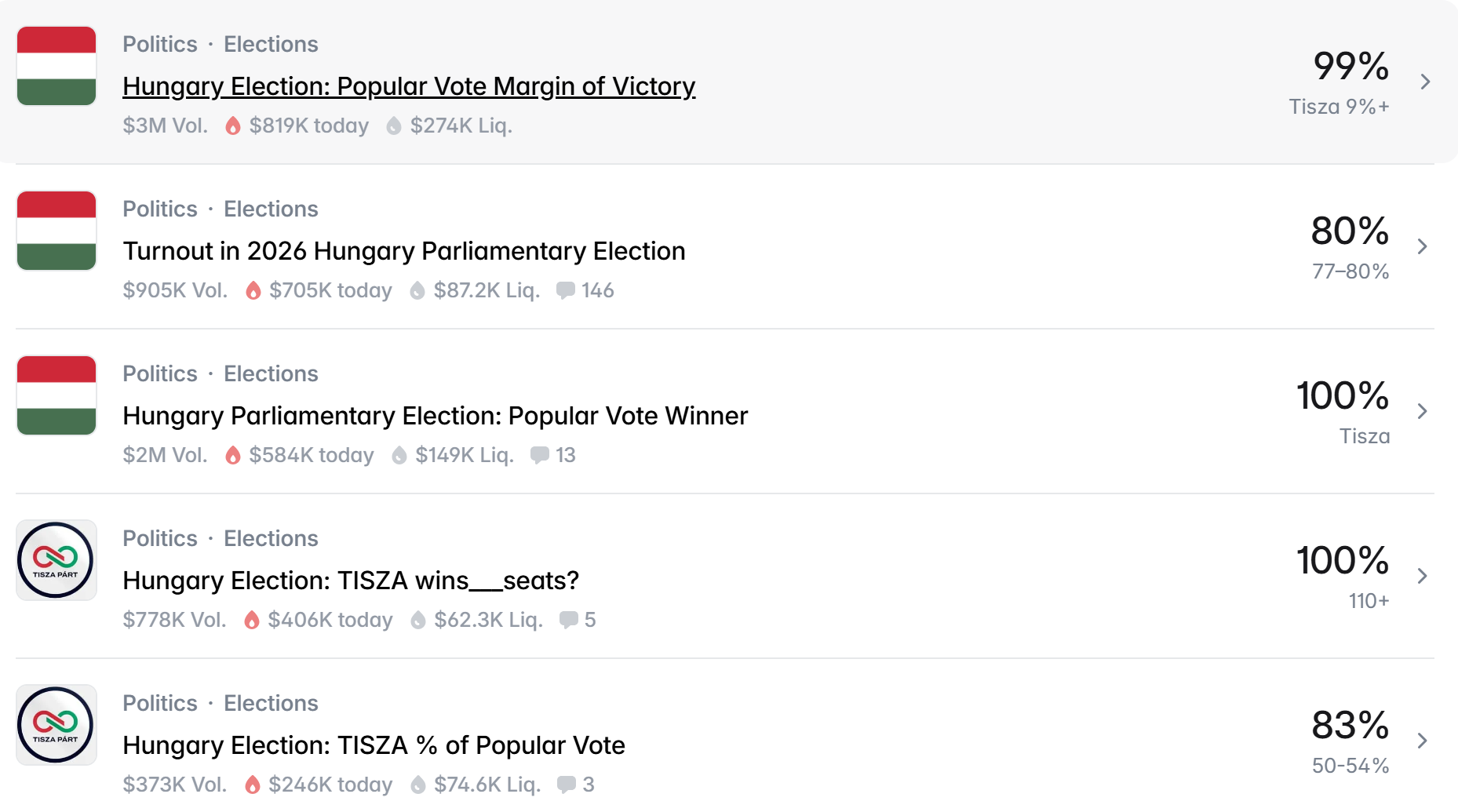
Worth mentioning is that traders on the prediction market Polymarket previously bet millions of dollars that Orbán would not win; as the result was revealed, those bets were validated as forward-looking market judgments.
Frequently Asked Questions
How Will Viktor Orbán’s Departure Affect Crypto Regulation in Hungary?
The “verification” system and criminal penalty mechanisms led by the Orbán government are widely considered to go beyond the MiCA coordination framework, and the European Commission has brought infringement proceedings. The new pro-EU government is expected to repeal these overreaching measures, restore compatibility with MiCA, and resolve the existing legal disputes within the EU.
What Is MiCA, and Why Do Orbán’s Policies Conflict With It?
MiCA (Markets in Crypto-Assets Regulation) is the EU’s unified regulatory framework for crypto-assets, designed to establish consistent rules for all member states. On top of MiCA, Hungary introduced additional local “verification” rules and criminal penalties. The European Commission believes these measures are incompatible with MiCA’s coordination principles and has formally initiated infringement proceedings.
Will Revolut Return to Hungary’s Crypto Market?
Revolut suspended local crypto services during the Hungarian crackdown in 2025. If the new government abolishes the overreaching regime as expected, platforms such as Revolut could re-enter Hungary’s market, but the specific timeline depends on how quickly the relevant regulations are amended and on the compliance assessments of the businesses.
Disclaimer: The information on this page may come from third parties and does not represent the views or opinions of Gate. The content displayed on this page is for reference only and does not constitute any financial, investment, or legal advice. Gate does not guarantee the accuracy or completeness of the information and shall not be liable for any losses arising from the use of this information. Virtual asset investments carry high risks and are subject to significant price volatility. You may lose all of your invested principal. Please fully understand the relevant risks and make prudent decisions based on your own financial situation and risk tolerance. For details, please refer to
Disclaimer.
Related Articles
Bitcoin Community Questions US Military Officials' Crypto Knowledge After Senate Testimony
Gate News message, April 27 — Admiral Samuel Paparo testified before the U.S. Senate and House on April 21 and April 22 that Bitcoin has cybersecurity value and that the U.S. military is already operating a node on the network. According to a House Armed Services Committee transcript released by
GateNews4m ago
Five Central Banks to Hold Policy Meetings This Week; Monetary Decisions Expected to Drive Markets
Gate News message, April 27 — Five major central banks—the Bank of Japan, Bank of Canada, U.S. Federal Reserve, Bank of England, and European Central Bank—will hold policy meetings this week, with monetary policy decisions expected to be the primary market driver, according to Asger Wilhelm
GateNews52m ago
Bitcoin falls below $78,000, as negotiations between the U.S. and Iran again hit a stalemate, pushing up oil prices
Bitcoin slipped below $78,000 during Asian early trading on Monday, April 27; meanwhile, with the U.S.-Iran second round of peace talks falling through again, the price of Brent crude oil rose 1% to $106.50 per barrel. U.S. crude oil (WTI) rose in tandem by 1% to $95.40 per barrel. Ether was quoted at $2,335.24, and Ripple was quoted at $1.4230.
MarketWhisper1h ago
U.S. Economic Data This Week May Drive Crypto Market Volatility; Fed Decision and Jobs Report Key
Gate News message, April 27 — The crypto market slipped 0.5% to $2.59 trillion as investors braced for several major U.S. economic releases this week that could shape Bitcoin and altcoin price direction. Bitcoin traded near $77,800, while the Crypto Fear & Greed Index has recently moved toward the m
GateNews2h ago
France: More than 40 crypto investor kidnappings in 2026, involving leaked tax data
According to Market Forces Africa, reported on April 27, incidents of kidnapping and violent attacks targeting cryptocurrency investors in France have increased sharply. On the X platform, Telegram founder Pavel Durov said that since the beginning of 2026, he has recorded 41 cases of cryptocurrency investor kidnappings, averaging one incident every 2.5 days, and that they are linked to a leak of French tax records.
MarketWhisper3h ago
Chainalysis: EU's New Sanctions on Russia Mark 'a New Era' of Crypto Enforcement
The blockchain intelligence agency highlighted that the recently issued sanctions package against Russia was perhaps the most comprehensive crypto-focused action by the EU, targeting the whole Russian cryptocurrency sector rather than individual actors, including the digital ruble in full and the
Coinpedia3h ago


