I. From “Owning Assets” to “How Assets Move”
In previous lessons, the foundational structure of Web3 has become increasingly clear: users control assets with private keys, smart contracts define the rules, and tokens serve as carriers of value. But how do these assets move within the system and form a complete financial ecosystem?
In traditional finance, fund flows rely on intermediaries like banks, payment institutions, and exchanges; in Web3, these roles are decomposed into a series of on-chain mechanisms, automatically executed by smart contracts.
Therefore, the Web3 financial system is not simply a copy of traditional finance, but a reorganized structure.
II. Stablecoins: The System’s “Base Currency”
Source: USDC official website
Within the on-chain financial system, stablecoins play a role similar to the “US dollar,” serving as the foundation for nearly all transactions and financial activities.
Common stablecoins include USDT and USDC.
Stablecoins are crucial for several reasons:
- Relatively stable prices make them suitable as units of account
- High liquidity allows easy transfer between different protocols
- Reduce volatility risk
In most scenarios, fund flows often start with stablecoins, such as:
- Buying tokens with stablecoins
- Participating in DeFi with stablecoins
- Transferring across protocols using stablecoins
Thus, stablecoins can be understood as the “settlement layer” of the on-chain financial system.
III. Two Ways to Trade: CEX and DEX
Once assets can move, trading becomes one of the core activities. In Web3, trading mainly takes two forms: centralized exchanges (CEX) and decentralized exchanges (DEX).
CEX (such as Gate) is an extension of traditional exchanges, featuring:
- Platforms matching buy and sell orders
- Higher liquidity and depth
- User assets are custodied by the platform
DEX (such as Uniswap) operates via smart contracts, with key features:
- Users directly control their assets
- Trades are executed through contracts
- No centralized intermediary required
The difference can be simplified as:
- CEX: Trust the platform
- DEX: Trust the code
These two models are not mutually exclusive—they jointly form the foundational trading infrastructure of Web3.
IV. The Core Mechanism of DEX: How AMM Sets Prices
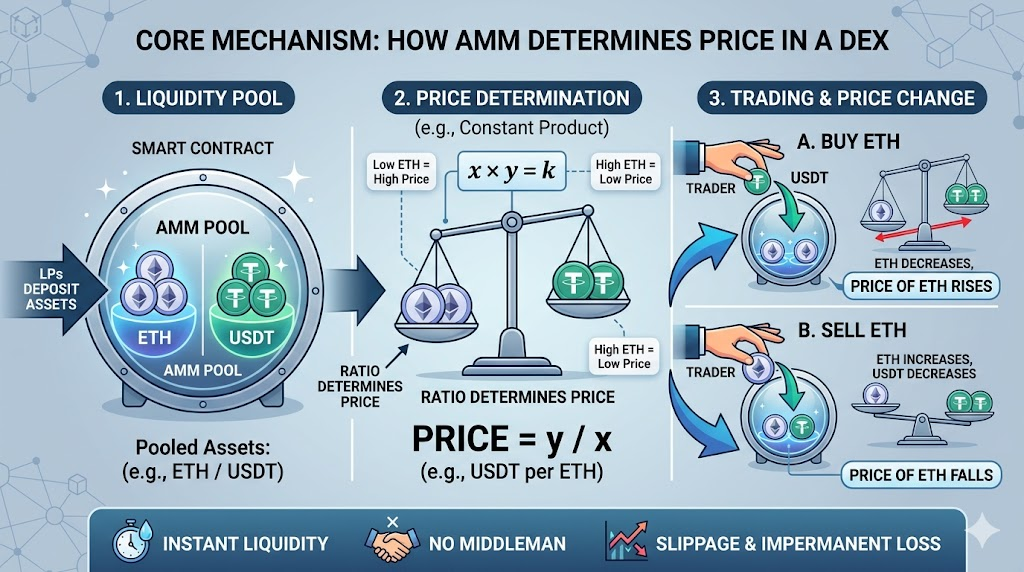
In DEXs, there is no traditional “order book”; instead, an automated mechanism called AMM (Automated Market Maker) is used.
The core logic of AMM is to facilitate trades through a liquidity pool. Users do not trade directly with each other but swap with the pool.
The basic principle can be summarized as:
- The pool holds two assets (e.g., ETH / USDT)
- Price is determined by the ratio of assets in the pool
- Each trade alters this ratio, thus changing the price
This mechanism has several key features:
- No need to match counterparties
- Always provides liquidity (as long as there are funds in the pool)
- Prices change in real time
However, it also introduces new concepts such as slippage and impermanent loss—important factors to consider in on-chain trading.
V. Where Does Liquidity Come From: The Role of LPs
Since AMMs depend on liquidity pools, the question naturally arises: Who provides these funds?
The answer is liquidity providers (LPs).
LPs deposit assets into pools to provide market depth and earn rewards. These rewards typically come from:
- Trading fees
- Protocol incentives (token rewards)
Thus, LPs play a role similar to “market makers” within the system.
It’s important to note that providing liquidity is not without risk; common risks include:
- Impermanent loss (losses from asset price changes)
- Market volatility risk
- Protocol risk
VI. How Funds Move Further: Lending and Leverage
Beyond trading, Web3’s financial system also includes lending and leverage functions.
The basic logic is:
- Users collateralize assets
- Borrow stablecoins or other assets
- Continue using these funds elsewhere
This mechanism allows capital to be reused, increasing capital efficiency.
Typical applications include:
- Collateralizing ETH to borrow stablecoins
- Reinvesting borrowed funds into the market
- Building leveraged positions
This process is similar to leverage structures in traditional finance but is entirely executed by smart contracts.
VII. How the System Connects: Fund Flow Paths
Connecting all the above modules reveals a complete on-chain financial loop:
- Users exchange fiat for stablecoins
- Use stablecoins to buy other tokens
- Deposit assets into liquidity pools to earn rewards
- Collateralize assets to borrow more funds
- Re-enter trading or investment activities
This cycle can repeat continuously, forming complex fund flow structures. The key point is that all these actions are automatically executed by smart contracts.
Lesson Summary
This lesson can be distilled into three key insights:
- Web3’s financial system is composed of stablecoins, trading mechanisms, and lending structures
- DEXs and AMMs have redefined trading, with liquidity provided by users
- The entire system is connected via smart contracts, enabling continuous fund flows
Overall, on-chain finance is not a copy of traditional finance but a new structure centered around “code + liquidity.”