I. The Market Is Not Random, but a Structured Game
In many cases, price fluctuations are viewed as “trends” or “luck,” but from a higher perspective, the Web3 market is not a collection of random changes—it’s the result of structured games between different participants.
Price changes fundamentally depend on several factors:
- Who is buying
- Who is selling
- Who is shaping expectations
- Who is providing liquidity
Therefore, rather than focusing solely on prices, it’s more important to understand which forces drive price changes and what motivates them.
II. Core Participants: Five Key Roles in the Web3 Market
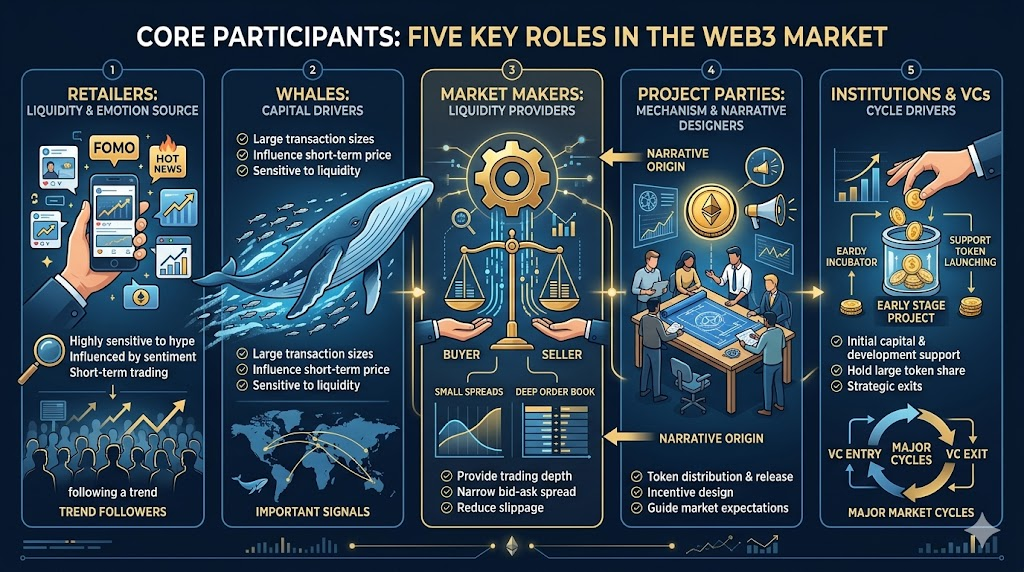
In most market environments, Web3 can be broken down into five core participant types. The goals and behaviors of these roles define how the market operates.
Retail Investors: Source of Liquidity and Sentiment
Retail investors make up the largest group of participants in the market, with behaviors characterized by clear emotional tendencies:
- Highly sensitive to trending narratives
- Easily influenced by market sentiment
- Shorter trading cycles
Usually, retail investors enter the market after trends form, providing liquidity during uptrends and amplifying volatility during downturns. Their role is closer to “trend followers.”
Whales: Capital Drivers
Whales typically refer to addresses or institutions holding large amounts of assets. These participants wield greater capital influence in the market:
- Larger individual transaction sizes
- Can impact short-term price movements
- Highly sensitive to liquidity conditions
Whale actions (such as large transfers or concentrated accumulation) are often seen as key signals by the market, further amplifying their impact.
Market Makers: Liquidity Providers
Market makers’ main function is to maintain normal market operations, with key responsibilities including:
- Providing buy/sell depth
- Narrowing bid-ask spreads
- Reducing slippage
Market makers don’t directly determine market direction but ensure sufficient liquidity and efficiency, making them indispensable to the trading structure.
Project Teams: Designers of Mechanisms and Narratives
Project teams are responsible not only for product development but also for mechanism design and narrative construction.
Their influence mainly manifests in:
- Token allocation and release schedules
- Incentive mechanism design
- Guiding market expectations
In many cases, project teams initiate narratives, while the market amplifies them.
Institutions and VCs: Cycle Drivers
Institutions and venture capital typically participate in early project stages and hold a significant share of tokens.
Their functions include:
- Providing initial capital
- Supporting project development
- Exiting at specific stages
Thus, cyclical fluctuations in the market are closely tied to institutional capital entering and exiting.
III. The Role of Narratives: Why Markets Cycle Upward
If participants determine “who acts,” narratives determine “why they act.”
In Web3, narrative is a major driving force—its core lies in forming market consensus and expectations. Classic examples include DeFi Summer, as well as phases like NFTs, AI combined with crypto, RWA, and others.
These narratives generally share several common traits:
- Provide new growth logic
- Attract new capital attention
- Strengthen market expectations
Narratives don’t always rely on real-world foundations but can generate strong consensus for a period, thereby driving price changes.
IV. Price Formation: The Overlay of Narratives and Liquidity
Understanding participants and narratives allows us to simplify the price formation mechanism into two core variables:
- Narrative: Determines market direction
- Liquidity: Determines price magnitude
When a narrative emerges and gains market acceptance—and liquidity is ample—prices typically rise rapidly. Conversely, even with a compelling narrative, without sufficient capital support, sustained trends are hard to establish.
Therefore, the key isn’t whether there’s a “story,” but whether enough capital believes in and participates in the narrative.
V. Market Cycles: From Consensus Formation to Consensus Breakdown
Web3 markets usually display clear cycles, driven by shifts in consensus.
A typical cycle can be divided into these stages:
- Early stage: Few participants build awareness
- Diffusion phase: Narrative spreads; capital gradually enters
- Peak phase: Emotion dominates the market
- Pullback phase: Expectations begin to adjust
- Clearing phase: Market returns to rationality
During this process, participant behavior also shifts:
- Early stage dominated by institutions and professional capital
- Mid-stage expands to broader participants
- Peak phase driven by sentiment
- Later stage sees gradual capital withdrawal
Understanding this structure helps judge which stage the market is in—rather than relying solely on price changes.
VI. AI Enters: Markets Undergo “Structured Understanding”
As markets grow more complex, relying solely on individual experience becomes increasingly difficult. AI is gradually entering the Web3 market layer to process complex information.
Its main functions include:
- Analyzing on-chain capital flows
- Identifying whale behavior patterns
- Tracking narrative trends
- Integrating multi-dimensional market data
These capabilities are being incorporated into various toolsets—for example, Gate for AI structurally processes trends, data, and information flows, lowering the threshold for market understanding.
VII. Intelligent Web3: From Market Participation to Market Comprehension

When AI deeply integrates with Web3, the market enters a new phase—Intelligent Web3.
Key features of this phase include:
- Users retain asset control rights
- AI assists in information processing
- Decision-making becomes increasingly structured
Future directions may include:
- Automated data analysis
- Intelligent strategy recommendations
- Semi-automated or fully automated execution mechanisms
This shift means participation will gradually move from “experience-driven” to “data-and-model-driven.”
VIII. Back to the Overall Structure: The Complete Logic of Web3 Operations
Connecting all course content reveals a complete system structure:
- Blockchain and account systems → Solve ownership issues
- Smart contracts → Define rules and execution methods
- DeFi and stablecoins → Build financial infrastructure
- Tokens → Carry value and incentive mechanisms
- Markets → Enable price discovery
- AI → Provide understanding and decision support
These elements collectively form the operational mechanism of Web3.
Lesson Summary
The core points of this lesson can be summarized as follows:
- Market prices stem from games between different participants
- Narratives and liquidity jointly drive market cycles
- AI is becoming an essential tool for understanding and participating in markets
Within this framework, Web3 is no longer just a technical system—it’s a complex network formed by assets, rules, capital, and information.
Course Conclusion
The core goal of this entire course is to establish a structured framework for understanding:
- How assets are created
- How assets are controlled
- How assets are used
- How assets are priced
And how the entire system operates. Once these questions are connected, Web3 ceases to be a collection of fragmented concepts and becomes a whole that can be understood systematically.