I. Assets Alone Aren’t Enough—the Key Is “How Assets Are Used”
In the previous lesson, we explained Web3’s account system: users control assets via private keys, and wallets are essentially signing tools.
But if Web3 is limited to just “holding assets,” its significance is actually quite limited.
A more critical question is: What else can you do with assets besides transferring them?
In Bitcoin’s design, the functionality is relatively simple:
It solves the problem of “digital assets can be owned,” but doesn’t provide complex interaction capabilities. What truly brought Web3 to the next stage was the emergence of Ethereum.
II. Ethereum Did Something Critical: Writing Rules Onto the Chain
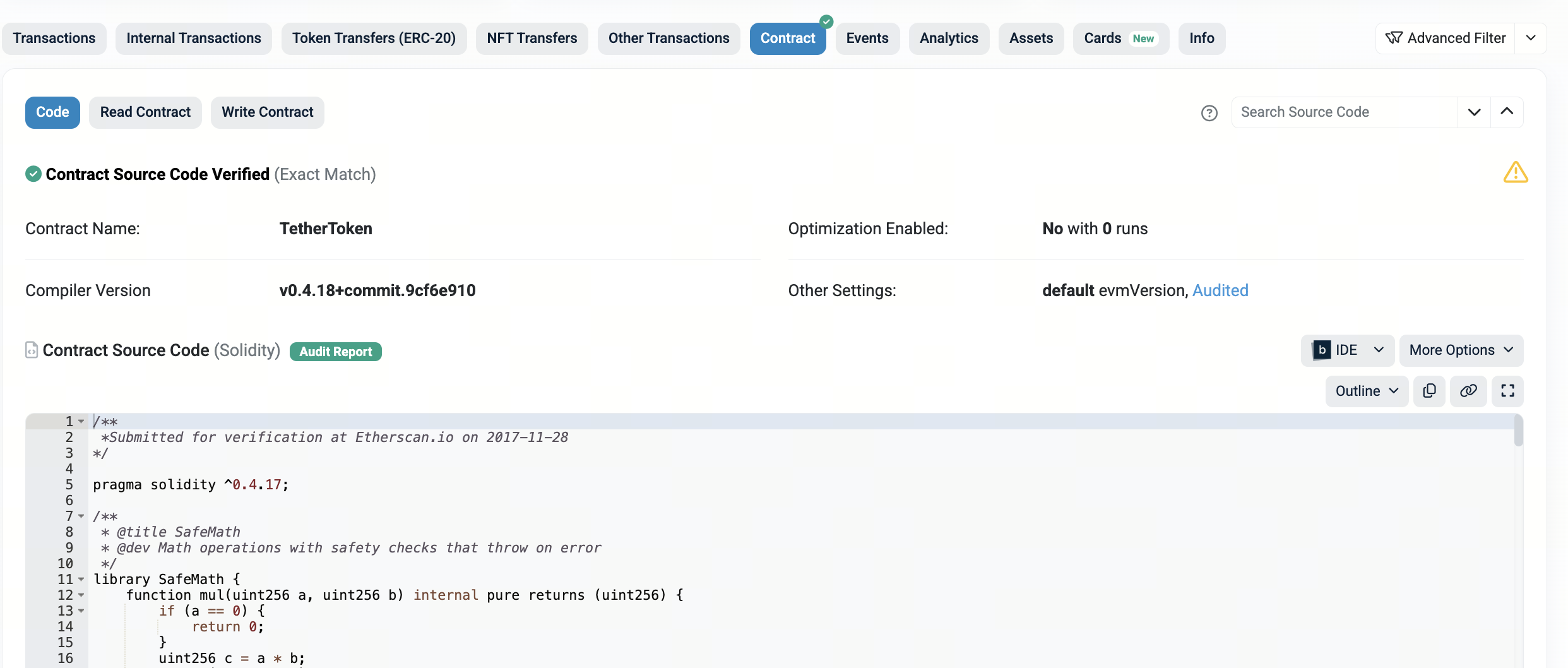
Source: Tether stablecoin smart contract page
Ethereum’s core innovation can be summarized in one sentence: writing “programs” into the blockchain. These programs are called “smart contracts.”
But it’s important to clarify: smart contracts aren’t actually “smart”—they’re essentially deterministic code running on the blockchain.
Their key features aren’t intelligence, but:
- Verifiable (anyone can view the code)
- Executable (jointly executed by network nodes)
- Not dependent on a single entity (no central server)
The basic logic can be abstracted as: when certain conditions are met → automatically execute preset rules
For example:
- If A sends funds to the contract
- Then the contract automatically sends a specific token to A
This process does not require:
- Intermediaries
- Manual review
- Credit guarantees
Essentially, this is the first time execution of rules shifted from institutions to the system itself.
III. What Do Smart Contracts Mean: From “Rules Enforced by People” to “Rules Automatically Enforced”
In traditional systems, rules don’t happen automatically—they rely on institutions for enforcement:
- Banks handle bookkeeping and transfers
- Exchanges match trades
- Platforms handle reviews and risk control
Rules exist, but their enforcement depends on people and organizations.
But in a smart contract system, a fundamental change occurs: rules = code = execution itself
Rules are written directly onto the chain and are automatically triggered and executed by the blockchain network.
This brings three structural changes:
- No need to trust intermediaries: users no longer need to trust whether an institution will honor its commitments, only whether the code is correct.
- Automatic execution: once conditions are met, execution is mandatory—not “optional.”
- Immutable: once a contract is deployed, its core logic usually can’t be arbitrarily changed (unless upgrade permissions are reserved).
In short, smart contracts replace institutions with code and replace trust with algorithms.
IV. Why Smart Contracts Are a Watershed for Web3
If Bitcoin achieved: asset on-chain,
Then Ethereum achieved: logic on-chain.
The difference is: BTC’s core ability is recording “who owns what,” while ETH’s core ability is defining how assets operate.
The significance is that blockchain shifted from being a “ledger” to being an “operating system.”
Because of smart contracts, Web3 finally gained an application layer.
Examples include:
- Decentralized exchanges (DEX)
- Lending protocols
- NFT marketplaces
- On-chain game assets
These are no longer just “assets,” but combinations of assets + rules + behavioral logic.
V. Why DeFi Emerged
The most direct result of smart contracts is DeFi (decentralized finance). In traditional finance, core functions depend on institutions:
- Deposits → banks
- Lending → banks / credit agencies
- Trading → exchanges
- Derivatives → brokers / market makers
In DeFi, these functions are fully “modularized + contractualized”:
|
Financial Function
|
How DeFi Implements It
|
| —- | —- |
|
Deposits
|
Liquidity pool contracts
|
|
Lending
|
Collateral + liquidation logic
|
|
Trading
|
Automated Market Making (AMM)
|
|
Interest Rates
|
Algorithmic dynamic adjustment
|
The key change isn’t simply going “online,” but breaking down financial functions into composable code modules. So, DeFi isn’t just replicating traditional finance—it’s reconstructing financial structure with code.
VI. “Code Is Law”: A Double-Edged Sword
Smart contracts increase efficiency but also introduce new systemic risks. In Web3: code is the rule—if the code fails, so do the rules.
Common risks include:
- Contract vulnerabilities (attack vectors)
- Logic design flaws (such as failed liquidation mechanisms)
- Permission control errors (admin abuse)
- Backdoors or hidden functions
Unlike traditional systems:
- There’s no manual intervention “backstop”
- Emergency rollbacks are difficult
- Errors get “automatically executed”
VII. Users Are Actually “Calling Contracts”
Most users think they’re just “using an app” when interacting with Web3. But under the hood, they’re calling smart contracts.
For example:
- Trading on a DEX
- Depositing tokens in DeFi for yield
- Minting an NFT
The underlying process is:
- Send a request to a contract
- Sign with a private key
- Blockchain verifies and executes the logic
The front-end interface (UI) is just a “visualization of contract calls.” Users aren’t using a product—they’re interacting with a protocol.